The Paylocity review 2026 that most HR software sites publish focuses on features. That framing misses the more important question.
Paylocity is not competing on features. ADP has more. Workday has more. SAP SuccessFactors has significantly more. What Paylocity is competing on is the gap between what enterprise HCM platforms deliver and what mid-market companies actually need from one, and whether the employee experience layer it has built on top of payroll and HR administration is worth the custom pricing conversation you have to have before seeing a single number.
For companies with 50 to 750 employees that have outgrown basic payroll tools but cannot justify the complexity and cost of enterprise HCM implementations, that gap is real and the answer to whether Paylocity fills it depends heavily on which specific problems you are trying to solve.
This is what the platform actually delivers, where the independent review data differs from the marketing, and what you need to know before booking the demo.
What Paylocity Is Actually Selling
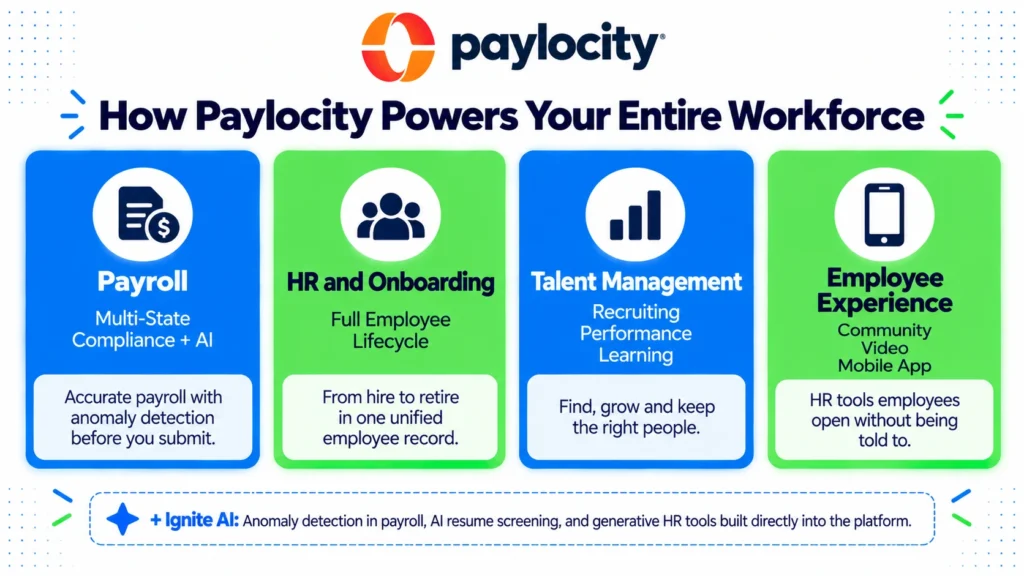
Paylocity is a cloud-based Human Capital Management platform serving the mid-market. Founded in 1997 and publicly traded since 2014, it covers payroll processing, HR administration, time and attendance, benefits management, recruiting, talent management, learning and development, and what it calls employee experience tools including a social collaboration feature called Community and a video communication tool called Premium Video.
The positioning that distinguishes it from competitors is deliberate. Where Rippling competes on unified data architecture connecting HR, IT, and finance, and where ADP competes on scale and compliance breadth, Paylocity competes on making HR software feel less like enterprise software. The mobile app, the Community social feed, the video tools, and the on-demand pay feature are all aimed at the same outcome: reducing the friction between HR systems and the employees who are supposed to use them.
Whether that positioning justifies the pricing requires understanding what you are actually getting versus what you are paying for.
Pricing: The Honest Picture
Paylocity does not publish pricing anywhere on its website. Every implementation requires a custom quote based on headcount, selected modules, and negotiation leverage. This is the most consistent frustration in independent reviews and the first thing any buyer needs to understand before investing time in the evaluation process.
Independent buyer data from multiple 2026 sources puts the full HCM suite in the $18 to $33 per employee per month range. The variance is significant and driven by which modules you select and your company size. A 100-person company selecting payroll plus core HR plus time tracking lands in a different range than the same company adding the Learning Management System, Benefits Administration, and Spend Management modules.
The non-obvious pricing issue is implementation cost. Multiple reviewers describe surprise implementation fees that were not clearly communicated during the sales process. This is a pattern across enterprise-adjacent HR platforms, not unique to Paylocity, but it is consistent enough in the review data to warrant explicit mention. Always ask for a fully loaded first-year cost including implementation, configuration, and training before comparing Paylocity’s quote to competitors.
The modular pricing model means the headline per-employee-per-month number is a floor, not a ceiling. Essential features like the Learning Management System, advanced analytics, and employee engagement tools are sold as modules that add to the base cost. A company that wants the full platform pays meaningfully more than a company selecting only payroll and core HR.
For context on how this compares to alternatives: Rippling starts at approximately $8 per employee per month for the core platform with modules added on top. Gusto has published pricing starting at $40 per month base plus $6 per employee for payroll plus core HR. Paylocity’s range puts it above Gusto and more comparable to mid-tier Rippling configurations, though the feature sets are not directly equivalent.
Payroll: Where Paylocity Earns Its Core Reputation
Paylocity’s payroll processing is where independent review data is most consistently positive. Across 8,000 plus verified reviews analyzed by multiple sources, payroll accuracy, multi-state compliance handling, and tax filing automation are the features that generate the highest satisfaction scores.
The practical significance: multi-state payroll is genuinely complex. Each state has different withholding requirements, different filing deadlines, different wage and hour laws, and different unemployment insurance rates. Getting this wrong generates penalties. Paylocity’s payroll engine handles this automatically and its track record on multi-state compliance accuracy in independent reviews is strong.
The integration between time tracking and payroll is tighter than many competing platforms. Time data flows directly into payroll calculations without manual export-import cycles that introduce errors. For companies where hourly workforce management is significant, this tight integration reduces payroll processing time materially.
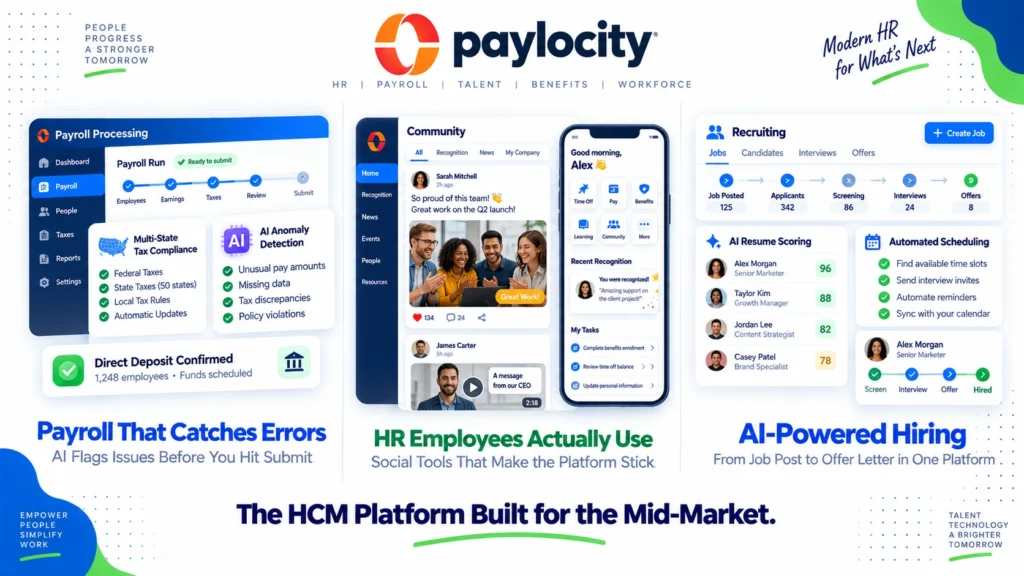
The non-obvious payroll insight: Paylocity was one of the first HCM vendors to integrate generative AI directly into its payroll workflow through a system called Ignite AI. The AI flags anomalies in payroll runs before they are submitted, surfaces potential errors, and identifies patterns across pay periods. This is not AI as a marketing label. Verified reviewers specifically note that the anomaly detection has caught errors that manual review missed. For payroll teams processing large headcounts, this error-catching layer has real operational value.
The Employee Experience Layer: Real Differentiation or Marketing?
Community is Paylocity’s internal social collaboration tool. It functions like a company-specific social network within the HR platform: employees post updates, recognize peers, share milestones, and access company announcements in a feed format that feels more like a consumer app than enterprise software.
Premium Video allows employees and managers to record and share video messages, training content, and announcements directly through the platform.
The honest assessment from independent reviewers is more nuanced than Paylocity’s marketing suggests. Where these features genuinely work: companies with dispersed or deskless workforces where traditional communication channels reach employees poorly. Retail, healthcare, manufacturing, and logistics companies report higher employee engagement with Community than with email or intranet tools because employees actually use the mobile app.
Where these features fall short: companies where employees are already in Slack or Microsoft Teams find Community redundant rather than additive. Adding another social feed to the communication stack does not reduce fragmentation for knowledge worker teams. It increases it. The value of Community is highest when it replaces an absence of communication infrastructure, not when it competes with an established one. Read our Slack review to understand where dedicated communication platforms outperform HCM-embedded social tools.
Recruiting and Talent Management: Mature but Not Best-in-Class
Paylocity’s recruiting module covers job posting distribution, applicant tracking, interview scheduling, offer letter management, and onboarding workflow initiation. The 2025 and 2026 product releases added AI-powered resume screening, candidate scoring, and automated interview scheduling that reduces recruiter manual workload on high-volume positions.
The talent management suite covers performance reviews, goal setting, compensation management, and succession planning. The Learning Management System handles course creation, assignment, and completion tracking for employee training programs.
The honest positioning: Paylocity’s talent management and recruiting are good enough for most mid-market companies and better than what most payroll-first platforms include. They are not best-in-class compared to dedicated ATS platforms like Greenhouse or Lever, or dedicated performance management tools like Lattice or 15Five. If recruiting velocity and talent development sophistication are primary purchase drivers, evaluating point solutions alongside Paylocity is worth the comparison effort.
The integration argument for keeping everything in Paylocity is real, however. When recruiting, onboarding, payroll, time tracking, and performance management all run on the same employee record, data quality is higher and reporting is more accurate than when the same information lives in four separate systems with integration connectors between them. That consolidation value is genuine even when individual modules are not best-in-class.
Ignite AI: What It Actually Does in 2026
Paylocity established itself as one of the first HCM vendors to integrate generative AI directly into its product. The 2025 acquisition of Grayscale, an AI recruiting platform, accelerated this investment.
Ignite AI in 2026 covers several functional areas. In payroll, it flags anomalies before submission and surfaces patterns that indicate potential errors. In recruiting, it screens resumes, scores candidates, and drafts job descriptions from role parameters. In performance management, it suggests review language based on goal completion data. In HR administration, it answers employee questions through a conversational interface that pulls from company policies and HR data.
The verified reviewer consensus from G2 and Capterra is that Paylocity’s AI features deliver meaningful functional value rather than surface-level branding. The anomaly detection in payroll is the most consistently cited example of AI that changes how the work gets done rather than AI that simply labels existing features differently.
The limit: AI features in 2026 are available across Paylocity’s plans but the depth varies by module and configuration. The AI recruiting features from the Grayscale acquisition are more mature on higher-tier configurations. If AI-powered hiring is a primary purchase driver, verify specifically which AI recruiting capabilities are included in your quoted configuration before signing.
Support: The Gap That Matters for Implementation
Customer support is where Paylocity’s review data is most divided. The G2 rating is 4.4 out of 5 overall. The support-specific rating across independent review aggregators is meaningfully lower, with a pattern of complaints concentrated around implementation responsiveness and post-go-live issue resolution.
The pattern in reviews is specific: initial implementation support during onboarding is generally rated well. Ongoing support for complex configuration issues after go-live is rated inconsistently, with wait times and resolution quality varying significantly by account size and support tier.
The practical implication: if your HR team is small and relies on vendor support to resolve configuration issues quickly, verify Paylocity’s support tier structure and typical response times for your company size during the sales process rather than assuming the support you receive during implementation represents ongoing service levels.
This gap between implementation support and ongoing support is common across mid-market HCM platforms and is not unique to Paylocity. However, it is consistent enough in the review data to name explicitly rather than smooth over.
Who Gets Real Value from Paylocity
The independent review data points to a consistent profile for companies that get strong ROI from Paylocity.
Mid-market companies with 50 to 500 employees that need a single platform covering payroll, time tracking, benefits administration, and HR without the implementation complexity and cost of enterprise HCM. The sweet spot is companies that have outgrown Gusto or ADP Run but are not ready for Workday or SAP.
Companies with dispersed or deskless workforces where the Community social features and mobile app genuinely improve communication reach. Healthcare, retail, manufacturing, and logistics companies appear most frequently in the positive review data for the employee experience features.
Multi-state US employers where payroll compliance complexity is significant and the cost of payroll errors is high. Paylocity’s multi-state payroll accuracy and AI-powered anomaly detection deliver measurable error reduction for companies processing payroll across multiple jurisdictions.
HR teams that want the recruiting-to-payroll workflow in one system without managing integrations between an ATS, an HRIS, and a payroll platform. The data quality benefits of a single record for each employee from application through termination are real for companies managing high hiring volume.
Who Should Look Elsewhere
Companies under 50 employees where Gusto’s transparent published pricing, faster implementation, and simpler interface deliver adequate payroll and HR at lower cost and complexity. The employee experience features that justify Paylocity’s premium are less relevant at small team sizes.
Companies that need pricing transparency before engaging sales. If your procurement process requires a budget number before a vendor conversation, Paylocity’s quote-only model creates a timeline problem. Rippling, with its published per-employee-per-month entry price, gives you a benchmark to work with earlier in the evaluation process. Read our Rippling review for how the two platforms compare.
Companies whose primary need is global payroll and EOR. Paylocity’s focus is the US market. International payroll and Employer of Record capabilities are not core strengths. Rippling’s 185-country EOR coverage or Deel’s global-first approach are more appropriate for companies with significant international hiring needs.
Knowledge worker teams already in Slack or Teams where the Community social features add communication overhead rather than solving a communication gap.
Paylocity vs Competitors: The Specific Comparisons That Matter
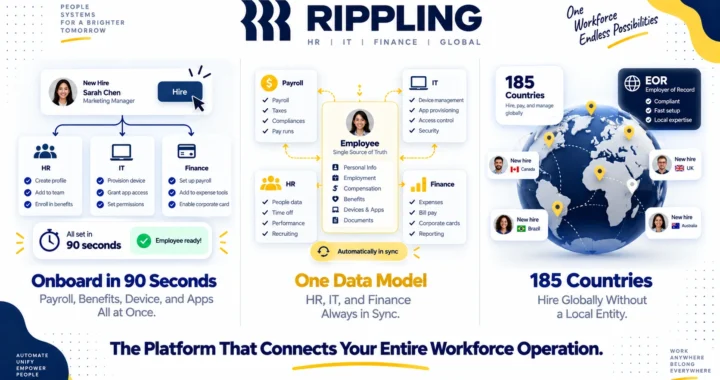
Paylocity vs Rippling: Rippling’s unified HR, IT, and finance architecture and 90-second onboarding automation are technically more sophisticated. Paylocity’s employee experience features, recruiting maturity, and US payroll depth are stronger for mid-market HR teams that do not need IT device management or global EOR. Read our full Rippling review for the detailed comparison.
Paylocity vs ADP Workforce Now: ADP has a larger compliance network, more extensive integration ecosystem, and longer enterprise track record. Paylocity has a more modern interface, stronger employee experience features, and better mid-market pricing. Most companies that move from ADP to Paylocity cite interface quality and support responsiveness as the primary drivers.
Paylocity vs Gusto: Gusto has transparent published pricing, faster implementation, and a simpler interface suited to smaller teams. Paylocity has deeper talent management, stronger multi-state payroll for complex jurisdictions, and better tools for companies above 50 employees. The decision point is straightforward: under 50 employees with simple needs, Gusto. 50 to 500 employees with complexity, Paylocity.
Paylocity vs QuickBooks Payroll: QuickBooks Payroll is deeply integrated with QuickBooks accounting and suited to small businesses already on the QuickBooks ecosystem. It lacks the HR depth, recruiting, and employee experience features that Paylocity provides. These platforms serve different company stages rather than competing directly. Read our QuickBooks review.
The Verdict
Paylocity is a genuinely strong mid-market HCM platform in 2026. The payroll accuracy, multi-state compliance handling, Ignite AI anomaly detection, and employee experience features are real product strengths that verified reviews consistently support.
The pricing opacity is the most significant barrier to a clean evaluation. Custom quotes only, surprise implementation fees, and modular pricing that makes total cost difficult to estimate create friction that platforms with transparent pricing avoid. This is not a reason to eliminate Paylocity from consideration, but it is a reason to be rigorous in the demo process: get the full-year cost in writing before comparing to alternatives.
The sweet spot is real. Companies with 50 to 500 US employees that need payroll, time tracking, benefits, and recruiting in one platform with an employee experience layer that employees actually use will find Paylocity among the strongest options available at this market segment.
Overall rating: 4.3 out of 5
Strong product. Opaque pricing. The gap between the two is manageable if you go into the evaluation process knowing what questions to ask.