Mailchimp is the most recognized name in email marketing. Founded in 2001 and acquired by Intuit in 2021 for $12 billion, it serves millions of businesses worldwide and remains the default starting point for anyone building their first email list.
However, 2026 has not been kind to Mailchimp’s value proposition. In January 2026, the free plan was cut again, reducing contacts from 500 to 250 with a 500-email-per-month cap. In April 2026, prices increased across paid plans. Furthermore, Mailchimp counts unsubscribed and archived contacts toward your billing tier unless you manually remove them, a billing mechanic that catches growing businesses off guard and generates consistent complaints across Trustpilot, G2, and Reddit.
The result is a platform that is genuinely good at what it does but increasingly expensive and restrictive compared to alternatives like Brevo, Kit, and ActiveCampaign that have closed the gap on features while staying more affordable.
This honest review covers the real 2026 pricing, the genuine strengths, the documented frustrations, and exactly who Mailchimp works best for today.
What Is Mailchimp?
Mailchimp started as a simple email newsletter tool and has evolved into a broader marketing platform combining email campaigns, marketing automation, landing pages, CRM, AI content assistance, SMS marketing, social media posting, and ecommerce integrations.
As an Intuit product since 2021, Mailchimp has been repositioned within the broader Intuit ecosystem alongside QuickBooks and TurboTax. Consequently, its development roadmap has increasingly focused on small business owners who want marketing alongside financial management rather than pure email marketers who need the deepest automation capabilities.
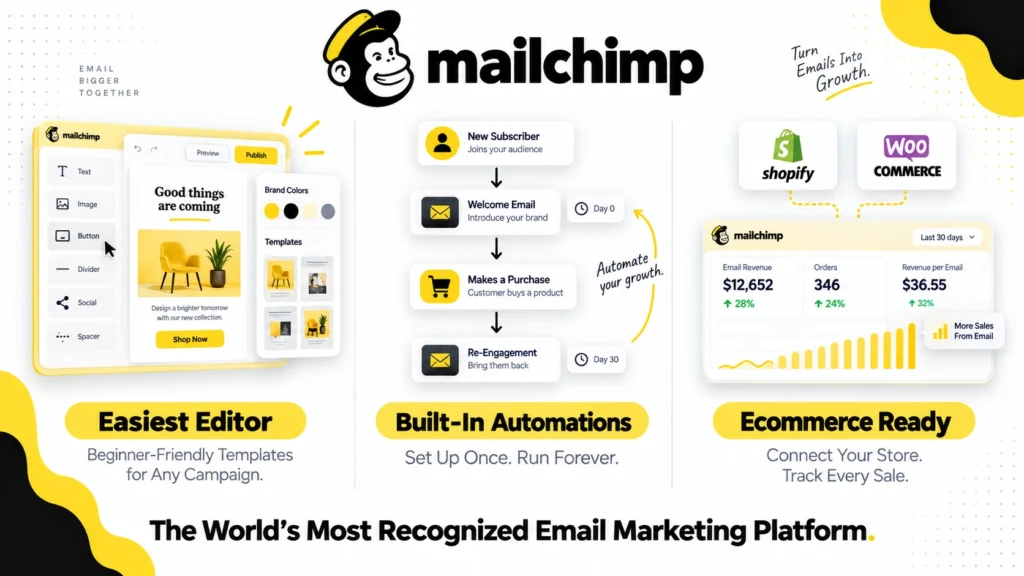
The platform’s historical strength is its approachability. More than any competing platform, Mailchimp made email marketing accessible to people who had never done it before. That accessibility remains its clearest competitive advantage in 2026. The drag-and-drop editor is still among the most intuitive available, and the interface is polished and easy to navigate even for complete beginners.
Mailchimp Pricing in 2026
Mailchimp has four tiers as of September 2026. All prices are contact-based and scale as your list grows. Here is the verified breakdown at the 500-contact tier for comparison:
Free: $0. As of January 2026, includes only 250 contacts and 500 emails per month with a 250-per-day send cap. Email support lasts only 30 days. Mailchimp branding appears on all emails. Automations are not available on the free plan since December 2023. This is genuinely useful only for testing the platform before committing. Most businesses outgrow it within weeks.
Essentials: $13/month for up to 500 contacts (annual billing). Includes 3 audience segments, A/B testing, custom branding removal, 24/7 chat and email support, landing pages, and basic automation. This is the minimum viable plan for professional email marketing use.
Standard: $20/month for up to 500 contacts (annual billing). Adds advanced audience segmentation, behavioral targeting, send-time optimization, dynamic content, and more automation triggers. This is the plan most growing businesses need for meaningful email marketing results. Furthermore, Standard includes AI content generation assistance that Essentials does not.
Premium: From $350/month for up to 10,000 contacts. Adds multivariate testing, comparative reporting, phone support, and unlimited audiences. Designed for large marketing teams with complex segmentation and testing requirements.
The real cost warning: Mailchimp’s contact-based pricing has three specific mechanics that consistently inflate real costs beyond what the pricing page suggests.
First, Mailchimp counts unsubscribed contacts toward your billing tier. If 500 people unsubscribe from your list of 2,000, you still pay for 2,000 contacts unless you manually archive the unsubscribed contacts regularly. Consequently, many users discover they are paying for significantly more contacts than they are actually marketing to.
Second, the pay-per-email credit system available as an alternative to monthly plans has a 12-month expiry on credits since 2026, where previously credits never expired. At $0.026 to $0.04 per email depending on volume, high-frequency senders often pay more on credits than on a monthly plan.
Third, SMS marketing is a paid add-on not included in any plan. Users have reported being billed for SMS without clear opt-out warnings during setup, generating consistent Trustpilot complaints. Always verify total cost including SMS add-on charges before committing to Mailchimp for multichannel campaigns.
Key Features
Email Editor and Templates
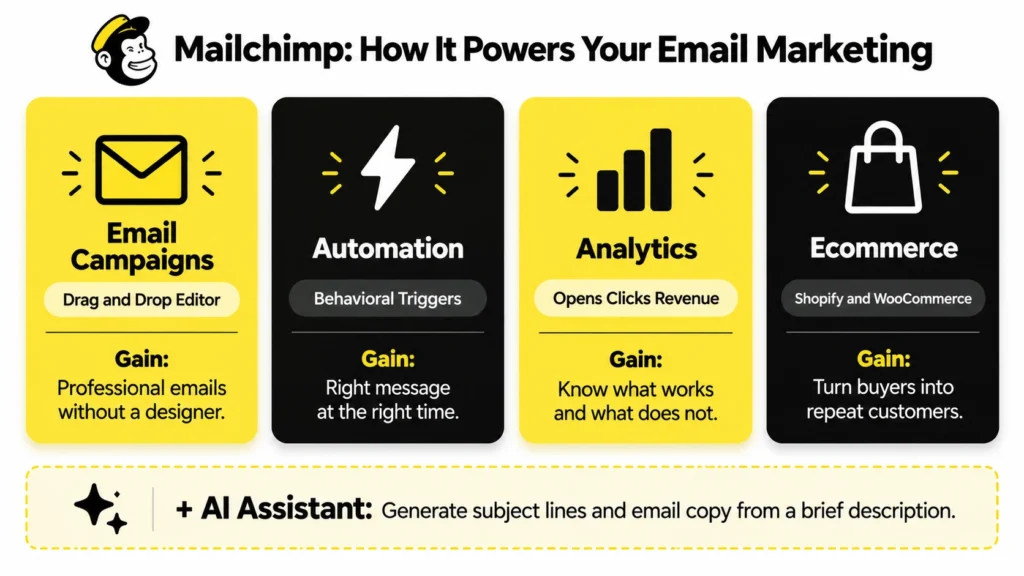
Mailchimp’s drag-and-drop email editor remains one of the most beginner-friendly in the category. The interface is clean and self-explanatory. Template selection is extensive with hundreds of professionally designed options across industries and campaign types. Furthermore, the brand kit stores your colors, fonts, and logo for consistent application across all campaigns without manual setup on each send.
For businesses creating their first email campaigns, the combination of accessible editor and template quality significantly reduces the time and design skill required to produce professional-looking emails. Consequently, Mailchimp’s editor is consistently cited as a primary reason users choose it over more complex but more capable alternatives.
Marketing Automation
Mailchimp’s automation capabilities are solid at the Standard tier and above. Pre-built automation journeys cover welcome series, abandoned cart recovery, post-purchase follow-up, re-engagement campaigns, and birthday messages. Furthermore, the visual journey builder lets you create custom multi-step automations triggered by audience behavior, purchase history, and custom events.
However, Mailchimp’s automation depth is significantly less than ActiveCampaign at comparable price points. Complex multi-branch conditional logic, advanced lead scoring, and sophisticated CRM-triggered automations are better handled by dedicated automation platforms. For businesses whose primary need is sophisticated marketing automation rather than accessible email campaigns, read our ActiveCampaign review for a deeper comparison.
Audience Segmentation
Mailchimp’s segmentation on Standard plans allows filtering by demographic data, purchase behavior, campaign engagement, and custom tags. Behavioral targeting sends different content to different audience segments automatically based on their actions.
However, the audience segmentation model uses separate audiences rather than a unified list with tags. Consequently, a contact who appears on two different audiences counts twice toward your billing tier, which is one of the most cited complaints among users who manage multiple product lines or customer segments. Platforms like Brevo and Kit use a unified contact model that avoids this duplication issue. Read our Brevo review and Kit review for how these platforms handle contact management differently.
AI Content Assistant
Mailchimp’s AI content tools, expanded in 2026, help generate email subject lines, body copy, and campaign ideas from brief text descriptions. The AI is positioned as a starting point rather than a finished output generator, producing drafts that users edit and refine before sending.
For email marketers who struggle with blank-page syndrome or want to accelerate campaign production, the AI assistant reduces the time from brief to first draft meaningfully. However, the quality of AI output varies and requires consistent editing for brand voice consistency. Dedicated AI writing tools like Jasper produce higher quality marketing copy with better brand voice retention for users who need more than basic draft assistance.
Landing Pages and Forms
Mailchimp includes landing page and form builders on all paid plans. Pages connect directly to your audience for lead capture without requiring third-party tools. The editor uses the same drag-and-drop interface as the email builder, making it familiar for existing users.
However, Mailchimp’s landing pages are less capable than dedicated tools like Unbounce for conversion optimization. A/B testing for landing pages is available on Standard plans, but the depth of testing and the AI traffic optimization that Unbounce provides at comparable price points are not matched. Read our Unbounce review for how dedicated landing page tools compare.
Integrations and Ecommerce
Mailchimp connects natively with over 300 apps including Shopify, WooCommerce, Squarespace, Salesforce, and major social media platforms. The Shopify and WooCommerce integrations enable purchase-triggered automations, product recommendation emails, and revenue tracking directly in Mailchimp reporting.
For ecommerce businesses running email marketing alongside their online store, the native integrations reduce setup complexity significantly. Consequently, small ecommerce businesses that need basic email automation without a separate CRM often find Mailchimp’s ecommerce features cover their needs adequately at the Standard tier.
What Mailchimp Does Well
The editor and interface remain the most beginner-friendly in the category. Despite years of competitors closing the gap, Mailchimp’s drag-and-drop editor and template library continue to set the standard for accessibility. For businesses new to email marketing who prioritize getting started quickly over advanced features, Mailchimp reduces the learning curve more than any competing platform.
Brand recognition creates confidence for new email marketers. For many small business owners, Mailchimp is the first name they encounter when exploring email marketing. The extensive documentation, tutorial library, and large user community mean finding answers to common questions is fast and straightforward.
Ecommerce integrations are well-developed and broadly compatible. The native Shopify and WooCommerce integrations handle purchase data, revenue tracking, and behavioral triggers reliably. For small ecommerce businesses, the integration quality reduces the technical complexity of connecting their store to email marketing.
The template library covers virtually every use case. Hundreds of professionally designed templates across industries reduce the design work required to produce polished campaigns. Furthermore, the brand kit applies consistent styling automatically across all template choices.
Where Mailchimp Falls Short
Contact billing mechanics inflate real costs significantly. Charging for unsubscribed contacts, counting duplicates across audiences, and the expiring credit system on pay-per-email plans create a billing environment where your actual monthly cost is consistently higher than the pricing page suggests. This is the most consistent complaint across all major review platforms in 2026.
The free plan is now nearly unusable for real business. 250 contacts and 500 emails per month with a daily cap of 250 is insufficient for any real email marketing operation. The January 2026 free plan cuts pushed Mailchimp’s free offering significantly behind competitors like Brevo (300 emails per day free) and Kit (10,000 subscribers free). Consequently, the free plan functions more as a 30-day trial than a genuine ongoing option.
Automation depth lags competitors at comparable price points. ActiveCampaign Standard at $49/month provides significantly deeper automation, CRM integration, and lead scoring than Mailchimp Standard at $20/month. For businesses whose growth depends on sophisticated marketing automation, Mailchimp is not the strongest investment per dollar.
Support quality on lower tiers is limited. Chat and email support are available on Essentials and Standard plans, but response quality is inconsistent. Phone support is only available on Premium at $350/month. Consequently, businesses that encounter complex technical issues on lower tiers sometimes spend significant time resolving problems that faster support would address quickly.
Price increases are a recurring pattern. Mailchimp has increased prices multiple times since the Intuit acquisition in 2021. The April 2026 increase follows similar increases in 2023 and 2024. Consequently, teams signing annual contracts should budget for year-two pricing increases rather than assuming current rates will hold.
Mailchimp vs Competitors
Mailchimp vs Brevo: Brevo prices by email volume rather than contact count, making it dramatically more cost-effective for businesses with large lists that email moderately. Furthermore, Brevo’s free plan allows 300 emails per day versus Mailchimp’s 500 per month. Brevo also includes SMS and WhatsApp natively without add-on charges. Therefore, Mailchimp wins on interface polish and template quality while Brevo wins on pricing fairness and multichannel value. Read our full Brevo review for a detailed comparison.
Mailchimp vs Kit: Kit is purpose-built for creators and newsletter writers with a 10,000-subscriber free plan, superior automation for digital product sellers, and a Creator Network for audience growth. For content creators and course sellers, Kit delivers more relevant features at lower cost than Mailchimp. For traditional small businesses with ecommerce needs, Mailchimp’s integrations are more relevant. Read our Kit review for the full comparison.
Mailchimp vs ActiveCampaign: ActiveCampaign offers significantly deeper automation, CRM functionality, and lead scoring at its Standard tier. However, its interface is more complex and its price at comparable tiers runs higher. Therefore, businesses that have outgrown Mailchimp’s automation depth often migrate to ActiveCampaign, while businesses that prioritize simplicity and design quality stay with Mailchimp. Read our ActiveCampaign review for details.
Mailchimp vs Systeme.io: Systeme.io includes email marketing alongside funnels, courses, and affiliate management at $17 to $97/month with unlimited email sends. For solopreneurs who need an all-in-one platform, Systeme.io eliminates the need for Mailchimp as a standalone tool. Read our Systeme.io review for how the two platforms compare for online business builders.
Mailchimp vs HubSpot: HubSpot‘s free CRM includes email marketing that exceeds Mailchimp’s free tier capabilities, and its paid plans provide deeper CRM integration alongside email. For businesses that need marketing and sales in one platform, HubSpot is a more complete solution. Read our HubSpot review for the full picture.
Who Should Use Mailchimp?
Mailchimp is the right choice if you are:
- A small business owner or beginner email marketer who wants the most accessible editor and the easiest learning curve available
- An ecommerce business running Shopify or WooCommerce that wants reliable purchase-triggered email automation without complex setup
- A team that values polished email design templates and brand consistency tools over automation depth
- A business that prioritizes widespread integration compatibility across 300 plus apps
However, Mailchimp may not be the right fit if you are:
- A growing business with a large contact list where contact-based pricing and unsubscribe billing inflate monthly costs significantly
- A creator or newsletter writer where Kit‘s 10,000-subscriber free plan and creator-specific features are more relevant
- A business that needs sophisticated marketing automation where ActiveCampaign delivers more capability at comparable price points
- A multichannel marketer who needs SMS and WhatsApp alongside email without paying separate add-on charges
Mailchimp Review: Final Verdict
Mailchimp remains a solid, beginner-friendly email marketing platform in 2026. The editor quality, template library, and ecommerce integrations are genuine strengths. For small businesses and complete beginners who prioritize getting started quickly over advanced features, Mailchimp is still a reasonable choice.
However, the January 2026 free plan cuts, the April 2026 price increase, and the contact billing mechanics that consistently inflate real costs have made Mailchimp’s value proposition increasingly difficult to defend against competitors. Brevo is more affordable with a fairer pricing model. Kit is more generous on the free tier and better designed for creators. ActiveCampaign delivers deeper automation for serious marketers.
The honest recommendation is straightforward. If you are just starting out and value simplicity above all, Mailchimp is fine. If you are growing and price matters, explore Brevo or Kit before committing to Mailchimp’s paid plans. If automation depth is your priority, ActiveCampaign is a better investment.
Overall rating: 3.9 out of 5
Mailchimp is good but no longer the obvious default it once was. The brand recognition is real. The execution quality is real. The pricing trajectory and billing mechanics are real concerns that require honest assessment before committing.