Zoho CRM review 2026: if you are searching for the most feature-rich CRM at the lowest price point, Zoho CRM is the answer that consistently appears at the top of every independent comparison.
With over 300,000 businesses worldwide using it, a permanent free plan for up to 3 users, paid tiers starting at just $14 per user per month, and one of the deepest customization toolkits available at this price point, Zoho CRM has built a strong reputation as the cost-conscious alternative to Salesforce and HubSpot.
However, Zoho CRM’s greatest strength is also its greatest weakness. The sheer breadth of features, configuration options, and Zoho ecosystem integrations creates a learning curve that rewards patient, technically comfortable teams and frustrates those who want immediate out-of-the-box simplicity. This honest review covers the real pricing, the genuine strengths, the documented frustrations, and exactly who Zoho CRM works best for in 2026.
What Is Zoho CRM?
Zoho CRM is a cloud-based customer relationship management platform developed by Zoho Corporation, a privately held software company founded in 1996. Unlike publicly traded competitors that answer to investors and face quarterly earnings pressure, Zoho’s private ownership allows it to prioritize long-term product investment, which partly explains why it consistently delivers more features per dollar than publicly traded competitors.
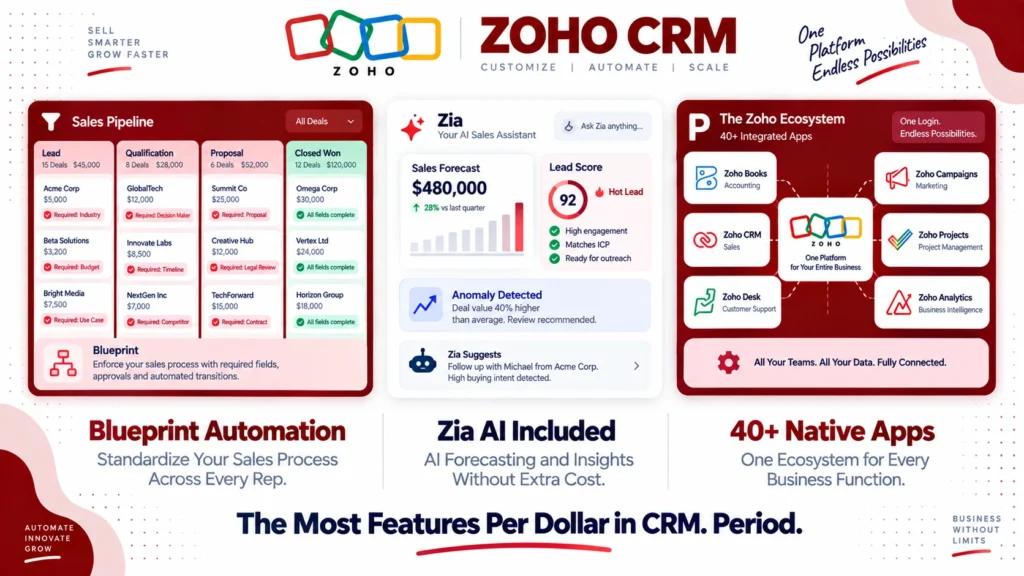
The platform covers the complete sales workflow including lead management, contact and account management, deal pipeline tracking, email marketing, workflow automation, AI-powered insights through its Zia assistant, territory management, inventory and CPQ tools, and advanced analytics. Furthermore, Zoho CRM integrates natively with 40 plus other Zoho applications including Zoho Campaigns for email marketing, Zoho Desk for customer support, Zoho Books for accounting, and Zoho Analytics for business intelligence.
In 2026, Zoho expanded its CRM with the CRM For Everyone update that opens the platform to all departments, not just sales, with Team user licenses at $9 per user per month. Consequently, cross-functional organizations can now give non-sales staff access to CRM data at a lower cost than traditional per-seat pricing.
Zoho CRM Pricing in 2026
Zoho CRM uses per-user monthly pricing billed annually. Monthly billing adds approximately 20 to 34% to each rate. Here is the verified breakdown as of September 2026:
Free: $0 for up to 3 users. Includes basic lead, contact, and account management, standard reports, and limited automation. The free plan is a genuine testing environment rather than a permanently useful tier. The 3-user cap and basic feature set mean most businesses outgrow it quickly. However, for very small teams validating whether CRM is worth investing in, it provides a real evaluation opportunity without financial commitment.
Standard: $14 per user per month (annual billing) or $20 per user per month (monthly billing). Adds scoring rules, workflows, email insights, social CRM, and custom dashboards. This is the entry point for teams that need more than basic contact management. Furthermore, the Standard plan includes email integration and mobile access, making it a legitimate option for startups and very small teams with simple sales processes.
Professional: $23 per user per month (annual billing) or $35 per user per month (monthly billing). Zoho’s most popular tier for growing businesses. Adds Blueprint process management for standardizing sales workflows, expanded automation, inventory management, and 10GB storage. For teams of 5 to 25 people that need structured sales processes without enterprise complexity, Professional delivers exceptional value.
Enterprise: $40 per user per month (annual billing) or $50 per user per month (monthly billing). Adds Zia AI features including sales forecasting and customer insights, CommandCenter for cross-module process orchestration, advanced customization through Canvas Design Studio, territory management, and custom modules. This is where Zoho CRM becomes genuinely enterprise-capable.
Ultimate: $52 per user per month (annual billing) or $65 per user per month (monthly billing). Adds Zoho Analytics integration for advanced business intelligence, higher feature limits across all categories, and extended AI capabilities. Most teams do not need Ultimate. It exists for data-heavy organizations that would otherwise buy a separate BI tool.
Team Users (CRM For Everyone): $9 per user per month for non-sales staff who need CRM data access without full sales functionality. This is a meaningful cost reduction for cross-functional organizations.
Bundle options worth knowing:
Zoho CRM Plus bundles CRM with Campaigns, Desk, SalesIQ, Social, Analytics, and more at approximately $57 per user per month. If you need two or more Zoho add-on products, CRM Plus frequently costs less than buying them individually while also removing integration friction. Always calculate CRM Plus cost before committing to individual add-on purchases.
Zoho One bundles 45 plus Zoho applications at a per-employee headcount price rather than per-user pricing. For organizations that want the entire Zoho ecosystem, Zoho One often delivers the lowest per-application cost available.
15-day free trial available on all paid plans.
The honest pricing verdict: Zoho CRM Standard at $14 per user per month delivers more built-in features than HubSpot Starter at $20 per user per month and Pipedrive Growth at $39 per user per month. The price advantage is real and compounds significantly for larger teams. A 20-person team on Zoho Professional pays $460 per month versus $1,560 on Pipedrive Growth for comparable functionality.
Key Features
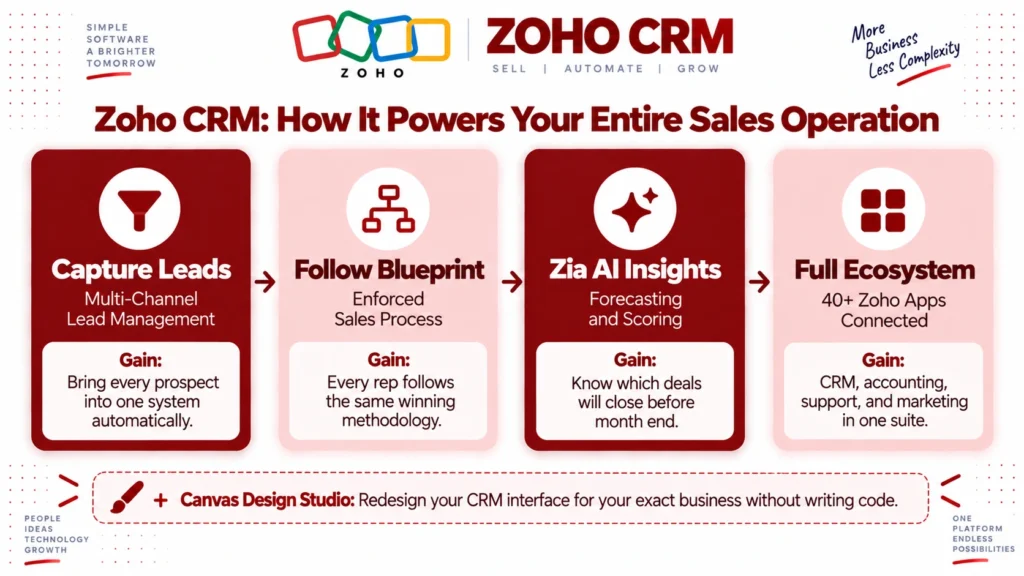
Sales Force Automation
Zoho CRM’s sales automation covers lead capture from multiple sources, automatic lead assignment based on rules, workflow automation for follow-up tasks, email automation, and deal stage progression. On Professional plans and above, Blueprint lets you define your exact sales process with required fields, mandatory actions, and transition conditions at each stage.
Blueprint is Zoho’s most distinctive sales process feature and one that neither HubSpot nor Pipedrive matches at comparable price points. It enforces sales methodology adherence by requiring specific conditions to be met before a deal can advance to the next stage. Consequently, sales managers can standardize their entire team’s process without relying on discipline and manual enforcement.
Zia AI Assistant
Zia is Zoho’s AI assistant, available from the Enterprise plan. It provides sales forecasting based on historical deal patterns, lead and deal scoring, anomaly detection that flags unusual patterns in your data, email sentiment analysis, and conversational AI for querying your CRM data in plain language.
The Zia AI layer is included in the license cost on Enterprise and Ultimate plans rather than sold as a separate add-on. This is a meaningful differentiator from Salesforce where AI features through Einstein require additional licensing costs on top of base plan pricing. Consequently, teams that need AI-powered sales intelligence pay significantly less for it on Zoho Enterprise at $40 per user than on Salesforce.
Customization and Canvas Design Studio
Zoho CRM’s customization depth is exceptional at its price point. Canvas Design Studio lets you redesign the CRM interface for your specific business needs using a drag-and-drop visual editor without writing code. Module customization, custom fields, page layouts, validation rules, and Deluge scripting for advanced automation give technical teams virtually unlimited configuration flexibility.
For businesses with non-standard sales processes that require specific field structures, custom views, or unique workflows, Zoho’s customization capabilities match what Salesforce provides at a fraction of the cost. Consequently, technical teams that have been priced out of Salesforce’s customization depth consistently find Zoho CRM the most powerful alternative available.
Multichannel Communication
Zoho CRM integrates email, phone, live chat, social media, and web forms into a unified communication hub. Sales Signals aggregates customer touchpoints from all channels into a real-time activity feed directly inside the CRM record. Consequently, sales reps see every interaction a prospect has had across channels without switching between tools.
This multichannel visibility at the Professional tier significantly reduces the tool-switching friction that slows sales teams using disconnected point solutions for each communication channel.
Inventory and CPQ Tools
A genuinely surprising Zoho CRM feature for teams coming from other CRMs is the built-in inventory management, product catalog, price books, quotes, orders, and invoices available from the Professional plan. For businesses that sell physical or digital products and need to generate quotes and track orders inside their CRM, this eliminates the need for a separate quoting tool or CPQ software.
Consequently, product-based businesses find Zoho CRM significantly more complete than alternatives that require separate tools for quoting and order management.
Zoho Ecosystem Integration
Zoho CRM integrates natively with 40 plus other Zoho products. If your business runs Zoho Books for accounting, Zoho Campaigns for email marketing, Zoho Desk for customer support, and Zoho Projects for project management, all of these connect to CRM with native two-way data sync. Consequently, organizations that adopt the Zoho ecosystem eliminate significant integration complexity and reduce the need for middleware tools like Zapier or n8n.
For organizations that want a comprehensive business software suite at a fraction of enterprise platform costs, the Zoho ecosystem is a genuinely compelling alternative to the Salesforce or Microsoft 365 ecosystems.
Third-Party Integrations
Beyond the native Zoho ecosystem, Zoho CRM connects with 600 to 1,100 plus third-party tools including Google Workspace, Microsoft 365, Slack, Mailchimp, Asana, and QuickBooks. The open API enables custom integrations for teams with specific technical requirements.
What Zoho CRM Does Well
Features per dollar is genuinely best-in-class at the SMB price point. Blueprint process management, inventory tools, Canvas UI customization, and Zia AI on Enterprise at $40 per user per month would require plans costing two to four times more on competing platforms. Consequently, budget-conscious businesses consistently find more capability per dollar on Zoho than anywhere else in the market.
The permanent free plan is genuinely functional for micro-teams. Up to 3 users with real CRM functionality is a legitimate evaluation opportunity rather than a stripped trial. Micro-businesses and freelancers with very small sales operations can run meaningful customer management on the free plan indefinitely.
Customization depth rivals enterprise platforms at SMB prices. Canvas Design Studio, custom modules, Deluge scripting, and Blueprint process enforcement give technical teams configuration power that matches Salesforce at a fraction of the cost. Consequently, businesses with non-standard processes that other CRMs cannot accommodate often find Zoho the only viable non-enterprise option.
Private ownership drives long-term product investment. Zoho’s independence from public market pressure allows it to invest in product depth rather than optimizing for quarterly earnings optics. This is reflected in consistent feature additions and the expanding Zoho ecosystem rather than pricing increases and feature removal.
The Zoho ecosystem is the strongest integrated business software suite below enterprise pricing. For organizations that want accounting, email marketing, customer support, project management, and CRM in one vendor relationship with native integration, Zoho’s breadth is unmatched at its price point.
Where Zoho CRM Falls Short
The learning curve is genuinely steep. This is the most consistent complaint across G2, Capterra, and independent reviews. The breadth of features, configuration options, and Zoho-specific terminology creates an onboarding experience that is more demanding than HubSpot, Pipedrive, or Monday Sales CRM. Teams without a dedicated CRM administrator or technical champion often find the platform underutilized relative to its capability.
The interface feels less modern than competitors. Multiple reviewers in 2026 note that while Zoho’s functionality is excellent, the user experience design does not match the visual polish of HubSpot or Pipedrive. The Canvas design studio helps customization but requires effort to achieve the interface quality that competitors deliver out of the box.
Support quality is inconsistent. Independent reviews consistently note that Zoho’s customer support response times and resolution quality are less predictable than Salesforce or HubSpot at comparable price points. For teams that rely on support during implementation and troubleshooting, this is a real operational risk.
The Zoho ecosystem can create lock-in complexity. The native integrations between Zoho products are excellent, but migrating away from Zoho once you are on multiple Zoho applications becomes increasingly complex. Consequently, organizations should evaluate the full Zoho ecosystem commitment before adopting it rather than discovering the exit complexity later.
AI features require Enterprise at $40 per user per month. Zia’s AI capabilities are genuinely useful but gated behind the Enterprise tier. Teams on Standard or Professional who want AI-powered forecasting and insights face a meaningful plan upgrade. Consequently, the effective minimum for AI-enabled CRM on Zoho is $40 per user per month, which is less affordable than the headline $14 entry price suggests for AI-focused buyers.
Zoho CRM vs Competitors
Zoho CRM vs HubSpot: HubSpot offers a more polished user experience, stronger marketing automation, and better out-of-the-box onboarding. Zoho CRM offers more features per dollar, deeper customization, and a broader ecosystem at lower cost. For teams that prioritize ease of adoption and marketing-sales alignment, HubSpot wins. For teams that prioritize feature depth and cost efficiency, Zoho wins. Read our full HubSpot review.
Zoho CRM vs Salesforce: Salesforce offers deeper customization, more extensive AppExchange integrations, and stronger enterprise compliance certifications. However, Salesforce Enterprise at $175 per user per month is 4x more expensive than Zoho Enterprise at $40. For SMBs that do not need Salesforce’s enterprise complexity, Zoho delivers 70 to 80% of the capability at 20 to 25% of the cost. Read our full Salesforce review.
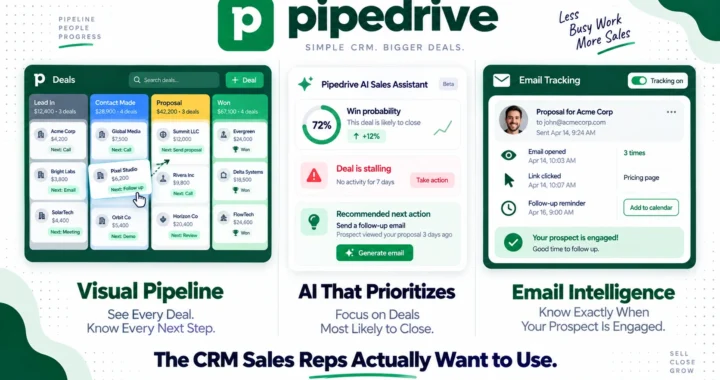
Zoho CRM vs Pipedrive: Pipedrive has a cleaner, more intuitive pipeline interface that drives faster adoption for sales-only teams. Zoho CRM has more feature breadth including inventory tools, Blueprint process management, and the Zoho ecosystem. Pipedrive Growth at $39 per user per month costs significantly more than Zoho Professional at $23 per user per month for comparable sales automation. Therefore, sales-focused teams that value interface simplicity choose Pipedrive while feature-hungry teams on tighter budgets choose Zoho. Read our full Pipedrive review.
Zoho CRM vs Apollo.io: Apollo.io combines a 230 million plus B2B contact database with email sequencing and basic CRM. Zoho CRM is a full-featured CRM without a built-in contact database. For outbound-heavy sales teams that need prospecting data alongside CRM, Apollo.io provides more outbound infrastructure. For teams managing complex deal pipelines with custom processes, Zoho CRM is significantly more capable. Read our full Apollo.io review.
Who Should Use Zoho CRM?
Zoho CRM is the right choice if you are:
- A small to mid-sized business that wants the most feature-rich CRM available below $50 per user per month
- A technically comfortable team willing to invest in setup and configuration to unlock significant capability at low cost
- An organization considering multiple business software needs where the Zoho ecosystem (CRM, Campaigns, Desk, Books, Analytics) provides an integrated suite at a fraction of enterprise platform costs
- A product-based business that needs inventory management, quoting, and order tracking inside the CRM without a separate tool
- A growing team that needs Blueprint process enforcement to standardize a structured sales methodology
However, Zoho CRM may not be the right fit if you are:
- A team that wants quick time-to-value without significant configuration investment, where Pipedrive or HubSpot provide faster onboarding
- A business that prioritizes interface polish and modern UX over feature depth and price
- A team that relies heavily on customer support during implementation and wants guaranteed fast response times
- A pure outbound sales team that needs a large B2B contact database alongside CRM, where Apollo.io is more relevant
Zoho CRM Review: Final Verdict
Zoho CRM is the strongest value CRM available for small and mid-sized businesses in 2026. The feature-to-price ratio is genuinely unmatched. Blueprint process management, Canvas UI customization, Zia AI on Enterprise, inventory tools, and the depth of the Zoho ecosystem collectively deliver capabilities that competitors charge two to four times more to provide.
The honest trade-off is complexity. Getting full value from Zoho CRM requires investment in setup, configuration, and training that faster-onboarding alternatives avoid. Teams without technical champions or CRM administrators frequently underutilize the platform and ultimately conclude that the complexity is not worth it despite the lower cost.
If your team can invest the setup time and has the technical comfort to configure the platform to your exact needs, Zoho CRM delivers exceptional return on that investment. If you need something working productively within days without significant configuration, consider Pipedrive for sales simplicity or HubSpot for marketing-sales alignment.
Overall rating: 4.3 out of 5
Zoho CRM is excellent for the right team. The value is real. The complexity is real. Knowing which one matters more for your situation is the key decision.