ChatGPT is not just a chatbot anymore. In 2026, it is the most powerful income-generating tool available to freelancers who know how to use it correctly.
However, most people use it wrong. They type a question, get a generic answer, and move on. They are getting 10% of what the tool can actually do.
This guide shows you the other 90%. You will learn exactly how to use ChatGPT to find clients, deliver professional work faster than ever, and build a growing freelance income, step by step, starting today.
Before You Start: What You Actually Need
First, let us be clear about the setup. You do not need expensive tools or technical skills.
Here is everything you need to get started:
- A ChatGPT account, free plan works to start
- A profile on Fiverr or Upwork, both are free
- A specific service to offer, we will cover this in Step 1
- A willingness to put in real work for the first 30 days
That is it. No investment required beyond your time.
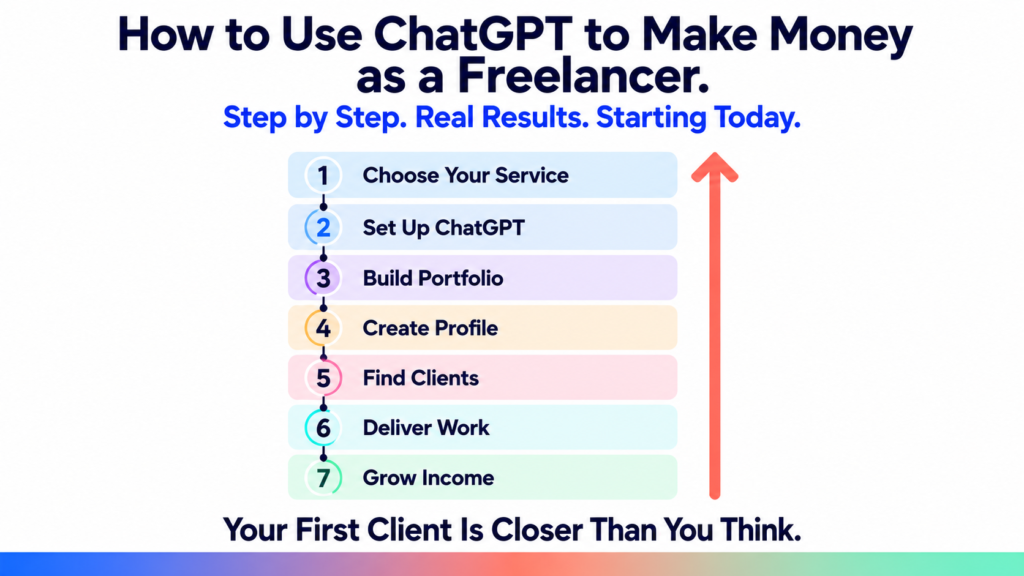
Step 1: Choose Your Freelance Service
The first step is deciding what service you will offer. This is the most important decision you will make.
Do not try to offer everything. Instead, pick one specific service for one specific audience. Specialists earn more than generalists, and they get hired faster.
Here are the best ChatGPT-powered services to offer in 2026:
Writing services:
- Blog articles for businesses ($100 to $300 per article)
- Email sequences for e-commerce stores ($200 to $500 per sequence)
- LinkedIn posts for executives ($500 to $1,500 per month)
- Product descriptions for online shops ($50 to $150 per batch)
Business services:
- Resume and LinkedIn profile rewrites ($75 to $150 per profile)
- Business proposal writing ($150 to $400 per proposal)
- Standard operating procedures for small businesses ($200 to $500 per SOP pack)
Marketing services:
- Social media caption packages ($100 to $300 per month)
- Ad copy for Facebook and Google ($150 to $300 per campaign)
- Newsletter writing ($200 to $500 per month)
How to choose: Pick the service that matches something you already know about. If you have worked in marketing, offer marketing copy. If you have a business background, offer business writing. Your existing knowledge makes your ChatGPT output significantly better than a generalist with no context.
Step 2: Set Up ChatGPT for Professional Work
Before writing a single word for a client, set up ChatGPT correctly. This makes a huge difference in output quality.
Use the system prompt effectively. At the start of every new client project, tell ChatGPT who it is writing for. For example:
“You are a professional copywriter specializing in B2B SaaS marketing. You write in a clear, confident, and direct tone. You avoid jargon and focus on business outcomes. My client is [company name], which sells [product] to [audience].”
Furthermore, on the ChatGPT Plus plan, you can use the Projects feature to save these instructions permanently. As a result, every conversation you start for that client automatically has the context it needs.
Save your best prompts. Keep a personal document of prompts that consistently produce great results. Over time, this becomes your most valuable professional asset as a ChatGPT-powered freelancer.
Step 3: Build Your Portfolio Before You Get Clients
Most freelancers make a critical mistake. They set up their profile before they have any samples to show. Consequently, potential clients see an empty portfolio and move on.
Here is the right approach. Before applying for a single job, create 3 to 5 high-quality samples using ChatGPT.
For a blog writing service: Write 3 sample articles in your chosen niche. Each should be 1,000 to 1,500 words, well-structured, and genuinely useful.
For a LinkedIn ghostwriting service: Write 5 sample LinkedIn posts in different styles. Show range: a personal story, a tips list, an industry opinion, a case study, and a question post.
For an email copywriting service: Write a 5-email welcome sequence for a fictional business in your niche. Show the full flow from introduction to first purchase.
However, do not just publish raw ChatGPT output. Always read everything, fix anything that sounds robotic, and add specific details that make the content feel real. Your editing is what separates professional work from amateur output.
Step 4: Create Your Freelance Profile
Now you are ready to set up your profile. Use Fiverr or Upwork depending on your service type.
Fiverr is better for: Clearly packaged services with fixed prices. Blog writing, resume rewrites, social media packages.
Upwork is better for: Ongoing client relationships and higher-value projects. Monthly retainers, long-term content partnerships.
Writing your profile headline: Be specific. Instead of “I am a professional writer,” try “I write SEO blog articles for SaaS companies that rank on Google.” Furthermore, use ChatGPT to help you write the profile itself. Use this prompt:
“Write a professional Fiverr profile for a freelance writer who specializes in [service] for [audience]. Make it clear, benefit-focused, and under 150 words.”
Setting your prices: Start lower than you think you should. Your first goal is getting 5 reviews, not maximum income. After 5 positive reviews, raise your prices by 30%.
Step 5: Find Your First Clients
Getting your first client is the hardest part. However, once you have one, the second becomes much easier.
Here are the three most effective methods in 2026:
Method 1: Apply to Upwork jobs immediately. New Upwork accounts get a boost in search visibility in their first 30 days. Use this window aggressively. Apply to 5 to 10 jobs per day. Use ChatGPT to write personalized cover letters for each application. Use this prompt:
“Write a short, personalized Upwork cover letter for this job posting: [paste the job description]. My relevant experience is [your background]. Keep it under 150 words and focus on the client’s specific need.”
Method 2: Reach out directly on LinkedIn. Find small business owners, startup founders, and marketing managers in your niche. Send a short, direct message offering a free sample piece. Out of every 20 messages, expect 1 to 3 positive responses. That is all you need to get started.
Method 3: Post on relevant Reddit communities. Communities like r/forhire, r/freelance, and niche-specific subreddits allow services posts. Write a clear, honest post explaining what you offer, your price, and how to contact you. Avoid hype. Straightforward posts convert better.
Step 6: Deliver Client Work with ChatGPT
Once you land a client, your workflow determines your profit. The faster you deliver high-quality work, the more clients you can take on and the more you earn per hour.
Here is the professional workflow for a blog article:
Step 1: Research the topic. Use Perplexity AI to find current statistics, expert opinions, and recent developments. This gives you cited, accurate information to include.
Step 2: Create a detailed outline. Ask ChatGPT: “Create a detailed outline for a 1,500-word article about [topic] targeting [audience]. Include an introduction, 5 main sections with subheadings, and a conclusion.”
Step 3: Write section by section. Do not ask ChatGPT to write the entire article at once. Instead, write each section separately with specific instructions. This produces significantly better quality than one large generation.
Step 4: Edit everything. Read the full draft out loud. Fix any sentence that sounds unnatural. Add one or two specific details, statistics, or examples that make the content feel genuinely informed. This editing step is what clients are paying you for.
Step 5: Format for delivery. Structure the article with proper headings, short paragraphs, and a clear introduction and conclusion. Then deliver it in the format the client requested.
Step 7: Grow Your Income Over Time
Once you have your first 3 to 5 clients and positive reviews, you are in a strong position to scale.
Raise your rates. After every 5 positive reviews, increase your prices by 20 to 30%. Clients who value quality will follow your price increases. Those who do not were not your best clients anyway.
Build retainer relationships. One-off projects are fine for starting out. However, monthly retainers are where freelance income becomes stable and predictable. After delivering strong work for a client, offer a monthly package. For example, 8 articles per month for a fixed fee.
Add a second service. Once your first service is running smoothly, add a complementary one. A blog writer can add newsletter writing. A LinkedIn ghostwriter can add bio rewrites. Each additional service increases your average client value.
Use ChatGPT for admin too. Beyond client deliverables, use ChatGPT to write your invoices, follow-up emails, client onboarding messages, and rate increase announcements. This saves additional hours every week.
Real Income Expectations
Here is an honest breakdown of what you can expect at different stages:
Month 1 to 2: $0 to $300. You are building your profile, getting first reviews, and learning the workflow. This is the hardest period. Do not give up here.
Month 3 to 4: $300 to $800. Your profile has reviews, you have a workflow, and repeat clients are starting to appear.
Month 5 to 6: $800 to $2,000. Retainer clients are in place, your rates have increased, and referrals are starting to come in.
Month 7 to 12: $2,000 to $5,000+. Consistent client base, strong reputation, and the ability to be selective about which projects you take.
These numbers are realistic for someone who follows this guide and puts in consistent daily effort. They are not guaranteed. However, the freelancers who reach these levels are not more talented than you. They are simply more consistent.
The One Thing That Makes Everything Work
Every step in this guide depends on one thing: consistency.
Applying for jobs every day. Delivering work on time every time. Following up with clients after delivery. Raising your rates at the right moment. Improving your prompts and workflow every week.
ChatGPT makes each of these easier. However, it cannot do them for you. The tool is the accelerator. You are the driver.
Start today. Your first client is closer than you think.