If you’ve ever tried to extract text from a 40-page PDF using an AI tool and hit a wall around page ten, you already understand the pain point Baidu just solved. In 2026, the Chinese tech giant has released what it’s calling Unlimited OCR — a document processing model that reads dozens of pages in a single pass without breaking a sweat. And right now, it holds the top spot on the most important OCR benchmark in the industry.
For freelancers, entrepreneurs, and businesses using AI tools to save time and make money, this is a significant leap forward. Let’s break down exactly what Unlimited OCR does, why the technology matters, and how you can start putting it to work.
What Is Baidu’s Unlimited OCR and How Does It Work?
Optical Character Recognition — OCR — is the technology that converts images of text (like scanned documents, PDFs, and photos) into machine-readable text. It’s the backbone of countless business workflows: invoice processing, legal document review, data entry automation, and more.
Until now, most OCR systems — even AI-powered ones — struggled with long documents. The typical ceiling was around ten pages per pass. After that, memory usage would balloon, accuracy would drop, and you’d need to break your document into chunks and reassemble the output manually. That’s slow, error-prone, and expensive at scale.
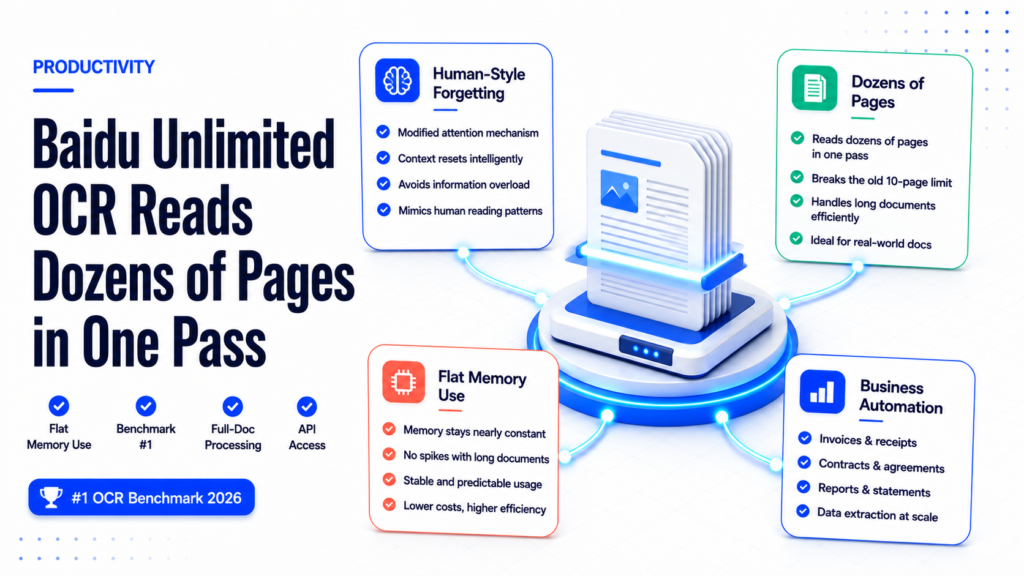
Baidu’s Unlimited OCR changes this with a clever architectural tweak. The model uses a modified attention mechanism that mimics human forgetting. Rather than trying to hold every single character and word in memory simultaneously, the model selectively retains what’s important and releases what isn’t — much like how your brain prioritizes meaningful information while discarding irrelevant details. The result: memory usage stays flat no matter how many pages you feed the model.
According to The Decoder, Unlimited OCR currently ranks first on the most widely used OCR benchmark, outperforming every other model tested. That’s not a minor improvement — that’s a category-defining result.
Why This Matters for People Who Use AI to Make Money
The practical implications for AI-powered workflows are enormous. Consider these real-world use cases:
1. Freelance Data Entry and Document Processing
Freelancers who offer document digitization services on platforms like Upwork or Fiverr often charge by the page or by the hour. With Unlimited OCR, what used to require manual chunking and reassembly can now be processed in one clean pass. That means you can deliver faster, take on more clients, and charge premium rates for accuracy. A freelancer processing 50-page legal contracts or 30-page financial reports can now do so without the usual headaches.
2. Automating Business Back-Office Operations
Small business owners and agencies that handle invoices, contracts, or compliance documents stand to gain significantly. Pair Unlimited OCR with automation tools and you can build pipelines that ingest a stack of documents, extract structured data, and pipe it directly into your CRM or accounting software — all without human intervention. If you’re already exploring automation workflows, this kind of document intelligence layer is a powerful addition. Tools like Zapier or Make.com can serve as the connective tissue between Unlimited OCR and your existing stack — check out our guide on how to make money with Zapier and Make.com for inspiration.
3. Research, Legal, and Compliance Work
Professionals in legal, academic, or regulatory fields deal with dense, multi-page documents every single day. Unlimited OCR’s ability to process entire documents in one pass means that summaries, redlines, and data extractions can be done faster and more accurately. For researchers specifically, the ability to digitize and analyze long academic papers or reports without losing context across page breaks is a genuine game-changer. It complements AI research tools that are reshaping how professionals work in 2026.
4. Content Repurposing at Scale
Content creators and marketers who repurpose physical or scanned materials — old reports, print magazines, historical archives — into digital content now have a much more reliable pipeline. Extract clean text from a 60-page industry report, feed it into your AI writing workflow, and produce blog posts, newsletters, or social media content at scale. If you’re building that kind of content business, our guide to creating and selling digital products with AI is worth bookmarking alongside this development.
The Technical Edge: Why Flat Memory Use Is a Big Deal
To appreciate why Unlimited OCR’s memory efficiency matters, it helps to understand what usually goes wrong with long-document AI processing.
Most transformer-based models use what’s called full attention — every token (word or character) attends to every other token. That’s computationally expensive and memory-intensive. When you double the number of pages, memory requirements don’t just double — they can grow quadratically. This is why previous systems topped out at around ten pages.
Baidu’s modified attention mechanism is inspired by how human memory actually works. We don’t remember every word we’ve ever read with equal weight. We forget irrelevant details and retain meaningful ones. By building this selective forgetting into the model’s architecture, Baidu has essentially decoupled document length from memory cost. You can process 10 pages or 100 pages and the system uses roughly the same amount of memory.
According to research on long-context AI models covered by arXiv, efficient attention mechanisms are one of the most active areas of AI research right now — and Baidu’s implementation appears to be among the most practical deployments of this concept to date.
What’s Next: Availability, Pricing, and Integration
As of 2026, Unlimited OCR is being positioned as part of Baidu’s broader AI services ecosystem. Baidu has historically offered its AI models through its Baidu AI Cloud platform, with API access available to developers and enterprises. Pricing details for Unlimited OCR specifically are still emerging, but Baidu’s OCR APIs have traditionally been competitive — often cheaper per-page than Western equivalents from AWS Textract or Google Document AI.
For Western users, the key question is integration. Baidu’s tools work best within Chinese cloud infrastructure, but API access is available internationally. Developers building document processing pipelines should watch for third-party wrappers and integrations that make Unlimited OCR accessible via standard REST APIs.
It’s also worth watching whether this innovation pressure pushes competitors — Google, Microsoft, Amazon — to release their own upgraded OCR models. Competition in AI document processing is heating up, and that ultimately benefits users regardless of which platform they choose.
For businesses evaluating their AI tool stack in 2026, cost efficiency matters as much as capability. If you’re looking to keep your AI spend lean while accessing powerful tools, our roundup of best AI tools under $10 per month is a useful reference point as you evaluate where Unlimited OCR fits in your budget.
Conclusion: A Quiet Breakthrough With Big Earning Potential
Baidu’s Unlimited OCR isn’t flashy in the way that image generators or chatbots tend to grab headlines. But for anyone who relies on document processing as part of their AI-powered income stream, it’s one of the most practically significant releases of 2026 so far.
The ability to process dozens of pages in a single pass — with flat memory use and benchmark-topping accuracy — removes one of the last major friction points in document automation workflows. Whether you’re a freelancer charging for data extraction, a business automating back-office tasks, or a content creator mining old documents for new material, Unlimited OCR is the kind of quiet infrastructure improvement that compounds into real money saved and earned over time.
Keep an eye on Baidu AI Cloud for access details, and start thinking now about how long-document OCR could fit into your existing workflows. The tools keep getting better — the people who learn to use them first are the ones who benefit most.