On April 28, 2026, Adobe completed its $1.9 billion acquisition of Semrush. It was one of the biggest moves in marketing technology of the year. For Semrush’s 1.8 million users across 142 countries, the question became immediate: does this change anything?
The short answer is not yet. Semrush still operates as an independent product, prices have not changed post-acquisition, and the roadmap continues on its existing trajectory. However, the longer-term implications for pricing, integration with Adobe Creative Cloud, and competitive positioning against Ahrefs are worth understanding before you commit to an annual contract.
This honest review covers the real pricing, the 55 plus tools that make Semrush the broadest digital marketing platform available, the documented limitations, and exactly who should choose Semrush over its competitors in 2026.
What Is Semrush?
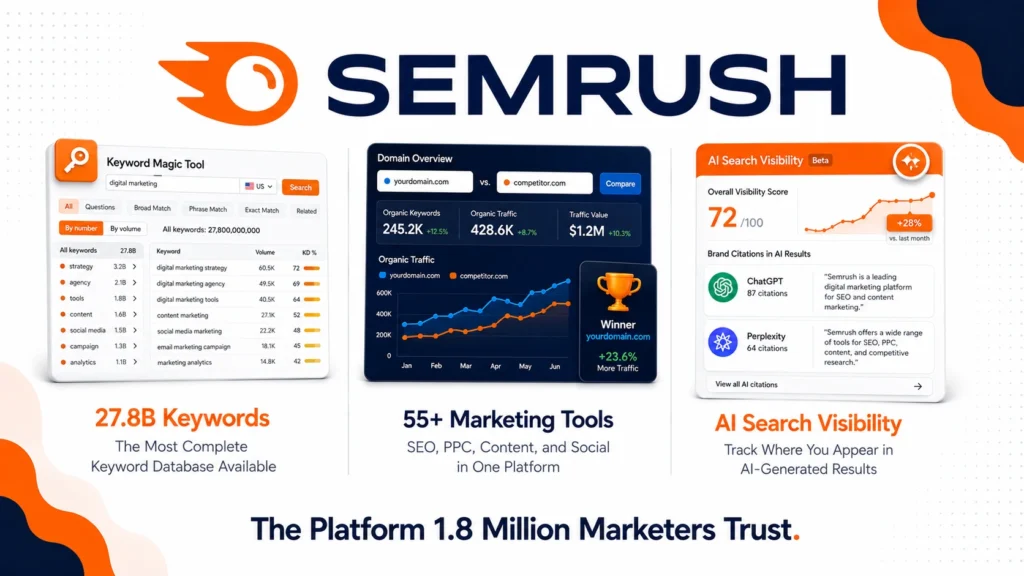
Semrush is an all-in-one digital marketing platform founded in 2008 in Boston that covers organic search, paid advertising research, content marketing, social media management, local SEO, and AI-driven visibility optimization. It serves over 1.8 million marketing professionals including 35% of Fortune 500 companies and generates over $330 million in annual revenue.
What distinguishes Semrush from pure SEO tools like Ahrefs is breadth. Where Ahrefs focuses on doing SEO exceptionally well, Semrush attempts to cover the entire digital marketing workflow in one platform. With 55 plus tools spanning SEO, PPC, content, social media, competitive intelligence, and AI search visibility, it is genuinely the most comprehensive marketing data platform available to non-enterprise buyers.
Furthermore, Semrush’s database scale is impressive. Its 27.8 billion keyword database spans 142 countries, and its 43 trillion backlink index is competitive with Ahrefs. Consequently, for teams that need broad marketing data rather than pure SEO depth, Semrush is the natural platform of choice.
Semrush Pricing in 2026
Semrush has three core SEO Classic plans as of August 2026, all available with a 7-day free trial. Annual billing saves approximately 17%. Here is the verified breakdown:
Pro: $139.95/month (monthly) or $117.33/month (annual billing). Includes 5 projects, 500 tracked keywords, 100,000 pages per month for site audits, 10,000 results per report, and access to all core SEO tools including keyword research, competitor analysis, site audit, backlink analytics, and position tracking. One user included. Additional users cost $45/month each.
Guru: $249.95/month (monthly) or $208.33/month (annual billing). Adds 15 projects, 1,500 tracked keywords, 300,000 pages per month for audits, full Content Marketing Toolkit including SEO Writing Assistant, Topic Research, and Content Audit, historical data access, and Looker Studio integration. One user included. Additional users cost $80/month each. This is the plan most independent reviewers describe as the recommended starting point for agencies and growing in-house teams.
Business: $499.95/month (monthly) or $416.66/month (annual billing). Adds 40 projects, 5,000 tracked keywords, 1 million pages per month for audits, Share of Voice metric, API access, PLA analytics, extended limits across all tools, and free migration from third-party tools. Designed for large agencies and enterprise marketing teams.
The hidden cost warning: Semrush’s headline prices are only the starting point. Several features most serious marketing teams consider essential are sold as paid add-ons on top of the plan price.
AI Visibility (tracking your brand in AI search results) is a paid add-on not included in any core plan. Semrush Trends (traffic analytics and market explorer at competitor traffic level) is a separate add-on at approximately $289/month. Additional user seats beyond the one included cost $45 to $80 per month each depending on the tier. Consequently, a small agency on the Guru plan with two additional users and AI Visibility can easily exceed $400 per month total.
The important verdict on Pro plan value: several independent reviewers describe Pro as structurally poor value for teams that only need SEO. At $117/month annually, you are paying for PPC research, social media tools, and content marketing features you may never use if SEO is your only need. For pure SEO work, Ahrefs Lite at $129/month or SE Ranking at a lower price point deliver better value. Semrush Pro pays off only when you actively use its broader marketing tools alongside SEO.
Key Features
Keyword Magic Tool
Semrush’s Keyword Magic Tool is one of its most celebrated features and a genuine strength over most competitors. You enter a seed keyword and it expands into a structured database of related terms grouped by topic, intent, and modifier type. Furthermore, the filtering options let you narrow by keyword difficulty, search volume, intent, SERP features, and dozens of other criteria simultaneously.
The database of 27.8 billion keywords across 142 countries makes it one of the largest keyword research tools available. For international SEO campaigns that need keyword data across multiple languages and markets, Semrush’s geographic coverage is particularly strong. Consequently, agencies managing campaigns across Europe, Asia, and the Americas consistently rely on Semrush for keyword research rather than tools with smaller international databases.
Site Audit
Semrush’s Site Audit tool performs technical SEO analysis across 140 plus checks covering crawlability, HTTPS implementation, duplicate content, Core Web Vitals, internal linking, structured data, and international SEO implementation. Furthermore, issues are categorized by severity and presented with clear explanations and prioritized recommendations.
The Core Web Vitals monitoring is particularly thorough in 2026, reflecting Google’s continued emphasis on page experience as a ranking factor. Consequently, teams that need to maintain strong technical SEO health across multiple client websites find Semrush’s audit depth and scheduling capabilities well-suited to ongoing monitoring workflows.
Position Tracking
Semrush tracks your keyword rankings daily across multiple search engines, devices, and locations with precision down to specific cities and zip codes. The Share of Voice metric on Business plans provides a high-level view of your organic visibility relative to competitors rather than focusing solely on individual keyword positions.
The SERP feature tracking is particularly useful. Semrush shows you not just where you rank but whether your content appears in featured snippets, People Also Ask boxes, image packs, local packs, and other SERP features that influence click-through rates independently of raw ranking position.
Competitor Analysis and Domain Overview
Domain Overview gives you an instant snapshot of any competitor’s organic traffic, paid traffic, backlink profile, top keywords, and traffic trend over time. Furthermore, the Organic Research tool shows you exactly which keywords drive traffic to any domain and how rankings have changed over time.
The Traffic Analytics tool (available as a paid add-on through Semrush Trends) provides estimated monthly visitor data, traffic sources breakdown, audience demographics, and competitive market share analysis. For market research and competitive strategy, this data level exceeds what free tools provide. However, the add-on pricing means it adds meaningfully to total monthly cost.
Content Marketing Toolkit
The Content Marketing Toolkit, available on Guru plans and above, is one of Semrush’s most significant differentiators from pure SEO tools. It includes Topic Research for finding content ideas, SEO Writing Assistant for real-time content optimization while writing, Content Audit for evaluating existing content performance, and Post Tracking for monitoring how individual pieces of content accumulate backlinks after publication.
The SEO Writing Assistant integrates with Google Docs, WordPress, and Microsoft Word, making it accessible within existing writing workflows rather than requiring content creation inside the Semrush interface. For content teams that use Semrush alongside tools like Surfer SEO, the Writing Assistant provides a secondary optimization layer directly in the writing environment.
PPC and Advertising Research
Semrush’s PPC research capabilities are unmatched by pure SEO tools. You can analyze competitor ad copy, identify which keywords competitors bid on, see their estimated ad spend, and discover the landing pages they use for paid campaigns. Furthermore, the CPC data across thousands of keywords helps budget planning for new paid campaigns.
For agencies and in-house teams running both organic and paid search campaigns, having this PPC intelligence in the same platform as SEO data is a genuine workflow advantage. Consequently, teams that split between an SEO tool and a separate PPC intelligence tool often find consolidating to Semrush reduces both cost and context-switching.
Semrush Copilot and AI Features
Semrush Copilot is the AI recommendation dashboard that analyzes your project data and surfaces the most important actions to take across your SEO, content, and technical health. Furthermore, AI keyword clustering in Keyword Magic Tool automatically groups related keywords by topic, which saves significant manual organization time for large keyword research projects.
ContentShake AI generates content drafts trained on SERP data for your target keywords, meaning the content suggestions are grounded in what currently ranks rather than general AI training data. However, as one independent reviewer noted, Ahrefs has pulled ahead on AI interface in 2026, with its natural language AI Assistant being more intuitive for exploratory research. Consequently, teams focused on AI-powered SEO workflows should evaluate both platforms before committing.
AI Visibility Tracking
Semrush’s AI Visibility tool tracks your brand’s presence in AI-generated search results from ChatGPT, Perplexity, Google AI Overview, and other platforms. It measures citation rate, share of AI search voice, and which competitors appear more frequently in AI responses for your target topics.
However, this feature is a paid add-on rather than included in the core plans. Furthermore, Ahrefs’ Brand Radar offers comparable AI visibility tracking included in its platform without a separate add-on charge. Consequently, teams that prioritize AI search visibility as a core metric should compare the total cost of both platforms including add-ons before deciding.
Local SEO Tools
Semrush includes dedicated local SEO tools including Listing Management for distributing business information across 70 plus directories, Map Rank Tracker for monitoring Google Maps rankings by location, and Review Management for monitoring and responding to reviews across platforms from one dashboard. Pricing is $30 to $60 per location per month depending on the plan.
For local businesses and agencies managing local SEO campaigns, these tools consolidate what would otherwise require separate subscriptions to Yext, BrightLocal, or similar platforms. Consequently, the local SEO toolset is a meaningful cost consolidation opportunity for agencies with multiple local clients.
What Semrush Does Well
The broadest digital marketing platform at its price point. No competing platform combines keyword research, site audit, rank tracking, backlink analysis, PPC intelligence, content marketing, social media, and local SEO at Semrush’s scale and depth. For teams that need genuine breadth across marketing channels rather than deep specialization in one, Semrush is the most capable platform available.
The 7-day free trial removes the commitment barrier. Unlike Ahrefs which offers no free trial on paid plans, Semrush lets you test the full Pro or Guru plan for 7 days before committing. Consequently, teams that want to validate data quality and workflow fit before paying have a meaningful evaluation window.
Keyword Magic Tool is the strongest keyword research interface available. The structured grouping, filtering depth, and database scale of the Keyword Magic Tool consistently receive the highest praise in user reviews. For keyword research specifically, many SEO professionals consider it superior to comparable tools in Ahrefs.
The Content Marketing Toolkit fills a gap no pure SEO tool addresses. For content teams that need topic research, content optimization, and content audit alongside SEO data, the Guru plan delivers a genuinely integrated content workflow that would require multiple separate tools to replicate.
PPC intelligence is unmatched among SEO tools. For teams running paid and organic search simultaneously, Semrush’s competitor ad research, CPC data, and campaign intelligence provide value that Ahrefs and Moz simply do not offer.
Where Semrush Falls Short
The Pro plan is poor value for pure SEO work. At $117/month annually, Pro includes marketing tools that pure SEO practitioners never use. Consequently, teams that only need keyword research, rank tracking, and site audits are paying for significant unused capability. Ahrefs Lite at $129/month or SE Ranking at lower prices deliver better pure SEO value.
Add-ons significantly inflate the real cost. AI Visibility, Semrush Trends, and additional user seats can double the headline tier price. A small agency on Guru annual with two additional users and AI Visibility easily exceeds $450 per month. Therefore, always calculate your total cost including add-ons before signing an annual contract.
Backlink data quality trails Ahrefs. Independent comparisons consistently show Ahrefs’ backlink index discovering links faster and more completely than Semrush. For link building campaigns and backlink analysis specifically, Ahrefs remains the more trusted source. Read our full Ahrefs review for a detailed head-to-head comparison.
The interface has a steeper learning curve than competitors. With 55 plus tools across multiple toolkits, new Semrush users face significant onboarding complexity. Furthermore, some tools have interfaces that feel inconsistent with each other, reflecting their evolution across different product development eras. Consequently, new SEO practitioners sometimes find Moz or SE Ranking more accessible as first tools.
The Adobe acquisition introduces long-term uncertainty. While nothing has changed immediately post-acquisition, pricing strategy, integration priorities, and product roadmap under Adobe ownership remain unknown. Consequently, teams evaluating long-term platform commitments should factor in this uncertainty when choosing between annual and monthly billing.
Semrush vs Competitors
Semrush vs Ahrefs: This is the most important comparison most buyers make. Ahrefs has stronger backlink data, a cleaner interface, and a more focused SEO workflow. Semrush has broader marketing capabilities, a stronger keyword research interface, the Content Marketing Toolkit, PPC intelligence, and a 7-day free trial. Consequently, pure SEO specialists often prefer Ahrefs while full-stack marketing teams prefer Semrush. Read our complete Ahrefs review for the full comparison.
Semrush vs Moz Pro: Moz Pro starts at $99/month, making it the most affordable major SEO platform. It has a more accessible interface suited to beginners and a well-respected Domain Authority metric. However, Moz’s database is smaller than Semrush’s and it lacks PPC research, content marketing tools, and social media features. Therefore, beginners and small businesses on a budget start with Moz, while teams that need broader marketing data invest in Semrush.
Semrush vs SE Ranking: SE Ranking is the fastest-growing Semrush alternative in 2026, with a 4.8 out of 5 rating across over 1,300 G2 reviews at approximately one-third the cost. It covers keyword research, rank tracking, site audits, and backlink analysis competently without the breadth of Semrush’s broader marketing tools. For teams that need solid SEO data without PPC research or content marketing features, SE Ranking delivers exceptional value. Therefore, budget-conscious teams evaluate SE Ranking seriously before committing to Semrush’s pricing.
Semrush vs Surfer SEO: Surfer SEO focuses specifically on on-page content optimization that Semrush covers partially through its SEO Writing Assistant. However, Surfer’s content scoring and optimization depth exceed what Semrush provides. Consequently, many serious content teams use both Semrush for keyword research and competitive intelligence and Surfer for content optimization, rather than treating them as direct alternatives.
Who Should Use Semrush?
Semrush is the right choice if you are:
- A digital marketing agency managing SEO, PPC, content, and social media for multiple clients who needs all marketing data in one platform
- An in-house marketing team that runs both organic and paid search campaigns and needs integrated competitive intelligence across channels
- A content marketing team that needs topic research, SEO writing assistance, and content auditing alongside keyword research and rank tracking
- A business with international SEO needs across multiple countries where Semrush’s 142-country keyword database is more comprehensive than most alternatives
- A team that wants to evaluate a platform with a 7-day free trial before committing to annual billing
However, Semrush may not be the right fit if you are:
- A pure SEO specialist who only needs keyword research, backlink analysis, and rank tracking without the broader marketing tools, where Ahrefs delivers better value
- A budget-conscious freelancer or small business where SE Ranking or Moz Pro cover your needs at a fraction of Semrush’s cost
- A team focused primarily on link building and backlink analysis where Ahrefs’ superior backlink index is worth the focused investment
- An organization concerned about long-term pricing and product direction following the Adobe acquisition
Semrush Review: Final Verdict
Semrush is the most complete digital marketing platform available at its price point in 2026. For agencies and marketing teams that need genuine breadth across SEO, PPC, content, and competitive intelligence, it remains the strongest all-in-one option. The Keyword Magic Tool, Content Marketing Toolkit, and PPC research capabilities are genuinely difficult to replicate with any single competing platform.
However, the Pro plan is poor value for pure SEO work, the add-on structure inflates real costs significantly, and the Adobe acquisition introduces strategic uncertainty worth monitoring. Furthermore, for backlink analysis specifically, Ahrefs remains the more trusted data source.
The honest recommendation: if you run multiple marketing channels and need integrated data across SEO, PPC, and content, Semrush Guru is the right plan. If you only need SEO data and want the best backlink intelligence available, Ahrefs Standard is a better investment. If budget is the primary constraint, SE Ranking delivers solid SEO data at a fraction of both platforms’ cost.
Overall rating: 4.3 out of 5
Semrush is excellent for the right team with the right scope. The challenge is ensuring your actual marketing needs justify the breadth you are paying for.