What if you could cut your Claude API bill by up to 70% without changing a single line of your prompts? That’s exactly what a new open-source tool called pxpipe promises — and it’s already turning heads among developers and AI freelancers who rely on Claude Code to build, automate, and earn.
In 2026, token costs remain one of the biggest hidden expenses for anyone using large language models at scale. Whether you’re running an AI-powered SaaS product, offering Claude-based development services, or building automation pipelines for clients, your API spend can quietly eat into your margins. pxpipe is a clever — and controversial — attempt to change that math.
What Is pxpipe and How Does It Work?
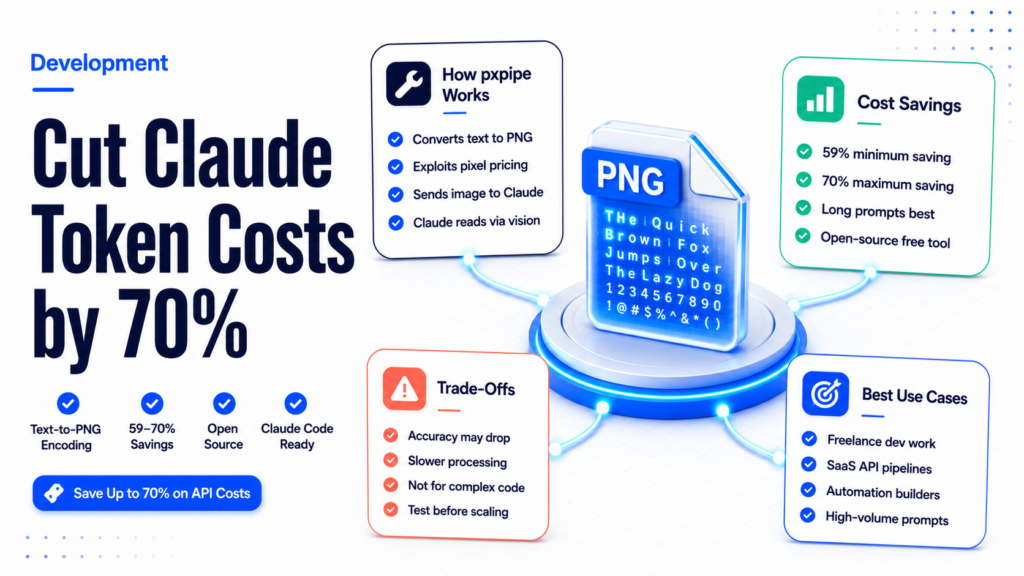
pxpipe is a lightweight open-source tool created by developer Steven Chong. The core idea is elegantly simple: instead of sending long text prompts directly to Claude Code or other Anthropic models like Fable 5, pxpipe converts those text prompts into PNG image files and sends the images instead.
Here’s the key insight behind it: Anthropic charges for images based on pixel dimensions, not on the amount of text contained within them. A dense block of text encoded into a compact PNG might cost a fraction of what that same text would cost when submitted as raw tokens. Chong reports cost savings ranging from 59% to 70% depending on the length and nature of the prompt.
The tool essentially exploits a pricing gap between how Anthropic bills for text tokens versus image inputs. It encodes your text into pixels, ships the image to the model, and lets Claude’s vision capabilities read the embedded text on the other side.
For a deeper look at how prompt structure affects your Claude costs and outputs, check out our guide on Claude prompting tips for 2026 and how blindspot passes can make you more money with AI.
The Real Trade-Offs: Speed, Accuracy, and Reliability
Before you rush to install pxpipe on every project, it’s important to understand what you’re giving up in exchange for those savings.
Accuracy Takes a Hit
When Claude reads text embedded in an image rather than processing it as native text tokens, the model is essentially performing OCR-like interpretation. This introduces a layer of potential error. Complex code snippets, special characters, formatting-sensitive content, and long technical prompts are all at higher risk of being misread or partially misinterpreted. For creative writing prompts or general instructions, the accuracy loss may be negligible. For precise coding tasks or data-heavy workflows, it could cause real problems.
Speed Is Slower
Processing image inputs takes longer than processing plain text. Depending on your use case, this latency could be a minor inconvenience or a genuine bottleneck — especially if you’re running large-scale automation pipelines where turnaround time matters.
Not a Universal Solution
pxpipe works best for longer prompts where the token savings are most dramatic. For short prompts, the overhead of converting to PNG may not justify the savings. Developers using it need to benchmark their specific workflows to understand where it adds value and where it doesn’t.
According to The Decoder, which first reported on pxpipe, the tool is already gaining traction in developer communities looking for creative ways to manage API costs as LLM usage scales.
What This Means If You’re Using AI to Make Money
For freelancers, indie developers, and small agencies building on top of Claude Code, pxpipe represents something bigger than a clever hack — it’s a reminder that API cost management is now a core skill for anyone serious about profiting from AI tools.
Freelancers and Developers
If you’re billing clients for Claude-powered development work or running automated pipelines on their behalf, a 59–70% reduction in token costs could meaningfully improve your profit margins. Even at half that savings rate, the difference on a $500/month API bill adds up to thousands of dollars over a year. Tools like pxpipe — used selectively and tested carefully — could give independent developers a competitive edge over larger teams with bloated infrastructure costs.
SaaS Builders and Product Creators
For anyone building an AI-native product on top of Claude’s API, token costs are a unit economics problem. The lower your cost per query, the more scalable your product becomes. pxpipe is one experimental approach to that problem, but it signals a broader trend: developers are actively finding creative ways to optimize LLM spend, and the tools to do so are becoming more accessible. If you’re thinking about creating and selling digital products with AI in 2026, understanding your API cost structure from day one is critical.
Automation Entrepreneurs
Automation builders running high-volume Claude workflows — think content generation pipelines, code review automation, or document processing — are often the hardest hit by token costs. For these use cases, pxpipe’s approach could be worth testing in controlled environments, particularly for standardized, repetitive prompt templates where accuracy can be validated at scale.
Should You Use pxpipe? A Practical Framework
The honest answer is: it depends on your tolerance for trade-offs. Here’s a simple framework for deciding whether pxpipe belongs in your AI toolkit:
- Use it if: You have long, standardized prompts that don’t require character-perfect accuracy, and your primary constraint is API cost.
- Avoid it if: You’re sending complex code, structured data, or prompts where a single misread character could break functionality.
- Test it if: You’re curious but cautious — run A/B comparisons on a sample of your prompts and measure both accuracy and actual cost savings before committing.
- Watch it if: You’re not ready to use it today but want to track how the project evolves. Open-source tools like this often improve rapidly once a community forms around them.
It’s also worth keeping in mind that Anthropic may update its pricing model to close this gap. As noted by AI providers like OpenAI, pricing structures for multimodal inputs are still evolving across the industry, and what works today may be repriced tomorrow.
Understanding how different AI models and their cost structures work is increasingly important for anyone building income streams around these tools. Our article on what Claude’s growing capabilities mean for your income puts this in broader context.
The Bigger Picture: AI Cost Optimization Is the New Competitive Moat
pxpipe is a fascinating case study in what happens when API pricing creates unexpected incentive structures. It’s also a preview of a broader arms race: as AI tools become more central to how people earn money, the ability to use them efficiently — at the lowest possible cost per output — becomes a genuine competitive advantage.
The developers and entrepreneurs who thrive in 2026’s AI economy won’t just be the ones with the best prompts or the most sophisticated workflows. They’ll be the ones who understand the full cost structure of their AI stack and find creative, responsible ways to optimize it.
pxpipe may be experimental, and it may come with real limitations. But the problem it’s trying to solve — making powerful AI tools more financially accessible for independent builders — is one that matters. Keep an eye on this one.