Your API bill is a choice, not a requirement
Most teams running AI assisted development are not doing cutting edge research. They are generating boilerplate, refactoring modules, summarizing documents, and scaffolding features. For that workload, paying $5-$15 per million tokens to a closed source provider is not a technical decision, it is a financial one nobody scrutinized. Kimi AI, built by Beijing-based Moonshot AI, entered that gap deliberately. Its K2.6 model delivers competitive benchmark results at roughly 8-10x lower API cost than leading Western alternatives, and its consumer interface bundles document processing, agent orchestration, code generation, and slide creation under one roof. Whether it belongs in your workflow depends on exactly what you are trying to do, and a few constraints that most reviews do not mention clearly enough.
How the underlying model actually works
Kimi K2.6, released on April 20, 2026, uses a Mixture of Experts architecture with 1 trillion total parameters and only 32 billion active per token. That gap between total capacity and active compute is what makes the pricing possible. Inference costs stay at the 32B level while the model draws on 1T-parameter capacity during routing, a design choice Moonshot calls out explicitly as the foundation of its cost argument.
The context window sits at 262,000 tokens via the API. The consumer platform advertises longer windows on paid tiers. In practice, context recall degrades well before the advertised ceiling on complex multi document tasks, a pattern consistent across long-context models generally, not unique to Kimi.
The one behavior most users discover too late: the free tier does not run K2.6. It uses a lighter model. For casual summarization that is fine. For code generation or structured reasoning, the quality difference is noticeable and the “server busy” errors that appear frequently on the free tier are actually aggressive rate limiting, 3 requests per minute, one concurrent request, not infrastructure problems.
The five features worth understanding before you start
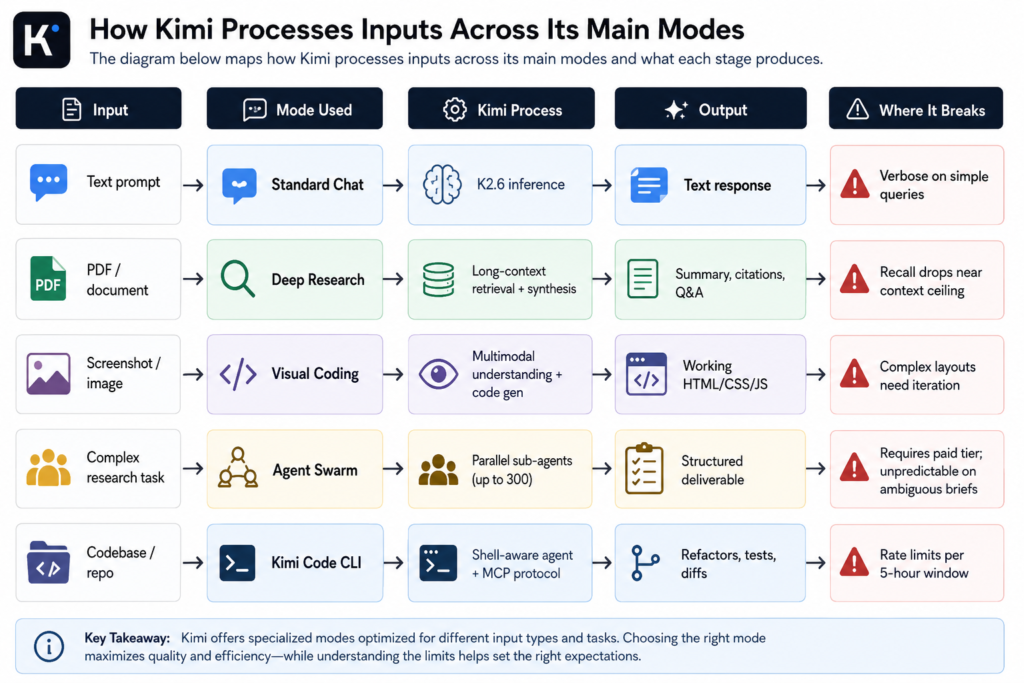
Agent Swarm: This is the feature with no current equivalent in other consumer-facing AI tools. Instead of processing a task sequentially, the orchestrator decomposes it, spins up specialized sub agents, researcher, coder, fact-checker, reviewer, and runs them in parallel. Moonshot’s own data cites 4.5x faster completion and an 80% reduction in end to end runtime on parallelizable tasks versus single agent approaches. The non-obvious limit: Agent Swarm produces inconsistent results on vague briefs. Tight task specifications reduce the ambiguity that causes sub-agents to diverge. It is available on paid tiers and currently capped at 300 agents per run on K2.6.
Visual coding: Kimi K2.6 processes screenshots alongside text. You can paste a UI mockup or a screenshot of a bug and receive working HTML/CSS/JS in return. This is not a demo capability, developers using Kimi for frontend scaffolding report it as the strongest practical differentiator over text only models. The limit is layout complexity: multi column responsive designs require iterative refinement, and the first pass often needs cleanup.
Kimi Code CLI: Launched in January 2026 under the Apache 2.0 license, this is Moonshot’s answer to Claude Code and Aider. It is shell-aware, supports Model Context Protocol out of the box (Claude Code MCP configurations work without modification), and implements Agent Client Protocol for Zed and JetBrains integration. The subscription allows 300-1,200 API calls per 5-hour window with up to 30 concurrent requests. That window limit matters more than it appears in documentation, heavy refactoring sessions can exhaust it.
Deep Research mode: The tool ingests multiple documents, financial reports, legal contracts, research papers, and synthesizes across them in a single pass. For professionals handling document-heavy workflows, this is more useful than the code features. The advertised context window is generous enough to process full annual reports without chunking. The practical limit: cross document citation accuracy is better than most models, not perfect.
Slides and Websites generation: The consumer interface generates slide decks from prompts or document uploads, with an editable outline step before rendering. The quality of content generation is strong; the in-browser editor is limited. Alignment and auto snapping are manual, and for final design polish most users export to PowerPoint or an external editor. The Websites feature generates full-stack deployable code from a prompt, useful for prototyping, not a production replacement.
A real workflow: from screenshot to working UI component
The workflow most developers underuse starts with a screenshot rather than a text description. Here is the sequence that produces the cleanest output.
Take a screenshot of the UI component you want to reproduce or improve. Open Kimi, enable K2.6 (confirm you are on a paid tier), and attach the image. Then write a prompt that specifies the output constraints, not just the intent.
Weak prompt: “Build this component in React.” Better prompt: “Convert this screenshot into a React functional component using Tailwind CSS. Include hover states, focus rings for accessibility, and TypeScript props. No external dependencies beyond React and Tailwind.”
The most common beginner mistake is attaching the image without specifying the tech stack and output format. Kimi will produce working code but may default to plain HTML/CSS, which requires a full rewrite to integrate into a React project. Specifying the stack upfront removes an unnecessary iteration loop.
After the first generation, paste the output directly into your editor. Most components produced this way need two rounds of iteration, one for layout accuracy, one for edge case behavior. That is faster than building from scratch, not equivalent to production ready code on the first pass.
Three scenarios where it saves real time
Startup with a mixed language codebase: A team processing a Chinese language partner agreement alongside English technical documentation needs a model that handles both without degradation. Kimi’s native Chinese language optimization means it processes CJK text without the loss of nuance that occurs in Western first models. The result is accurate cross document synthesis across languages in a single session. The insight: this use case is largely invisible in English language reviews and represents a genuine competitive moat for the tool.
Solo developer running high volume API calls: At $0.60-$0.74 per million input tokens versus $3-$5 for comparable models, the math changes the feasibility of certain products. A document processing pipeline that would cost $400/month on a leading US API runs at roughly $50/month on Kimi. That is not a marginal saving, it determines whether the product is economically viable at small scale. The result: several early stage SaaS products have been built specifically on Kimi’s API cost structure. The limit: no permanent free API tier; rate limits scale with cumulative recharge amounts.
Research analyst with multi hundred page reports. Processing an entire annual report or legal contract without chunking and re-summarizing is the workflow Kimi was designed around. The analyst uploads the file, asks structured questions across it, and receives synthesized answers with citations. The iteration cycle is document-in, answer out, follow up question, not document in, chunk, summarize each chunk, combine summaries. For time sensitive due diligence, that difference is significant.
Output comparison: same tasks, different tools
| Task | Without AI | With Kimi K2.6 | Notes |
|---|---|---|---|
| Summarize 150-page PDF | 3–4 hours manual reading | 5–10 minutes with Q&A follow-up | Accuracy depends on document structure |
| Screenshot to React component | 1–2 hours build from scratch | 15–30 minutes with 2 iterations | Works best with clear, flat UI designs |
| Parallel research across 5 sources | Half day with manual synthesis | Under 30 minutes via Agent Swarm | Requires paid tier; brief must be specific |
| Unit test suite for existing function | 30–60 minutes | 5–10 minutes with edge case review | Production-ready after light review |
| Bilingual document cross-analysis | Requires bilingual analyst | Single session, no translation step | Strong advantage over Western-first models |
Pricing
The consumer interface is free to start. The free tier uses a standard model rather than K2.6, has no stated daily message limit for basic chat, but enforces aggressive rate limiting, 3 requests per minute and 1 concurrent request, that surfaces as “server busy” errors. For sustained work, the free tier is not functional at professional pace.
Paid subscriptions use musical tempo names: Moderato starts at $19/month and gives access to K2.6, Deep Research, Kimi Code, and Slides. Allegretto and Vivace scale up usage quotas and agent credits. The top tier matches the $20/month price point of ChatGPT Plus and Claude Pro, but with significantly larger context windows and agent capabilities included.
The API is separate from the consumer membership. API access starts at roughly $0.60-$0.74 per million input tokens for K2.6 and $2.50-$3.50 per million output tokens. There is no permanent free API tier. Rate limits scale with cumulative recharge amount, which means new accounts start at low throughput until spending history accumulates.
The most common cost mistake is treating the consumer membership and API as interchangeable. They are entirely separate billing systems. Paying for Moderato does not reduce API costs, and API credits do not unlock consumer features. Teams building products need both lines in the budget.
The real cost is often in how the tool is used, not the subscription itself.
Strengths and limits
The pricing structure is a genuine advantage, not a marketing claim. The gap between Kimi’s API rates and US based alternatives is large enough to change product economics for startups and solo developers running document-processing or code generation pipelines at scale.
The bilingual and CJK language capability is underreported. Most reviews are written by English only users who do not test this. For teams with operations in China, Japan, or Korea, the quality difference in cross-language document analysis is material.
Agent Swarm is technically novel but operationally immature. On tightly specified tasks with parallelizable subtasks it performs well. On open ended research briefs it produces divergent outputs that require significant curation. It is not a set-and-forget capability yet.
The data residency situation is a real constraint, not a theoretical one. Moonshot AI is a Beijing based company subject to Chinese data regulations. The Kimi Claw agent feature, which can operate persistently across a user’s browser, has received specific attention from security researchers and the Institute for AI Policy and Strategy, which flagged it as a deeper privacy exposure than typical AI tools. For government, defense, healthcare, finance, or legal users handling sensitive IP, this is a blocking issue. The tool is not appropriate for those contexts regardless of model quality.
English prose quality trails Claude and GPT on nuanced writing tasks. The model produces verbose outputs on simple queries, a consistent complaint across Reddit and Hacker News threads. It is a coding and analysis tool first; it is not a writing assistant in the same tier as its Western competitors.
Who extracts the most value
Cost sensitive developers building products that require high volume document processing or code generation will find the API economics compelling. The math works especially well when existing alternatives are priced at $3-$5 per million tokens and the workload is straightforward rather than nuanced.
Researchers and analysts working with large document sets across multiple languages, particularly Chinese and English, will find capabilities here that have no clean equivalent elsewhere at this price. The combination of long context, CJK fluency, and synthesis quality makes it a credible daily tool for this profile.
Users in regulated industries, healthcare, finance, legal, government, should look elsewhere. The data residency constraints are not solved by organizational policy; they are structural to where the infrastructure lives.
Users who primarily need high quality English writing, complex creative work, or the ecosystem depth of established platforms (plugins, integrations, enterprise support) will find Western alternatives more complete. Kimi’s strength is technical throughput, not breadth of the surrounding product.
Advanced usage patterns most users miss
Configure MCP servers once for Claude Code and reuse them in Kimi Code without modification. Both tools implement Model Context Protocol, and the configuration files transfer directly. This removes a setup barrier that keeps developers locked into a single CLI tool unnecessarily.
Use automatic context caching for repeated workflows. When you send overlapping prompts, processing similar documents, running the same analysis pipeline, Kimi’s API caches context automatically and reduces input costs by up to 75%. No configuration is required. Most developers do not know this happens and do not account for it in cost projections, which makes their estimates 40-60% too high.
In Agent Swarm, specificity in the orchestration brief has an outsized effect on output quality. Vague briefs produce divergent sub agent results that require curation. Structured briefs, task, output format, constraints, sources, produce tighter, more actionable deliverables. Treat it less like a chatbot and more like a project brief.
For visual coding tasks, provide both the screenshot and a written description of the desired behavior. The multimodal model uses both inputs; using only the image produces functional but behaviorally incomplete code. The written description covers interaction states that visual input alone does not communicate.
The bottom line
Kimi AI is the most cost effective option currently available for developers and analysts who need high-volume document processing, code generation at scale, or bilingual Chinese English analysis, and who are not subject to data residency requirements that make a Chinese hosted service unusable. Its API pricing alone makes it worth evaluating for any startup running a document-heavy or code heavy pipeline.
Its key limitation is not the model quality, it is the data governance situation and the gap in English prose quality that makes it unsuitable as a general purpose writing tool or as an enterprise platform for regulated industries.
Frequently asked questions
Does the Kimi consumer membership include API access?
No. The consumer membership at kimi.com and the developer API are entirely separate billing systems. A Moderato or Vivace subscription does not provide or discount API token access. Developers building products need a separate API account with its own funding.
Why does the free tier show “server busy” so often?
The errors are rate limiting, not infrastructure failures. The free tier allows 3 requests per minute and 1 concurrent request. Rapidly refreshing or sending multiple queries in quick succession consumes the quota faster and extends the lockout period. Batching queries into single, comprehensive requests is more efficient than multiple short ones.
Is Kimi Code a direct replacement for Claude Code?
It is a functional alternative for developers comfortable with open-source tooling and a lower API cost base. Claude Code MCP configurations work in Kimi Code without modification, which lowers the switching cost. However, Kimi Code has a per 5-hour window API call limit (300-1,200 calls) that Claude Code’s Max plan does not impose. For sustained heavy development sessions, this matters.
What happens to documents I upload to Kimi?
Moonshot AI’s privacy policy contains broad data use clauses without specific opt out mechanisms for training use, no ISO 27001 or SOC 2 certifications listed, and data stored on infrastructure subject to Chinese law. For sensitive documents, contracts, proprietary code, personal health data, the recommendation from multiple independent security reviews is not to upload them.
Does Agent Swarm work on the free tier?
No. Agent Swarm is available on paid tiers starting with Moderato ($19/month). The free tier does not include agent credits. The feature is also currently in an active development phase, and behavior on complex tasks is less predictable than the core chat and document modes.
Try it before committing to a higher cost alternative
The most honest way to evaluate whether Kimi belongs in a workflow is to run a real task through it, a document you would normally process manually, a UI component from a screenshot, or a research brief that requires synthesizing multiple sources. The free tier is limited but functional enough for a meaningful test. If the quality holds for your specific use case and the data residency constraints do not apply to your context, the pricing case for a paid plan is straightforward. Start using Kimi AI and run the test against your actual workload before drawing conclusions from benchmarks alone.