What if the reason you’re not getting better results from AI isn’t the AI at all — it’s you? That’s the provocative but well-reasoned argument being made by Thariq Shihipar, a developer at Anthropic, in 2026. As Claude’s latest model (internally dubbed Fable 5) pushes the ceiling on raw capability, Shihipar says the real bottleneck has shifted. It’s no longer the model. It’s the user’s blind spots.
For anyone using AI tools to build income — whether you’re a freelancer, developer, content creator, or entrepreneur — this reframe is genuinely important. Because it means that the gap between average AI results and exceptional AI results isn’t about which tool you pay for. It’s about how well you understand your own unconscious assumptions and knowledge gaps.
Here’s what Shihipar’s prompting framework means for you, and how to apply it to actually make more money with AI in 2026.
The Bottleneck Has Shifted: From Model to Mindset
For years, the AI community treated model capability as the primary constraint. Better model = better output. That logic drove billions in investment and endless benchmark wars. But with models like Claude’s Fable 5 reaching near-expert performance across a wide range of tasks, Anthropic’s own developers are now pointing to a different constraint: the quality of how users engage with the model.
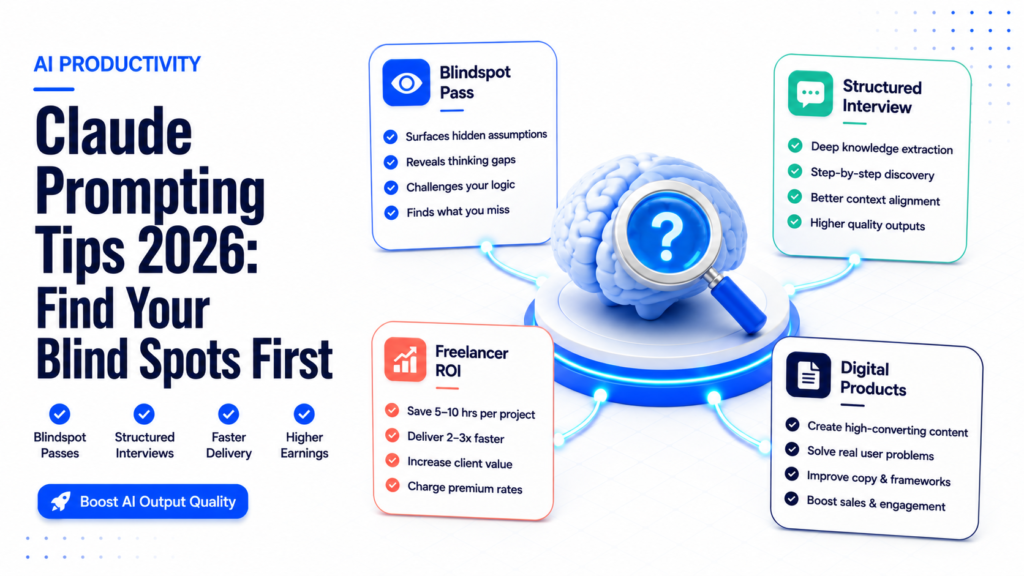
Shihipar describes this through the concept of blindspot passes — a structured technique where you deliberately prompt Claude to identify what you haven’t thought of, what you’re assuming without evidence, and where your framing might be limiting your results.
Think of it this way. If you ask Claude to help you write a sales page for your digital product, the output is only as good as the brief you give it. If your brief contains hidden assumptions — say, assuming your audience already knows the problem you’re solving — the output inherits those assumptions. A blindspot pass forces the model to surface those gaps before you build on top of them.
This is a paradigm shift. And for people using AI to generate income, it’s one of the highest-leverage shifts you can make right now. As we covered in our breakdown of how half of Claude users say AI can handle half their work, the users seeing the biggest income impact aren’t necessarily using more tools — they’re using them more strategically.
What Are Blindspot Passes and Structured Interviews?
Blindspot Passes Explained
A blindspot pass is a prompting technique where, before diving into a task, you ask Claude to interrogate your assumptions. A simple version looks like this:
“Before we start, I want you to identify any blind spots in my thinking about this project. What am I likely assuming that I shouldn’t be? What important context might I be missing?”
The result is often a list of questions or observations that you hadn’t considered — edge cases, missing audience perspectives, or strategic contradictions in your plan. For anyone building digital products, writing copy, or developing software, this single step can save hours of rework and significantly sharpen the final output.
Structured Interviews as a Knowledge Extraction Tool
The second technique Shihipar highlights is structured interviews — essentially flipping the dynamic so that Claude interviews you before you start a complex task. Instead of you prompting Claude with a wall of context, you ask Claude to ask you the right questions first.
A structured interview prompt might look like: “I need help building a content strategy for my freelance business. Before we begin, interview me with the most important questions you’d need answered to give me truly expert-level advice.”
This approach is particularly powerful for knowledge workers and Anthropic’s research suggests it consistently produces higher-quality outputs because the model surfaces unconscious expertise that the user holds but doesn’t think to share.
How These Techniques Translate Into Real Earning Potential
This isn’t just theoretical. For people monetizing AI, blindspot passes and structured interviews have direct, measurable applications.
Freelancers and Consultants
If you use Claude to help deliver client work — writing, strategy, code, analysis — running a blindspot pass before each project can dramatically reduce revision rounds. Fewer revisions means faster delivery, which means more clients per month. For a freelancer billing $75–$150/hour, even saving three hours per project adds up fast.
Digital Product Creators
If you’re building and selling digital products — courses, templates, SaaS tools — structured interviews help you design for the actual user rather than the imagined user. Blindspot passes before writing sales copy can surface objections you weren’t addressing, directly improving conversion rates. If you’re not already selling digital products with AI assistance, our guide on how to create and sell digital products with AI in 2026 is a strong starting point.
Developers and Technical Builders
For programmers specifically — which is Shihipar’s primary audience — blindspot passes before architecture decisions or debugging sessions can surface edge cases that would otherwise turn into expensive bugs. According to McKinsey’s digital research, code quality issues account for a significant portion of software project cost overruns. Eliminating one major architectural mistake per project has enormous financial value.
Content Creators and Marketers
For those building audiences and monetizing through content, a structured interview can replace a two-hour brainstorming session. Ask Claude to interview you about your niche, audience pain points, and content goals — then let it generate a strategy informed by your actual knowledge rather than generic assumptions. This pairs beautifully with tools covered in our roundup of the best AI tools for marketers in 2026.
How to Start Using These Techniques Today
You don’t need special access or paid tiers to start experimenting with these approaches. Claude is available via claude.ai, with a free tier and a Pro plan at $20/month that unlocks access to the most capable models.
Here’s a simple three-step framework to incorporate Shihipar’s techniques into your existing AI workflow:
Step 1: Run a Blindspot Pass Before Every Major Task
Before you start any significant project — writing, strategy, code, design brief — ask Claude to surface your hidden assumptions. Make this a non-negotiable first step, the same way you’d review a brief before starting client work.
Step 2: Use Structured Interviews for Complex or High-Stakes Work
When the stakes are high (a big client project, a product launch, a major codebase decision), flip the dynamic. Let Claude ask you the questions. The 10 minutes you spend answering them will improve the quality of everything that follows.
Step 3: Document What Blindspots Appear Repeatedly
Over time, you’ll notice patterns. Maybe you consistently underestimate scope. Maybe you always forget to think about mobile users. Maybe your copy never addresses pricing objections. Tracking these recurring blindspots turns a single technique into a genuine system for professional improvement — and a competitive advantage over AI users who just fire off prompts without reflection.
Conclusion: The New Edge in AI Is Self-Awareness
In 2026, the AI models available to everyday users are genuinely powerful. The gap between a great result and a mediocre one is increasingly determined not by which model you’re using, but by how clearly you understand your own assumptions, limitations, and knowledge gaps before you engage with it.
Thariq Shihipar’s prompting framework — blindspot passes and structured interviews — gives you a concrete, actionable way to close that gap. Whether you’re a freelancer, developer, content creator, or entrepreneur building income with AI tools, these techniques can meaningfully improve the quality of your outputs and the efficiency of your workflow.
The model is ready. The question is whether you are.