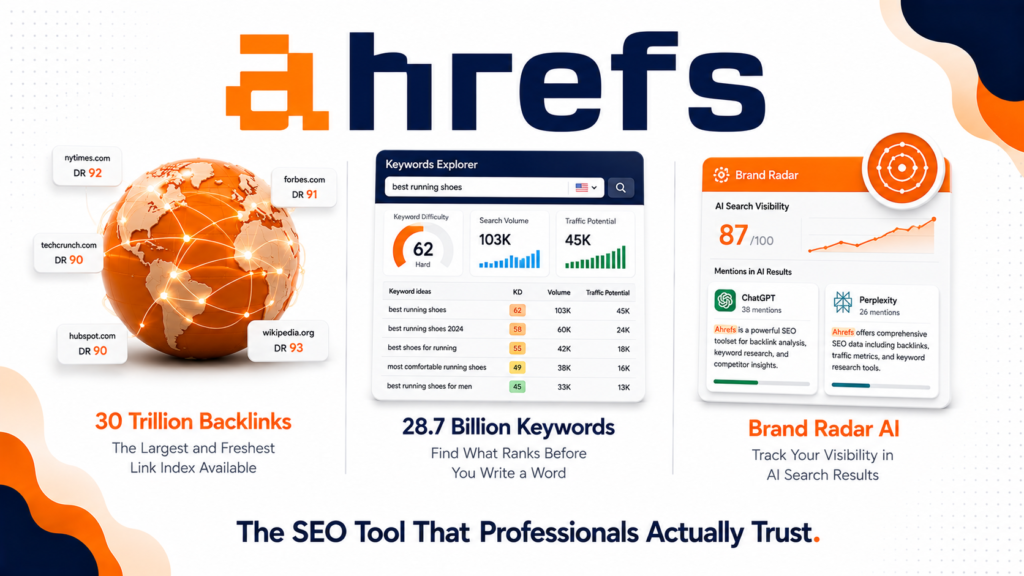
If you work in SEO, digital marketing, or content creation, you have almost certainly heard of Ahrefs. It is the tool that SEO professionals reference constantly in forums, YouTube videos, and agency recommendations. With a database of 28.7 billion keywords, over 30 trillion backlinks, and 44% of Fortune 500 marketers using it, Ahrefs has earned its reputation as the gold standard for SEO data.
However, Ahrefs is not cheap. A recent pricing update raised the Lite plan from $99 to $129 per month and Standard from $179 to $249 per month, representing a 30 to 39% increase overnight. Furthermore, the new credit-based crawl system on lower-tier plans surprised many existing users. Consequently, the question in 2026 is whether Ahrefs is still worth the premium over growing competition from Semrush, Surfer SEO, and more affordable alternatives.
This honest review covers the real pricing, the genuine strengths, the documented frustrations, and exactly who should and should not be paying for Ahrefs in 2026.
What Is Ahrefs?
Ahrefs is an all-in-one SEO platform founded in 2010 in Singapore by Dmytro Gerasimenko. It started as a backlink analysis tool and has evolved into a comprehensive suite covering keyword research, site audits, rank tracking, content analysis, competitive intelligence, and now AI visibility tracking through its Brand Radar feature.
What makes Ahrefs different from most SEO tools is its infrastructure. The company built its own web crawler, its own search engine (Yep), and its own supercomputer to power its data collection. Consequently, the scale and freshness of Ahrefs data consistently outperforms competitors in independent benchmarks, particularly for backlink data.
In 2026, Ahrefs added MCP (Model Context Protocol) server support, meaning you can connect Ahrefs directly to AI tools like Claude and ChatGPT to run SEO research through natural language commands without opening the Ahrefs dashboard. Furthermore, Brand Radar tracks your brand’s visibility in AI-generated search results from ChatGPT, Perplexity, and Google AI Overview, which is increasingly important as AI search captures a growing share of informational queries.
Ahrefs Pricing in 2026
Ahrefs has five tiers as of August 2026. All plans include one user by default, with additional users available at extra cost. Annual billing saves approximately 17% versus monthly. Here is the verified breakdown:
Starter: $29/month. Extremely limited access designed for casual users and website owners who want basic keyword research and backlink data without a full subscription. However, the Starter plan excludes Site Audit, Rank Tracker, Content Explorer, and historical data. Consequently, it is best treated as an extended trial rather than a working plan for serious SEO.
Lite: $129/month (or approximately $108/month annually). Includes 5 projects, 750 tracked keywords, 100,000 crawl credits per month, 6 months of historical data, Site Explorer, Keywords Explorer, Site Audit, Rank Tracker, and Content Explorer. Additional users cost $40/month each. This is the entry point for freelancers and small businesses doing regular SEO work.
Standard: $249/month (or approximately $208/month annually). Includes 20 projects, 2,000 tracked keywords, 500,000 crawl credits per month, unlimited credits for most features, 2 years of historical data, and advanced SERP features. Additional users cost $60/month each. This is the plan most SEO professionals and small agencies use, and the one most independent reviewers describe as the best balance of features and cost.
Advanced: $449/month (or approximately $374/month annually). Includes 50 projects, 5,000 tracked keywords, 1.5 million crawl credits per month, 5 years of historical data, and access to Looker Studio integration and advanced reporting. Additional users cost $80/month each. Designed for growing agencies and in-house SEO teams managing multiple large websites.
Enterprise: $1,499/month (or $14,990/year on annual billing). Includes 100 projects, unlimited tracked keywords, unlimited crawl credits, unlimited historical data, API access, single sign-on, and 3 users included. Designed for large agencies and enterprise marketing teams with complex, high-volume SEO operations.
Webmaster Tools (Free): A separate free offering for website owners that provides limited Site Explorer and Site Audit access exclusively for domains you verify ownership of. Good for monitoring your own site’s SEO health at no cost.
The real cost warning: Ahrefs prices per seat, meaning a team of three on Standard pays $249 plus $60 plus $60 equaling $369 per month. Furthermore, the credit-based crawl system on Lite plans means heavy site audit users can exhaust their monthly credits quickly. Consequently, teams running audits on large websites often find Lite insufficient and need to upgrade to Standard where most features have unlimited credits. Always calculate your team size and crawl volume needs before choosing a plan.
Key Features
Site Explorer
Site Explorer is Ahrefs’ most powerful and most praised feature. You enter any domain or URL and instantly see its organic search traffic, ranking keywords, backlink profile, referring domains, top pages, and content gaps compared to competitors.
The backlink data is where Ahrefs genuinely outperforms the competition. With a live index of over 30 trillion backlinks updated every 15 to 30 minutes, Ahrefs consistently discovers new links faster and more completely than Semrush or Moz in independent comparisons. Consequently, for link building campaigns, competitor backlink analysis, and understanding why a competitor ranks above you, Site Explorer delivers data that other tools frequently miss.
Furthermore, the organic traffic estimation feature, while not perfectly accurate (no third-party tool can be), is consistently rated as among the most reliable available. For competitive research and understanding the relative SEO strength of different players in your market, Site Explorer provides a level of insight that was previously only available to enterprises with large SEO budgets.
Keywords Explorer
Keywords Explorer gives you access to Ahrefs’ database of 28.7 billion keywords across 200 plus countries. For any keyword, you get search volume, keyword difficulty, clicks per search, traffic potential, and a SERP overview showing who currently ranks and what it would realistically take to rank there.
The keyword difficulty score is one of Ahrefs’ most trusted metrics among SEO professionals. Unlike some competitors whose difficulty scores feel disconnected from real-world ranking difficulty, Ahrefs’ KD scores are built on actual link analysis of the current top 10 results. Consequently, it provides a more grounded estimate of the competitive landscape for any given keyword.
Parent Topic clustering helps identify which keywords represent the same searcher intent, which is essential for avoiding keyword cannibalization and building topic authority efficiently. Furthermore, the Traffic Potential metric shows not just how much traffic the main keyword gets but how much traffic you could realistically capture by ranking for the full cluster of related keywords.
Site Audit
Ahrefs Site Audit crawls your website and identifies technical SEO issues including broken links, missing meta tags, duplicate content, slow pages, crawl errors, and dozens of other factors that affect your search rankings.
The audit interface is well-designed and actionable. Issues are prioritized by severity and accompanied by clear explanations and fix recommendations. Furthermore, the crawl comparison feature shows you which issues appeared or were resolved between consecutive crawls, making it easy to track progress over time.
However, the credit-based system on Lite plans limits how frequently and thoroughly you can audit large sites. On Standard and above, crawl credits are effectively unlimited for most practical uses. Consequently, the right plan choice depends significantly on how large your sites are and how frequently you want to audit them.
Rank Tracker
Rank Tracker monitors your keyword rankings across multiple search engines and devices over time. It shows visibility trends, SERP feature appearances (featured snippets, People Also Ask, image packs), and competitor ranking movements for the same keywords.
The Share of Voice metric gives you a sense of your overall visibility relative to competitors rather than focusing solely on individual keyword positions. This is particularly useful for reporting to clients or stakeholders who want to understand broader competitive positioning rather than individual ranking fluctuations.
Content Explorer
Content Explorer lets you search Ahrefs’ index of over 14 billion web pages by topic, domain, or keyword to find the highest-performing content in any niche. You can filter by organic traffic, referring domains, social shares, publication date, and domain rating to identify content that earns significant links and traffic.
For content strategy, Content Explorer is genuinely useful for identifying which angles and formats work best in your market, finding link-building opportunities on competitor content gaps, and discovering guest posting prospects. Furthermore, it surfaces content ideas that keyword research alone often misses.
Brand Radar (AI Visibility Tracking)
Brand Radar is Ahrefs’ newest significant feature in 2026. It tracks how often your brand appears in AI-generated search results from ChatGPT, Perplexity, Google AI Overview, and other AI search platforms. Furthermore, it shows which competitors appear more frequently than you in AI responses for your target topics.
This feature is increasingly important as AI search captures a growing share of informational queries. For businesses and marketers who want to understand their visibility in the AI search era rather than just traditional Google rankings, Brand Radar provides data that no other major SEO platform currently matches at scale. If you are focused on building a content strategy for AI search in 2026, our guide on how to start a blog with AI covers the content principles that help with both traditional and AI search visibility.
MCP Integration
Ahrefs’ MCP server lets you run keyword research, backlink analysis, and site audit queries through AI assistants including Claude and ChatGPT using plain language commands. Instead of opening the Ahrefs dashboard, you can ask your AI assistant to find keyword opportunities for a topic and get structured Ahrefs data returned directly in the conversation.
For marketers already using AI tools in their workflow, this integration eliminates tool switching for research tasks. Consequently, it positions Ahrefs well for the growing adoption of AI agent workflows in content and SEO operations.
What Ahrefs Does Well
Backlink data is industry-leading. No competing tool matches the scale, freshness, and accuracy of Ahrefs’ backlink index. For link building, competitive research, and understanding the true authority of any website, Ahrefs is the most trusted data source available. Consequently, serious SEO practitioners consistently choose Ahrefs as their primary tool even when they use other platforms for supplementary data.
Keyword difficulty scores are the most trusted in the industry. The link-based KD methodology produces scores that correlate more closely with real-world ranking difficulty than the algorithmic scores used by most competitors. For content strategy decisions about which keywords to target, Ahrefs provides the most reliable guidance available.
The educational ecosystem is extraordinary. Ahrefs has invested heavily in free educational resources including the Ahrefs Blog, Ahrefs Academy, YouTube channel, and built-in video tutorials for virtually every feature. Consequently, new users can learn SEO fundamentals and Ahrefs-specific workflows without paying for additional training or hiring consultants.
Brand Radar is a genuine 2026 differentiator. AI search visibility tracking is not available at this scale and quality anywhere else. For brands and agencies that want to understand and improve their presence in AI-generated search results, this feature alone justifies the premium over competitors.
MCP integration future-proofs the platform. Connecting Ahrefs data to AI workflows through the MCP server positions it well for the next phase of marketing technology adoption. Teams building AI-powered content and SEO workflows will find Ahrefs more natively integrated than competing platforms.
Where Ahrefs Falls Short
The pricing increase frustrated many users. The 30 to 39% price increase on Lite and Standard plans was significant and not accompanied by proportionally significant new features. Consequently, budget-conscious users who were previously comfortable with $99 per month now face $129 per month for the same access, and many have explored alternatives as a result.
No free trial is a meaningful barrier. Unlike Semrush which offers a 7-day free trial and Moz which offers a 30-day trial, Ahrefs provides no free trial on paid plans. The Webmaster Tools free plan only works for domains you own. Consequently, new users must commit to at least $129 without being able to fully evaluate whether the data quality justifies the cost for their specific use case.
The credit system on Lite plans confuses users. Many users on the Lite plan discover their crawl credits are depleted before month-end, particularly when running site audits on larger websites. The credit system is not intuitive, and the limits are not prominently communicated during signup. Consequently, the gap between what the Lite plan costs and what it practically delivers for real SEO work is larger than the pricing page suggests.
No mobile app. Ahrefs has no native mobile application. All access requires a browser. For SEO professionals who want to check rankings or review data on the go, this is a meaningful limitation that competitors including Semrush have addressed with mobile apps.
Interface can overwhelm beginners. The data density and feature breadth of Ahrefs is genuinely intimidating for users new to SEO tools. While the educational resources help, the learning curve to use Ahrefs effectively is steeper than simpler tools like Ubersuggest or Moz. Consequently, small businesses without dedicated SEO staff sometimes find the tool underutilized relative to its cost.
Ahrefs vs Competitors
Ahrefs vs Semrush: Semrush is Ahrefs’ primary competitor and the most direct comparison most buyers make. Semrush offers broader marketing capabilities including PPC research, social media analytics, and content marketing tools alongside SEO features. It also offers a free trial that Ahrefs does not. However, Ahrefs’ backlink data is generally rated as more accurate and comprehensive, and its keyword difficulty scores are more trusted among SEO professionals. Furthermore, Ahrefs’ Brand Radar for AI search visibility has no equivalent in Semrush. Therefore, choose Ahrefs if backlink data quality and AI visibility tracking are priorities, and Semrush if you need broader marketing data or want a free trial before committing.
Ahrefs vs Surfer SEO: Surfer SEO focuses specifically on on-page content optimization rather than the full SEO research suite that Ahrefs provides. Surfer tells you how to optimize an article you are writing. Ahrefs tells you what topics to write about, which keywords to target, and how to build the links needed to rank. Consequently, the two tools are highly complementary rather than competitive. Many serious content teams use both. Read our full Surfer SEO and Writesonic review to understand how they work together for a complete content and SEO workflow.
Ahrefs vs Moz Pro: Moz Pro starts at $99 per month, making it the most affordable major SEO suite available. It covers keyword research, rank tracking, site audits, and backlink analysis with a well-designed interface suited to beginners. However, Moz’s backlink data is smaller and less frequently updated than Ahrefs, and its keyword database is narrower. Therefore, beginners and small businesses with budget constraints should start with Moz, while professionals who need the most comprehensive data available invest in Ahrefs.
Ahrefs vs Ubersuggest: Ubersuggest offers lifetime plans starting at $120 and monthly plans at $29, making it significantly cheaper than Ahrefs. It covers basic keyword research, site audits, and rank tracking well enough for solo bloggers and very small businesses. However, the data quality, database size, and feature depth fall significantly short of Ahrefs for professional SEO work. Therefore, Ubersuggest works for personal projects and learning SEO fundamentals, while Ahrefs is appropriate for businesses where SEO performance directly drives meaningful revenue.
Who Should Use Ahrefs?
Ahrefs is the right choice if you are:
- An SEO professional, agency, or in-house SEO team that needs the most comprehensive backlink and keyword data available
- A content marketer building a long-term organic growth strategy where data quality directly affects strategic decisions
- A business where SEO performance drives significant revenue and the cost of suboptimal keyword or backlink decisions exceeds the Ahrefs subscription cost
- A team adopting AI-powered marketing workflows that want native MCP integration and AI search visibility tracking through Brand Radar
- An established blogger or content creator investing seriously in growing organic traffic who has outgrown free tools
However, Ahrefs may not be the right fit if you are:
- A beginner or small business owner who needs to learn SEO basics before investing in premium data tools
- A freelancer or small team on a tight budget where the $129 to $249 per month price point is difficult to justify relative to free or cheaper alternatives
- A business that needs a free trial before committing, since Ahrefs does not offer one on paid plans
- A team that needs broader marketing capabilities including PPC data, social analytics, and content marketing tools in the same platform, where Semrush is more comprehensive
Ahrefs Review: Final Verdict
Ahrefs remains the most trusted and most comprehensive SEO data platform available in 2026. The backlink index quality, keyword research depth, Brand Radar for AI search visibility, and MCP integration make it genuinely difficult to replace for professional SEO work.
However, the pricing increase of 2025 and the credit-based system on Lite plans have made the value equation more complicated than it was previously. The Standard plan at $249 per month remains the best balance of features and unlimited credits for most professional users, but that is a meaningful monthly commitment that requires real SEO results to justify.
The honest recommendation: if SEO is a primary growth channel for your business and you have the budget for Standard, Ahrefs is worth every dollar. If you are budget-conscious, start with Moz Pro at $99 per month or explore Semrush’s free trial before committing to Ahrefs’ premium pricing.
Overall rating: 4.5 out of 5
Ahrefs is the closest thing to an industry standard in SEO tools. The pricing requires serious consideration, but the data quality consistently delivers results that justify the investment for the right user.