The Mangools review 2026 that most sites publish gets one thing consistently wrong. They compare it to Ahrefs and Semrush on features and conclude it loses. That framing misses the point entirely.
Mangools was never trying to beat Ahrefs on backlink database size or Semrush on PPC data. It was built to give bloggers, affiliate marketers, freelancers, and small businesses 80% of what they actually need from an SEO toolkit at roughly 25% of the price. For the audience it was designed to serve, it does that exceptionally well.
The real question in 2026 is not whether Mangools beats the enterprise tools. The real question is whether it beats the spreadsheet. For most small business owners and independent creators who are currently doing their keyword research in Google’s free Keyword Planner and tracking rankings manually, the answer is clearly yes, and the $29.90 per month investment pays back faster than most people expect.
This is what that investment actually buys you, where it works, and where the limits become real.
What Mangools Is and Is Not
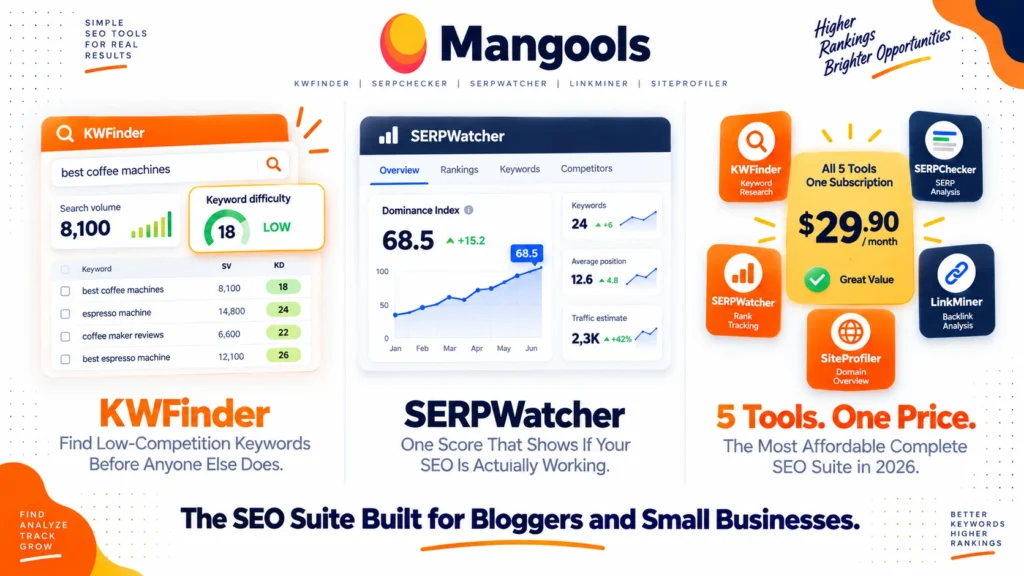
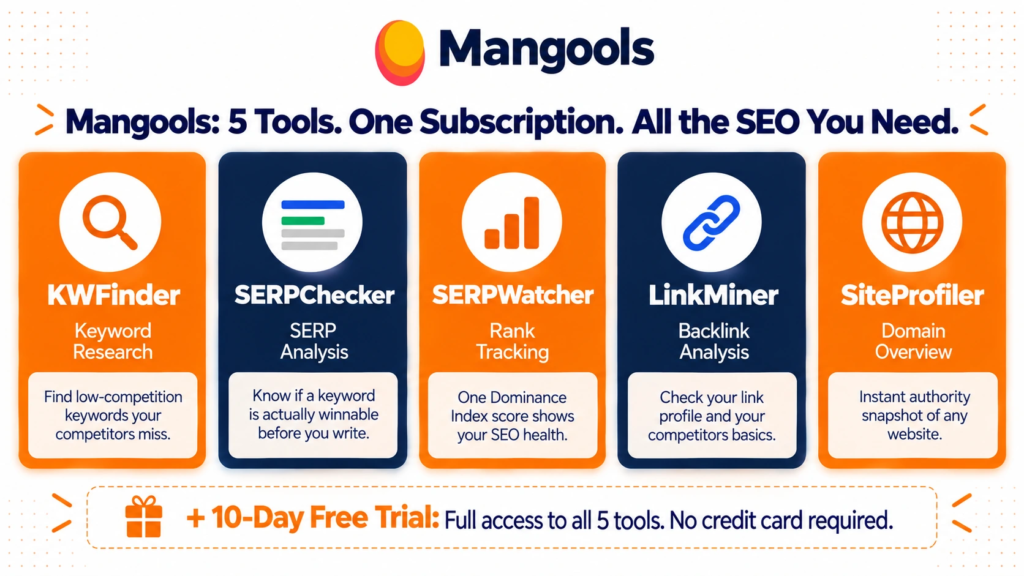
Mangools is a suite of five SEO tools bundled under one subscription. Every plan includes every tool. There is no upselling, no credit system, and no features hidden behind add-ons. You pay one price and you get the whole thing.
The five tools are:
KWFinder for keyword research. This is the tool Mangools is best known for and the one that earns the most consistent praise in independent reviews. Its keyword difficulty score is widely rated as one of the most accurate in the market, particularly for identifying long-tail keywords that larger tools tend to overvalue or undervalue.
SERPChecker for SERP analysis. You enter a keyword and see the top 10 results with 45 plus SEO metrics for each page, including Domain Authority, Page Authority, citation flow, trust flow, link profile strength, and social signals. This lets you assess whether a keyword is actually winnable before investing in content.
SERPWatcher for rank tracking. Daily position monitoring with local and device-level granularity. The Dominance Index metric, which weights your rankings by position and search volume to give you one number representing your overall keyword performance, is useful for tracking progress without wading through individual keyword data.
LinkMiner for backlink analysis. The backlink database is smaller than Ahrefs or Semrush. This is a real limitation and not one to minimize. However, for checking whether your own site and your primary competitors have significant link profiles worth understanding, LinkMiner covers the essentials at the price point.
SiteProfiler for domain analysis. Enter any domain and get a summary of its authority metrics, top content, competitor landscape, and keyword profile. Most useful for quick competitive intelligence rather than deep analysis.
Pricing in 2026: What You Actually Pay
Mangools has three plans. All plans include all five tools. The tiers differ on usage limits, not features.
Basic: $29.90 per month on annual billing, $49 per month on monthly billing. Includes 1 user seat, 100 keyword lookups per day, 200 tracked keywords per account, 200 backlink rows per search, and 20 SiteProfiler lookups per day.
Premium: $44.90 per month on annual billing, $69 per month on monthly billing. Includes 3 user seats, unlimited keyword lookups per day, 700 tracked keywords, 700 backlink rows per search, and 70 SiteProfiler lookups per day. This is the plan most small agencies and freelancers with multiple client sites land on.
Agency: $89.90 per month on annual billing, $129 per month on monthly billing. Includes 10 user seats, unlimited keyword lookups, 1,500 tracked keywords, 1,500 backlink rows, and 150 SiteProfiler lookups per day.
Free access: 3 searches per day across tools with a registered account. Genuinely useful for occasional checks but insufficient for any real ongoing SEO work.
10-day free trial: Full access to all features on all plans. No credit card required. This is the right way to evaluate Mangools before committing.
Annual billing saves 35 to 39% depending on the plan. If you are confident in using the tool after the trial, annual billing on Basic at $29.90 per month is one of the most cost-efficient entries into a full SEO toolkit available in 2026.
The non-obvious pricing consideration: The Basic plan’s 200-keyword tracking limit is the constraint that most commonly forces upgrades. If you manage one website and focus on a tight niche, 200 tracked keywords is enough. If you manage multiple sites or a site targeting a broad topic range, you will hit this limit sooner than you expect and need Premium at $44.90 per month.
KWFinder: Where Mangools Actually Earns Its Reputation
KWFinder’s keyword difficulty score deserves specific attention because it is the feature that most frequently appears in reviews as a genuine differentiator.
When you search a keyword, Mangools shows you a difficulty score from 0 to 100 alongside the top ranking pages with their link profiles and authority metrics. The difficulty score is calculated by analyzing the actual link profile of the current top 10 results rather than using a proxy metric or a simplified algorithm.
The practical result: KWFinder surfaces genuinely winnable keywords that other tools flag as harder than they are. Multiple independent SEOs in G2 reviews note that cross-checking between Google’s Keyword Planner and KWFinder produces very small discrepancies on search volume data, which is unusual. Most third-party keyword tools deviate more noticeably from Google’s own data.
The long-tail keyword research workflow is where KWFinder is strongest. You enter a seed keyword and the tool surfaces related terms, question-format keywords, and autocomplete suggestions with difficulty scores and search volume for each. For bloggers and affiliate site builders who want to identify a cluster of low-competition keywords around a topic before investing in content, this is the most efficient implementation of that workflow available at Mangools’ price point.
Where it falls short: KWFinder’s keyword database is smaller than Ahrefs or Semrush. For very niche or emerging topic areas, particularly outside English-language markets, the data thins out faster than enterprise alternatives. If your SEO work is primarily non-English or requires extremely broad keyword discovery across multiple languages, this limit becomes relevant.
SERPChecker: The Tool Most Users Underuse
Most Mangools users focus on KWFinder and use SERPChecker as an afterthought. This is a mistake.
SERPChecker’s value is not in the metrics themselves. The 45 plus metrics it shows for each ranking page are useful but not dramatically different from what competing tools provide. The value is in the workflow it enables.
When you identify a keyword in KWFinder and see a low difficulty score, SERPChecker is where you verify whether that score reflects reality. You look at the actual pages ranking for that keyword: How many of them have substantial backlink profiles? Are they exact-match topical pages or are they broad authority sites ranking on domain strength? Is the content thin or comprehensive?
This verification step is where most SEO decisions get made or unmade. A keyword might show a difficulty score of 28 in KWFinder but have the top three results coming from sites with Domain Authority above 70 whose homepage is ranking, not a specific topical page. That is a different competitive situation than the number alone suggests.
The non-obvious insight: the combination of KWFinder for discovery and SERPChecker for verification covers 80% of the competitive analysis workflow that most small business SEOs actually need. You do not need Ahrefs‘ full backlink explorer to decide whether to target a keyword. You need a clear picture of whether the current top 10 is beatable. SERPChecker gives you that.
SERPWatcher: Rank Tracking That Stays Out of Your Way
SERPWatcher tracks daily keyword positions with local and device segmentation. The interface is clean and the setup is fast. You add keywords, set your target location and device, and daily updates run automatically.
The Dominance Index is the feature worth understanding. Instead of showing you a list of keyword positions that you then have to interpret, the Dominance Index combines your rankings with the search volumes of those keywords into a single score that represents your estimated share of the available traffic. When the score goes up, your overall SEO position is improving. When it goes down, something needs attention.
This single-number health metric is particularly useful for small business owners who do not have time to analyze individual keyword movements daily. You can check the Dominance Index weekly and know immediately whether your SEO effort is moving in the right direction.
The documented reliability issue: One G2 reviewer reported losing access to daily keyword updates on their Premium plan for seven months after Mangools changed which feature tier it required. The feature was eventually reinstated but the timeline for resolution was slow. This is worth knowing. Mangools has a smaller support infrastructure than enterprise tools, and feature access disputes can take longer to resolve than they would at Ahrefs or Semrush.
LinkMiner: Honest Assessment of Its Limits
LinkMiner is the weakest of the five Mangools tools relative to competing products at the same price point, and the reviews reflect this consistently.
The backlink database is smaller than Ahrefs, Semrush, or Majestic. For checking your own site’s backlink profile at a basic level, or for identifying the most important backlinks your primary competitors have, LinkMiner is functional. For serious link building campaign research, prospecting, or analyzing link velocity on competitive targets, the smaller database means you are working with incomplete data.
The practical implication: if backlink analysis is a significant part of your weekly SEO workflow, LinkMiner is not a full replacement for a dedicated backlink tool. If backlinks are something you check occasionally rather than build systematically, LinkMiner covers those occasional checks adequately.
For content creators and bloggers whose primary SEO work is keyword research and rank tracking rather than link building, this limitation is largely irrelevant. The tools you use most are the ones that matter most.
Who Gets Real Value from Mangools
The G2 and Capterra review pattern is consistent: users who get real value from Mangools fall into recognizable profiles.
Bloggers and affiliate site builders who focus on identifying low-competition keywords in defined niches before writing. KWFinder and SERPChecker handle this workflow excellently. The price point means the tool pays back from a single affiliate commission or a modest traffic increase rather than requiring sustained ROI justification.
Freelance SEOs and small agencies managing 3 to 10 client sites who need professional keyword research and rank tracking without enterprise pricing. Premium at $44.90 per month with 3 seats and unlimited keyword lookups covers most boutique agency workflows at a cost that keeps margins healthy.
Small business owners doing their own SEO who have been relying on Google’s free tools and manual tracking. The jump from the free Keyword Planner to KWFinder is significant in terms of decision quality. The jump from manual rank checking to SERPWatcher eliminates a genuinely tedious weekly task.
In-house marketers at SMBs who need to demonstrate SEO progress to leadership without enterprise software budget approval. The 10-day free trial with no credit card required lets you build a case with real data before asking for budget.
Who Should Look Elsewhere
Large agencies and enterprise teams that need unlimited lookups, deep technical site auditing, extensive backlink data, API access, and CRM integrations should evaluate Ahrefs Standard at $208 per month or Semrush Guru at $208 per month for the capabilities Mangools does not provide. The price difference is real but so is the capability gap.
Technical SEOs who need crawl-based site auditing, log file analysis, Core Web Vitals monitoring, and structured data validation. Mangools has no site audit tool. Screaming Frog, Sitebulb, or the site audit modules in Ahrefs and Semrush cover these needs. Mangools does not.
PPC advertisers who need to research paid search competition, CPC data, and ad copy analysis alongside organic SEO. Mangools has no PPC features. Semrush’s advertising intelligence capabilities, for example, have no equivalent in the Mangools suite.
Non-English markets where Mangools’ database coverage thins. If your primary SEO targets are in languages other than English, verify data quality for your specific target markets during the 10-day trial before committing.
Mangools vs Ahrefs vs Semrush: The Honest Comparison
This comparison gets muddied by reviewers who try to be comprehensive. The honest version is simpler.
Ahrefs has the strongest backlink database. Its keyword research is excellent. Its interface is clean. It has no free trial and starts at $129 per month on annual billing. If you need the best backlink data available, Ahrefs is the answer. Read our full Ahrefs review.
Semrush has the broadest marketing data including PPC, social media, content marketing, and brand monitoring alongside SEO. It offers a 7-day free trial and starts at $117 per month annually. If you need the widest marketing intelligence coverage in one platform, Semrush wins. Read our full Semrush review.
Mangools does keyword research and rank tracking better than anything else at its price point. It has a 10-day free trial and starts at $29.90 per month annually. If your primary SEO workflow is keyword research, rank monitoring, and basic competitive analysis, and you do not need the features above, Mangools is the most cost-efficient choice by a significant margin.
The choice is not about which tool is best in absolute terms. It is about which tool covers your actual workflow at the price your budget supports.
The Verdict
Mangools is not trying to compete with Ahrefs and Semrush on every dimension. It is trying to serve the blogger, the freelancer, and the small business owner who needs accurate keyword data, reliable rank tracking, and a tool they can actually use without a learning curve, at a price that does not require justifying to a finance team.
On those terms, it succeeds. KWFinder’s difficulty scores are accurate. SERPWatcher’s Dominance Index makes progress trackable. The interface is genuinely the cleanest in SEO software. And $29.90 per month for all five tools is the most cost-efficient entry into a professional SEO toolkit available in 2026.
The limits are real: smaller backlink database, no site audit, no PPC data, no technical SEO tools, and a support infrastructure that is less responsive than enterprise alternatives when things go wrong. Know the limits going in and they will not surprise you.
Start the 10-day free trial. Run your real keyword targets through KWFinder. Check your actual competitors in SERPChecker. Track your live rankings in SERPWatcher for a week. If those three things solve the problems you are currently solving manually or not solving at all, the $29.90 monthly investment is justified from the first month.
Overall rating: 4.5 out of 5
The strongest SEO toolkit for its price range available in 2026. The right tool for the right user. Not a replacement for enterprise SEO platforms for teams that genuinely need them.