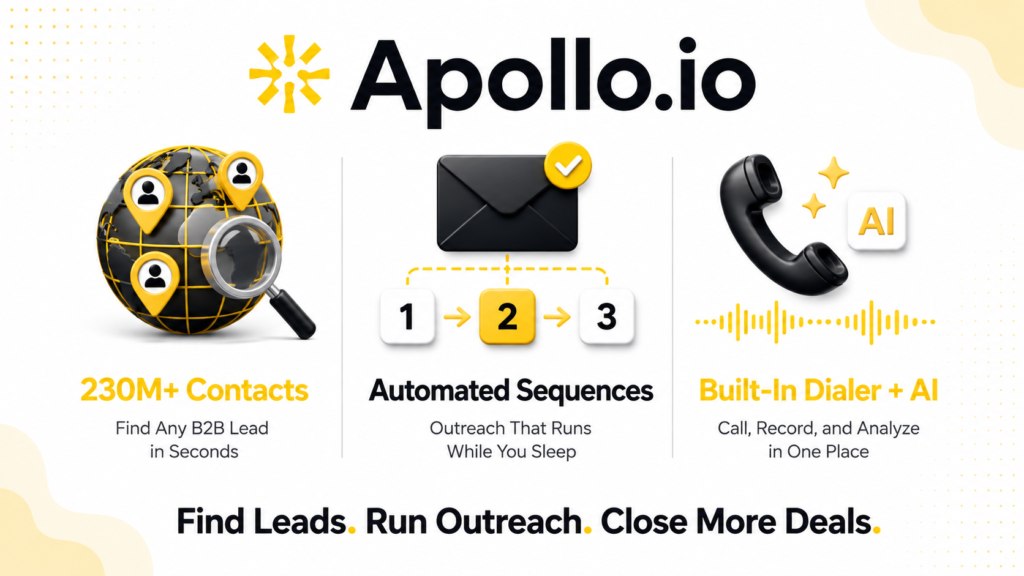
If you run B2B sales outreach, you have almost certainly heard of Apollo.io. With a 230 million plus contact database, built-in email sequences, a phone dialer, CRM integrations, and an AI assistant, all under one roof, Apollo positions itself as the all-in-one platform for finding leads and closing deals.
Furthermore, with a 4.7 out of 5 rating across over 9,400 reviews on G2, it is one of the most widely trusted sales tools in the mid-market segment. However, the gap between Apollo’s marketing claims and real-world performance is worth understanding before you commit.
This honest review covers real pricing, actual data accuracy, the hidden costs most articles skip, and who Apollo actually works best for in 2026.
What Is Apollo.io?
Apollo.io is a B2B sales intelligence and engagement platform. It combines four core capabilities in one subscription: a contact database for finding leads, data enrichment for verifying and updating contact information, email sequencing for automated outreach campaigns, and a phone dialer for direct calling.
The idea is straightforward. Instead of paying separately for a data provider like ZoomInfo, a sequencing tool like Outreach, and a dialer like Aircall, Apollo bundles all of these into one platform at a fraction of the combined cost. Consequently, it is particularly attractive to startups and growing sales teams that need to consolidate tools and reduce software spend.
In 2026, Apollo made the most noise with improvements to its AI features, particularly intent data surfacing and AI-generated personalized email copy. Furthermore, its Chrome extension lets sales reps prospect directly from LinkedIn, Gmail, Salesforce, HubSpot, and company websites without leaving their browser.
Apollo.io Pricing in 2026
Apollo uses a credit-based pricing system alongside per-seat plan pricing. Understanding both is essential before signing up. Here is the verified breakdown as of July 2026:
Free: $0 forever. Includes 100 credits per month, full database access with basic filters, 2 active sequences, Chrome extension, and AI assistant access. Furthermore, this is one of the most generous free tiers in B2B SaaS. However, the free plan only supports Gmail for email sending. Microsoft and other email providers require a paid plan.
Basic: $49/user/month on annual billing, or approximately $59/month on monthly billing. Includes roughly 30,000 credits annually, unlimited sequences, CRM integrations, and expanded database filters. This is the entry point for teams ready to scale outbound prospecting.
Professional: $79/user/month on annual billing, or approximately $99/month on monthly billing. Adds A/B testing for email sequences, a US dialer with call recording, AI-powered call insights, and advanced analytics. This is the tier most active outbound teams need.
Organization: $119/user/month on annual billing, or approximately $149/month on monthly billing. Requires a minimum of 3 users. Adds international dialer, custom LLM API access, advanced admin controls, and higher credit limits.
The real cost warning: Apollo’s sticker price is only half the story. A few factors drive up actual monthly spend significantly.
First, pricing is per seat. A 10-person team on Basic costs $490/month, not $49/month. Furthermore, credits reset monthly with no rollover. Unused credits are lost. Mobile phone number credits cost 8 times more than email credits, which surprises many users doing phone-heavy outreach. Finally, annual contracts often include 5 to 10% price escalation clauses. Therefore, always review your contract carefully before signing.
Real spend for active outbound teams typically lands between $150 and $400 per user per month once credit usage and potential overages are factored in.
14-day free trial is available on paid plans. No credit card required to test the free tier.
Key Features
Contact Database and Prospecting
Apollo’s database contains over 230 million B2B contacts. Furthermore, 65 plus advanced filters let you search by job title, company size, industry, technology stack, funding stage, location, and many more criteria. The result is a highly targeted prospect list built around your ideal customer profile.
The Chrome extension is one of Apollo’s most praised features. It overlays contact information directly on LinkedIn profiles, company websites, and Gmail threads. Consequently, sales reps can find, verify, and add contacts to sequences without ever leaving the page they are browsing.
However, real-world data accuracy is lower than Apollo’s marketing claims suggest. Independent testing shows approximately 65 to 73% email deliverability on contact data, with stronger accuracy for US-based contacts at around 73% compared to international contacts at approximately 58%. Phone number accuracy is lower still, with roughly 40% connect rates reported by users running phone-heavy campaigns. Therefore, always verify contact data for high-stakes campaigns rather than trusting raw exports.
Email Sequencing
Apollo’s email sequencer lets you build multi-step outreach campaigns combining email, phone calls, LinkedIn touchpoints, and manual tasks. Furthermore, AI-generated email personalization on paid plans analyzes prospect data and suggests personalized opening lines and talking points for each contact.
However, Apollo discontinued its email warmup feature in 2024. The replacement, called Inbox Ramp Up, only paces sending volume rather than building sender reputation. Consequently, teams running high-volume cold outreach should pair Apollo with a dedicated email deliverability tool to protect inbox placement rates.
Email credits are governed by a fair use policy. Most plans cap you at approximately 250 emails per mailbox per day. Push past that and sending gets throttled. Furthermore, unlimited email credits on higher plans are capped at 10,000 per month for verified corporate domains and 100 per month for non-corporate domains.
AI Features
2026 has been Apollo’s biggest year for AI improvements. The AI assistant generates personalized email drafts based on prospect data. Intent data signals surface accounts showing buying behavior such as recent funding, technology changes, and job postings. Furthermore, AI call summarization on Professional plans automatically transcribes and summarizes calls with key action items.
Intent data quality is solid for US markets. However, it is less reliable for international prospecting or niche verticals where data signals are thinner. Consequently, teams with heavy international pipelines should verify intent data quality for their specific markets before relying on it.
CRM Integration
Apollo integrates directly with Salesforce, HubSpot, Pipedrive, and other major CRMs. Two-way sync keeps your Apollo prospecting data and your CRM contact records aligned automatically. Furthermore, the integration is generally rated as reliable by users, with deal creation, contact updates, and activity logging all syncing correctly on properly configured setups.
However, syncing contacts outside Apollo consumes export credits, which are capped per plan. Therefore, high-volume CRM sync operations can consume credits faster than expected.
Phone Dialer
Apollo includes a built-in phone dialer on Professional plans and above. The US dialer with call recording is available on Professional. The international dialer requires the Organization plan. Furthermore, AI call insights automatically surface key moments, objection patterns, and follow-up actions from recorded calls.
For teams that combine email and phone outreach, having the dialer inside the same platform as the contact database and sequencer eliminates significant workflow friction. However, for teams that do primarily phone-based outreach at high volume, specialist dialers like Aircall or Ringover offer more advanced features and better call quality.
What Apollo.io Does Well
The all-in-one value proposition is real. No other platform at $49 to $119 per user per month gives you a contact database, email sequences, a dialer, intent data, CRM integrations, and an AI assistant under one roof. The consolidation value significantly reduces total software costs for growing sales teams.
The free tier is genuinely one of the best in B2B SaaS. Full database access, two sequences, the Chrome extension, and AI assistant access on the free plan is extraordinary. Consequently, small teams and individual sellers can run meaningful prospecting operations without paying anything.
The Chrome extension is consistently praised. Overlaying contact data directly on LinkedIn and company websites dramatically speeds up the prospecting workflow. Furthermore, adding contacts to sequences directly from the extension eliminates the need to switch between tabs constantly.
G2 reputation is among the strongest in the category. A 4.7 out of 5 rating across over 9,400 reviews reflects a large, mostly satisfied user base. The peer community, learning resources, and agency support network are all substantial.
AI improvements in 2026 are meaningful. Intent data surfacing and AI-personalized email generation have both improved noticeably. Consequently, teams using these features report higher response rates compared to generic template-based outreach.
Where Apollo.io Falls Short
Data accuracy is lower than claimed. Apollo markets 97% email accuracy. Real-world testing shows 65 to 73% deliverability. Furthermore, international data accuracy drops to approximately 58%. Therefore, teams should always validate contact data for high-stakes campaigns rather than trusting raw database exports.
The credit system is confusing and expensive at scale. Mobile phone credits cost 8 times more than email credits. Credits do not roll over. Export limits consume credits differently from search credits. Consequently, many teams hit unexpected credit walls mid-campaign and face overage costs.
Per-seat pricing makes team scaling expensive. A 10-person team on Basic costs $490/month. A 10-person team on Professional costs $790/month. Therefore, costs compound quickly as teams grow.
No email warmup. Apollo discontinued its email warmup feature in 2024. The current Inbox Ramp Up replacement only manages volume, not deliverability. Consequently, cold email senders without external warmup tools risk inbox placement issues at scale.
Individual features are good but not best-in-class. Apollo does many things well. However, specialist tools typically outperform it in each individual category. Pure data providers like ZoomInfo offer better data quality. Pure sequencers like Outreach offer more advanced workflows. Pure dialers like Aircall offer better call quality. Therefore, teams with very specific needs may find that a best-of-breed stack outperforms Apollo despite the higher cost and complexity.
Apollo.io vs Competitors
Apollo vs ZoomInfo: ZoomInfo offers superior data quality and depth, particularly for enterprise contacts and international markets. However, ZoomInfo typically costs 3 to 5 times more and requires a separate engagement platform. Consequently, Apollo wins on consolidated value for teams that do not need enterprise-grade data accuracy.
Apollo vs HubSpot Sales Hub: HubSpot offers deeper CRM functionality, better reporting, and a more polished user experience. However, it lacks a built-in contact database and its sequencing features are less sophisticated than Apollo’s. Therefore, Apollo wins for outbound-heavy teams while HubSpot wins for inbound-focused businesses.
Apollo vs Lusha: Lusha is simpler and better suited for solo sellers who need quick contact lookups without a full outreach platform. However, Apollo wins on feature depth, AI capabilities, and automation for teams running systematic outbound campaigns.
Apollo vs Clay: Clay offers superior data enrichment by aggregating dozens of data providers, which produces higher accuracy than Apollo alone. However, Clay requires more technical setup and does not include a built-in sequencer or dialer. Therefore, Clay suits technically sophisticated teams that prioritize data accuracy while Apollo suits teams that want a simpler all-in-one setup.
Who Should Use Apollo.io?
Apollo.io is the right choice if you are:
- A B2B startup or growing sales team that wants to consolidate prospecting, outreach, and dialing into one platform
- A sales team that primarily targets US-based contacts where data accuracy is strongest
- A small team that wants to test B2B outbound prospecting without upfront investment using the free tier
- A sales operation that needs a balance of database access, sequencing, and calling without a large software budget
- A team that values a strong peer community, extensive learning resources, and a platform with proven track record
However, Apollo may not be the right fit if you are:
- A team with heavy international prospecting needs where data accuracy drops significantly
- A phone-heavy outbound operation where mobile credit costs will compound quickly
- A business that needs the most advanced automation workflows available, where dedicated sequencers like Outreach perform better
- A team where data accuracy is critical and cannot afford the 25 to 35% contact error rate in real-world testing
- A large team where per-seat pricing makes total cost difficult to justify
Apollo.io Review: Final Verdict
Apollo.io delivers on its core promise of consolidating prospecting, outreach, and enrichment into one accessible platform at transparent pricing. For startups and mid-market sales teams that want to reduce tool complexity and cut costs, the value proposition is genuine and well-supported by its strong G2 reputation.
However, the gap between Apollo’s marketing claims and real-world performance is real. Data accuracy, the confusing credit system, and the discontinued email warmup are limitations that require clear-eyed planning before committing.
If you are looking for the best single tool to run B2B outbound prospecting and email outreach without an enterprise budget, Apollo.io is the strongest option in its price range in 2026. Just go in with realistic expectations about data accuracy and total cost.
Overall rating: 4.2 out of 5
Apollo.io is functional, affordable, and consistently good enough for most B2B teams. It is rarely exceptional at any single task, but no other tool at this price point does as many things as well.