ActiveCampaign has built a reputation as the automation platform that grows with your business. Over 180,000 customers in 170+ countries use it to run email campaigns, automate customer journeys, manage sales pipelines, and send targeted SMS and WhatsApp messages from one platform.
However, ActiveCampaign starts cheap and scales steeply. The Starter plan opens at $15/month, but contact-based billing and aggressive feature gating push serious teams toward the $145/month or higher tiers quickly. Furthermore, it has a steep learning curve that intimidates beginners.
So who is ActiveCampaign actually for in 2026? And is it worth the price? This honest review gives you the full picture.
What Is ActiveCampaign?
ActiveCampaign is a marketing automation and CRM platform that sits between simple email tools like Mailchimp and full enterprise marketing clouds like HubSpot or Marketo. It offers more sophisticated automation, segmentation, and CRM functionality than lightweight email platforms, while remaining more accessible and affordable than enterprise suites for most small to mid-market businesses.
In 2026, ActiveCampaign has reorganized around three primary product lines: Email Marketing, Sales CRM, and Cross-Channel. Furthermore, it has adopted an “autonomous marketing” approach with its Active Intelligence AI system, which helps plan, build, and optimize campaigns automatically.
The platform powers billions of automated interactions every week. Consequently, it is one of the most widely adopted marketing automation tools among small and mid-size businesses globally.
ActiveCampaign Pricing in 2026
ActiveCampaign uses contact-based pricing. You pay based on how many contacts are in your account, and prices scale significantly as your list grows. Here is the verified breakdown as of July 2026:
Starter: From $15/month (annual billing) for 1,000 contacts. Includes email marketing, basic automations, and 900+ integrations. However, the Starter plan is genuinely limited for B2B use. Lead scoring, predictive sending, and advanced testing are all locked behind higher tiers. Furthermore, you get limited automation steps per flow.
Plus: From $49/month (annual billing) for 1,000 contacts. Adds landing pages, advanced automations, SMS marketing, and CRM with deal pipelines. This is where ActiveCampaign starts showing its real power for marketing automation. Moreover, the Plus plan includes Facebook Custom Audiences integration for retargeting.
Pro: From $79/month (annual billing) for 1,000 contacts. Adds predictive sending, split automations, site messaging, and attribution reporting. This is the tier serious B2B teams typically need. However, at scale these prices climb steeply. At 10,000 contacts, Pro runs approximately $145/month.
Enterprise: Custom pricing. Adds custom reporting, single sign-on, dedicated support, and custom domains. Designed for large organizations with complex compliance and customization requirements.
WhatsApp plans: WhatsApp Core starts at $99/month for 1,000 WhatsApp contacts. Cross-Channel Plus (email plus WhatsApp combined) starts from $112/month for 1,000 email and 5,000 WhatsApp contacts.
14-day free trial: Available on all plans. No credit card required to start. Furthermore, nonprofits receive a 20% discount on all plans.
The honest pricing verdict: ActiveCampaign starts cheap but the pricing curve is steep. Consequently, early-stage businesses on tight budgets often find themselves upgrading faster than expected as their needs grow. Always calculate your projected cost at 5,000 and 10,000 contacts before committing annually.
Key Features
Marketing Automation Builder
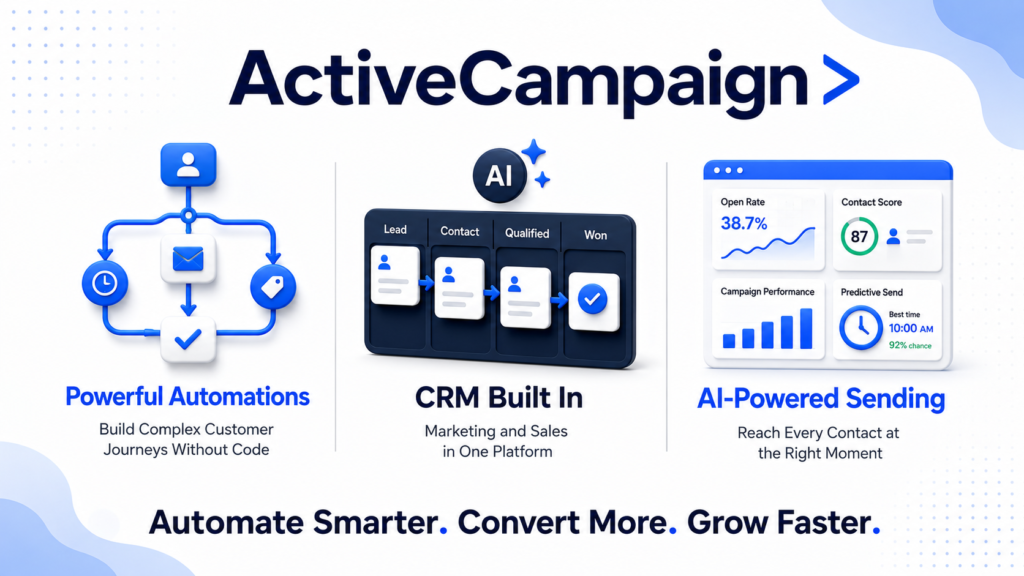
This is the genuine reason most people choose ActiveCampaign. The visual automation builder is the most powerful in the mid-market segment. You can build complex multi-step workflows triggered by any combination of subscriber behavior, CRM events, purchase history, website visits, and custom fields.
Furthermore, the automation builder supports if/else branching, wait steps, goal tracking, and split testing entire automation paths. This level of sophistication typically requires enterprise platforms costing 5 to 10 times more. Consequently, ActiveCampaign offers genuine enterprise-grade automation at SMB pricing.
A typical B2B automation might look like this: a prospect fills out a contact form, gets scored based on company size and industry, receives a personalized nurture sequence tailored to their industry, gets assigned to a sales rep when their score reaches a threshold, and triggers a CRM task for follow-up. All of this runs automatically without human intervention.
Active Intelligence AI System
In 2026, ActiveCampaign introduced Active Intelligence, its AI-powered automation system. It includes AI agents that help plan campaign strategies, build automation flows from plain-language descriptions, and optimize send times based on individual subscriber behavior.
Furthermore, predictive sending on Pro and Enterprise plans analyzes each contact’s historical open patterns and delivers emails at the moment each individual is most likely to open. This feature alone measurably improves open rates for high-volume senders. However, it is locked behind the Pro plan, which is a significant limitation for Starter and Plus users.
CRM and Sales Pipeline
ActiveCampaign includes a built-in CRM on Plus plans and above. The CRM connects directly to your marketing automation, meaning deals can be created, updated, and moved through pipelines automatically based on subscriber behavior and email engagement.
For service businesses, agencies, and B2B teams, this tight integration between marketing automation and sales pipeline is a significant advantage over platforms that require separate CRM tools. Moreover, the CRM includes deal scoring, win probability, and automated task assignment for sales teams.
Email Marketing and Deliverability
ActiveCampaign’s email editor supports responsive templates, drag-and-drop design, and conditional content blocks that show different content to different segments within the same email. Furthermore, its deliverability reputation is strong, with consistent inbox placement rates across major email providers.
The platform also supports advanced segmentation based on virtually any combination of subscriber data, behavior, and custom fields. Consequently, highly targeted campaigns that speak directly to specific audience segments are straightforward to execute.
Integrations
ActiveCampaign connects with over 900 third-party tools. The most cited integrations include Zapier, WordPress, Calendly, Shopify, WooCommerce, and Salesforce. Furthermore, the integration quality is generally high, with deep two-way data syncing rather than simple surface-level connections on most major platforms.
What ActiveCampaign Does Well
The automation builder is best-in-class for its price range. No mid-market email platform matches ActiveCampaign’s automation depth and flexibility. For businesses that need sophisticated lifecycle marketing, complex lead nurturing, or multi-step customer journeys, ActiveCampaign consistently outperforms alternatives at its price point.
The CRM integration is genuinely useful. Most email platforms treat CRM as an afterthought or require a separate tool entirely. ActiveCampaign’s native CRM with direct automation triggers makes it uniquely powerful for teams that want marketing and sales in one system.
Over 900 integrations cover most business needs. The integration library is comprehensive. Furthermore, the Zapier connection extends this to virtually any tool not natively supported.
Active Intelligence AI is a meaningful upgrade. The AI agents for campaign planning and the predictive sending feature measurably improve results for users on Pro plans and above. Moreover, the natural language automation builder lowers the barrier to building complex flows.
Strong reputation and large community. With over 180,000 customers and years of market presence, ActiveCampaign has extensive documentation, agency support, and a large user community. Consequently, finding answers to specific questions or hiring help is straightforward.
Where ActiveCampaign Falls Short
The learning curve is steep. Multiple G2 and Capterra reviewers consistently mention that ActiveCampaign is overwhelming for beginners. The sheer number of features, settings, and options can be paralyzing for users who just want to send a newsletter. Furthermore, setting up advanced automations correctly requires significant time investment.
Pricing scales steeply with list size. The Starter plan at $15/month looks affordable. However, at 10,000 contacts on the Pro plan, you are paying approximately $145/month. At 50,000 contacts, costs can easily exceed $300 to $400/month. Consequently, fast-growing lists make ActiveCampaign significantly more expensive than volume-based alternatives like Brevo.
Key features are locked behind higher tiers aggressively. Lead scoring, predictive sending, site messaging, and attribution reporting all require Pro or Enterprise. Therefore, the Starter and Plus plans feel limited for sophisticated marketing operations. Teams often discover they need to upgrade sooner than anticipated.
Support quality tracks your spend. Multiple user reviews note that support response times and quality improve significantly on higher-tier plans. Consequently, Starter plan users sometimes struggle to get timely help with complex setup questions.
Design flexibility lags behind some competitors. While functional, the email editor and template library are less polished than what Mailchimp or Campaign Monitor offer. Furthermore, the interface, while powerful, feels more utilitarian than modern SaaS design standards.
ActiveCampaign vs Competitors
ActiveCampaign vs Brevo: Brevo prices by email volume rather than contacts, making it cheaper for businesses with large lists and moderate sending frequency. Furthermore, Brevo includes SMS and WhatsApp on lower-tier plans where ActiveCampaign requires higher tiers or separate add-ons. However, ActiveCampaign’s automation depth and CRM integration are significantly stronger. Therefore, ActiveCampaign suits B2B teams that need complex automation while Brevo suits multichannel businesses that need cost-efficient volume sending.
ActiveCampaign vs Kit: Kit is purpose-built for content creators and newsletter writers. Its automation builder is simpler and its monetization features are stronger for digital product sellers. However, ActiveCampaign’s automation capabilities and CRM are far more powerful for B2B and service businesses. Consequently, Kit wins for creator-led businesses while ActiveCampaign wins for growth-focused B2B operations.
ActiveCampaign vs HubSpot: HubSpot offers deeper native CRM, reporting, and content management at enterprise level. However, HubSpot’s marketing automation features are less flexible and its pricing is significantly higher. Furthermore, ActiveCampaign’s automation builder is often rated as more powerful for pure email automation use cases. Therefore, ActiveCampaign wins on automation flexibility while HubSpot wins on ecosystem depth and reporting.
ActiveCampaign vs Mailchimp: Mailchimp has a gentler learning curve, a more polished design interface, and a larger template library. However, ActiveCampaign’s automation depth is significantly stronger at comparable price points. Consequently, Mailchimp suits simple email marketing needs while ActiveCampaign suits businesses that want to automate complex customer journeys.
Who Should Use ActiveCampaign?
ActiveCampaign is the right choice if you are:
- A B2B business that needs sophisticated lead nurturing and sales pipeline management in one platform
- A service business or agency that wants to automate complex client communication workflows
- An ecommerce business that needs behavioral triggers, cart abandonment sequences, and purchase-based segmentation
- A marketing team that has outgrown simple newsletter tools and needs genuine lifecycle automation
- A business willing to invest time in the learning curve in exchange for the most powerful automation builder in the mid-market segment
However, ActiveCampaign may not be the right fit if you are:
- A complete beginner who just wants to send a simple newsletter without complexity
- A budget-sensitive early-stage business where the price scaling is a concern
- A content creator or blogger whose primary need is growing and monetizing an audience rather than running B2B automation
- A business that needs richly designed marketing emails as its primary use case
ActiveCampaign Review: Final Verdict
ActiveCampaign earns its reputation as the most powerful marketing automation platform in the mid-market segment in 2026. The automation builder is genuinely best-in-class. Furthermore, the tight integration between marketing automation and CRM gives B2B and service businesses a significant operational advantage.
However, the steep learning curve, aggressive feature gating, and price scaling with list size make it a poor fit for beginners or budget-sensitive businesses. The Starter plan is too limited for serious automation work, which means most businesses that choose ActiveCampaign end up on Plus or Pro plans where the real value lives.
If you need simple email marketing, choose Kit or MailerLite. If you need multichannel marketing at scale, choose Brevo. However, if you need the most powerful marketing automation and CRM combination available without paying enterprise prices, ActiveCampaign is the strongest choice in 2026.
Overall rating: 4.3 out of 5
ActiveCampaign is excellent for the right use case. The challenge is making sure your use case actually requires what it offers before committing to the pricing curve.