The internet contains more valuable data than any business can collect manually. Competitor prices change hourly. Search engine rankings shift daily. Social media sentiment moves in real time. Consequently, businesses that can collect and analyze web data systematically have a significant competitive advantage over those that cannot.
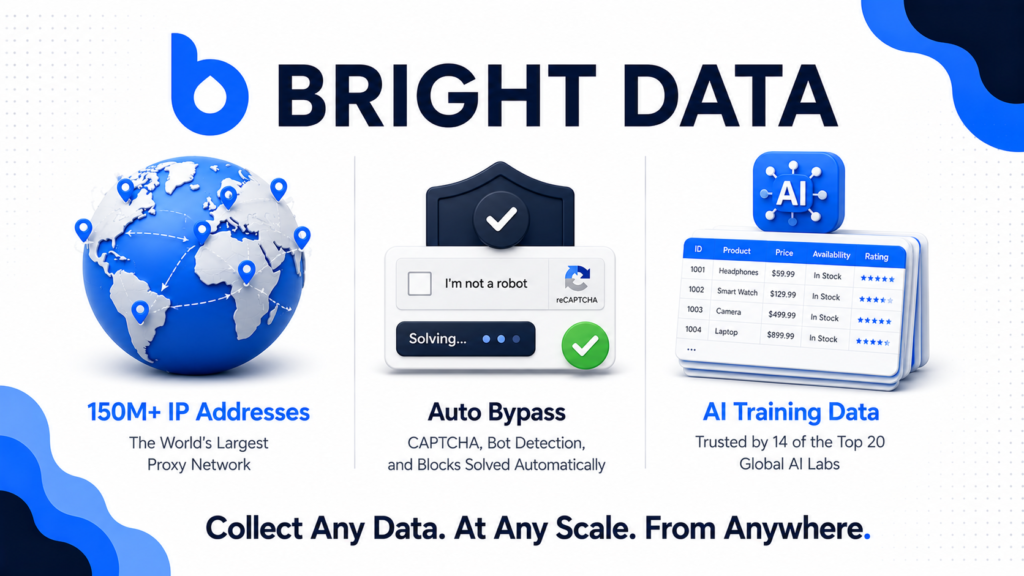
Bright Data is the largest web data infrastructure platform in the world. With over 150 million IP addresses across 195 countries, 20,000 plus paying organizations, and more than $300 million in annual recurring revenue in 2025, it has become the industry standard for web data collection at scale. Furthermore, 14 of the top 20 global AI labs use it to collect training data for their language models.
However, Bright Data is not cheap. It is not simple. And it is not designed for beginners. This honest review covers exactly what it does, who it is for, what it actually costs, and when you should choose it over cheaper alternatives.
What Is Bright Data?
Bright Data is a web data infrastructure company that offers four core products: proxy networks, a Web Unlocker API, a Scraping Browser, and pre-built datasets. Together, these products allow businesses and developers to collect data from any website at any scale, bypassing the bot detection, CAPTCHAs, IP blocks, and rate limiting that websites use to prevent automated data collection.
The company was founded in 2014 as Luminati Networks and rebranded to Bright Data in 2021. In 2026, it serves a wide range of use cases including e-commerce price monitoring, SEO rank tracking, ad verification, brand protection, market research, financial data collection, and AI training data at scale.
Furthermore, Bright Data has expanded significantly beyond raw proxy infrastructure. Its managed APIs and pre-built datasets allow non-technical teams to access structured web data without writing any scraping code. Consequently, it now serves both technical teams building custom data pipelines and business teams that simply want clean, structured data delivered on a schedule.
Bright Data Pricing in 2026
Bright Data prices by product line rather than a single flat plan. Understanding each product’s cost structure is essential before budgeting. Here is the verified breakdown as of August 2026:
Proxy Networks
Residential Proxies: $8.40 per GB on pay-as-you-go with no monthly commitment. Volume discounts apply with committed monthly spend. At 100 GB per month, the rate drops to approximately $5.04 per GB. At 1,000 GB per month, enterprise pricing applies with further discounts. These proxies route traffic through real residential IP addresses, making them the hardest to detect and block.
Datacenter Proxies: $0.89 per GB pay-as-you-go, or per-IP pricing for dedicated or shared datacenter IPs. Significantly cheaper than residential but easier for websites to detect and block.
ISP Proxies: Priced between residential and datacenter at approximately $5.00 to $7.00 per GB. Combine the authenticity of residential IPs with the speed of datacenter proxies. Increasingly popular for high-volume scraping where residential proxy costs are prohibitive.
Mobile Proxies: $12.00 per GB pay-as-you-go. The most expensive proxy type. Designed for use cases that specifically require mobile carrier IP addresses, including app testing and mobile-specific web scraping.
Web Unlocker API
The Web Unlocker abstracts proxy selection, browser fingerprinting, CAPTCHA solving, and anti-bot bypass into a single API call. You send a URL and receive the page HTML. Bright Data handles everything in between automatically.
Pricing starts at $2.00 per 1,000 requests for standard web pages, with higher rates for JavaScript-rendered pages that require a headless browser. For teams that previously spent engineering time maintaining anti-detection logic, the Web Unlocker eliminates that maintenance cost entirely.
Scraping Browser
The Scraping Browser is a cloud-hosted browser environment that integrates directly with Playwright and Puppeteer. It handles proxy rotation, CAPTCHA solving, and fingerprinting automatically while giving developers full programmatic control over the browser session.
Pricing is session-based, starting at approximately $0.10 per browser session with volume discounts. This is the right product for scraping highly dynamic JavaScript-heavy websites where a standard HTTP request cannot render the full page content.
Pre-Built Datasets
Bright Data offers structured datasets ready for immediate download across categories including e-commerce products, job listings, real estate listings, social media profiles, financial data, and search engine results. Pricing is per dataset and varies significantly based on size, freshness, and category.
For teams that need structured data without building a scraping pipeline, datasets provide immediate access to clean, pre-processed information. Furthermore, custom dataset delivery on a recurring schedule is available for enterprise customers.
Platform Pricing Summary
Starting at $500/month for meaningful production use. Pay-as-you-go is available at higher per-unit rates for testing and low-volume usage. Free trial credits are available for new accounts. Enterprise pricing includes committed spend discounts, dedicated account management, and bundled product access.
The important caveat is that Bright Data’s marketing pages update frequently and do not always reflect current rates accurately. Therefore, always verify pricing directly on brightdata.com before budgeting. Furthermore, enterprise deals often bundle commitments across multiple products, which can significantly change the effective per-unit cost.
Key Features
Proxy Network Scale and Quality
Bright Data’s 150 million plus IP residential network is the largest commercially available. Furthermore, the network uses opt-in IPs, meaning real device owners have agreed to share their connection, which provides genuine residential IP authenticity that synthetic or data-center-based alternatives cannot replicate.
Geographic targeting goes down to ZIP code and ASN level for residential proxies, which is essential for use cases like local price monitoring, geo-restricted content access, and regional ad verification. Consequently, Bright Data’s targeting granularity exceeds what most competing proxy providers offer.
Web Unlocker and Anti-Detection
The Web Unlocker API uses AI-powered browser fingerprinting, automatic header rotation, CAPTCHA solving, and intelligent retry logic to bypass the anti-bot systems deployed by major websites. In independent testing, it achieves success rates significantly above what raw proxy networks can deliver on protected sites.
For teams scraping heavily protected targets like Amazon, LinkedIn, Instagram, Zillow, or major retail sites, the Web Unlocker’s automatic bypass logic saves significant engineering time that would otherwise go toward maintaining custom anti-detection solutions.
Compliance Engine
Bright Data’s compliance engine is one of its most important differentiators in 2026. It includes built-in privacy tools, consent management, geographic restriction enforcement, and robots.txt compliance options. Furthermore, the company has published extensive legal opinions on the lawfulness of web scraping under US and EU law.
This compliance focus matters because web scraping operates in a legally complex space. Several high-profile court cases in recent years have clarified that scraping publicly available data is generally lawful, but the legal landscape continues to evolve. Consequently, enterprise customers increasingly prefer Bright Data’s documented compliance framework over unregulated alternatives.
AI Training Data
One of Bright Data’s fastest-growing product categories in 2026 is AI training data. Fourteen of the top 20 global AI labs use Bright Data to collect the web data needed to train and ground their models. Furthermore, Bright Data offers structured datasets specifically formatted for LLM pre-training, fine-tuning, and retrieval-augmented generation.
For AI companies and research teams, the combination of scale, compliance documentation, and structured output format makes Bright Data the preferred source for large-scale web training data over building custom scraping infrastructure.
Dashboard and Developer Experience
Bright Data’s unified dashboard handles proxy zone setup, API key management, usage monitoring, billing, and data collection task management in one interface. Furthermore, native SDKs for Python, Node.js, Java, and other languages, alongside integrations with Playwright, Puppeteer, and Selenium, make it accessible to developers across technology stacks.
However, the dashboard has a learning curve. Multiple user reviews cite the interface as complex for beginners, particularly when configuring proxy zones or setting up advanced targeting rules. Consequently, teams without prior proxy infrastructure experience typically require several days of onboarding before running production workloads efficiently.
What Bright Data Does Well
Network scale is genuinely unmatched. No competing provider offers 150 million plus opt-in residential IPs across 195 countries. Consequently, for use cases that require broad geographic coverage, high IP diversity, or access to specific regional carrier networks, Bright Data has no practical equivalent.
Success rates on protected sites are industry-leading. The Web Unlocker’s AI-powered anti-detection consistently outperforms raw proxy networks on heavily protected targets. Furthermore, Bright Data’s engineering investment in maintaining bypass capabilities against continuously evolving anti-bot systems means success rates remain high even as target sites update their defenses.
G2 category leadership reflects genuine enterprise satisfaction. A 4.6 to 4.7 out of 5 rating across 240 plus verified G2 reviews and a 4.4 out of 5 TrustScore across approximately 970 Trustpilot reviews reflect largely positive enterprise experiences. Furthermore, the review distribution of approximately 85% five-star ratings suggests consistent satisfaction among the majority of users.
Compliance documentation reduces legal risk. For enterprise customers, particularly in regulated industries or those operating across multiple jurisdictions, Bright Data’s documented compliance framework and published legal opinions provide meaningful risk reduction compared to unregulated alternatives.
Customer support is consistently rated as responsive. Multiple G2 reviewers specifically cite quick support response times, including cases where feature requests were escalated to engineering within days. Furthermore, enterprise plans include dedicated account management with 15-minute priority response SLAs.
Where Bright Data Falls Short
Premium pricing is the most consistent complaint at lower volumes. At $8.40 per GB for residential proxies on pay-as-you-go, Bright Data is among the highest list-rate providers in the market. Teams scraping under 100 GB per month frequently find mid-tier providers like Oxylabs, Smartproxy, or SOAX deliver acceptable performance at 30% to 50% lower cost.
The dashboard complexity frustrates beginners. Multiple reviews across Capterra and G2 cite the interface as difficult to navigate, particularly for proxy zone configuration and advanced targeting setup. Furthermore, the documentation for complex tasks is described as confusing by multiple reviewers. Consequently, teams without dedicated technical resources face a meaningful onboarding investment.
Billing for failed requests is a recurring concern. Several reviews document charges for requests that returned errors or empty results rather than successful page content. Consequently, teams running high volumes on difficult targets need to monitor usage and implement budget caps to prevent unexpected bill spikes.
Minimum commitment requirements for enterprise pricing. Access to volume-discounted rates requires meaningful monthly spend commitments. Consequently, teams with spiky or uncertain data collection needs may find pay-as-you-go rates prohibitively expensive while lacking the predictability to commit to enterprise contracts.
KYC and account verification can be slow. Multiple Trustpilot reviews document delays in the Know Your Customer verification process required for new accounts, sometimes taking several days. For teams that need immediate access to begin a project, this verification delay can be operationally disruptive.
Bright Data vs Competitors
Bright Data vs Oxylabs: Oxylabs is the closest direct competitor in the enterprise proxy market. It offers comparable network size, similar product categories, and slightly lower list prices on residential proxies at approximately $7 to $8 per GB. However, Bright Data’s Web Unlocker API is more mature, its compliance documentation is more comprehensive, and its AI training data offering is more developed. Therefore, Bright Data wins for compliance-sensitive enterprise use cases and AI data collection, while Oxylabs competes closely on raw proxy pricing.
Bright Data vs Smartproxy: Smartproxy starts at approximately $2.50 per GB for residential proxies, significantly underpricing Bright Data. For smaller teams with less aggressive anti-bot targets, Smartproxy delivers acceptable performance at a fraction of the cost. However, Smartproxy’s network is smaller, its geographic targeting is less granular, and its support for enterprise compliance requirements is less developed. Therefore, Smartproxy wins for budget-conscious teams with moderate scale needs, while Bright Data wins for enterprise teams needing maximum scale and compliance.
Bright Data vs Apify: Apify focuses on managed scraping actors and a marketplace of pre-built scraping tools rather than raw proxy infrastructure. It is more accessible for non-technical teams and better suited for specific structured data extraction use cases. However, for teams that need raw proxy infrastructure or the Web Unlocker’s bypass capabilities at scale, Bright Data’s infrastructure depth exceeds what Apify provides. Therefore, Apify wins for teams wanting managed, code-light data extraction, while Bright Data wins for teams building custom high-volume pipelines.
Bright Data vs Building In-House: Many technical teams initially consider building their own proxy rotation and anti-detection infrastructure. However, the ongoing engineering maintenance required to keep pace with evolving anti-bot systems is substantial. Furthermore, building a network of residential IPs at meaningful scale is practically impossible without Bright Data’s opt-in network model. Consequently, most teams that start by building in-house eventually migrate to Bright Data or a comparable provider once they encounter the real complexity of maintaining bypass capabilities at scale.
Who Should Use Bright Data?
Bright Data is the right choice if you are:
- An enterprise team collecting web data at scale where reliability, compliance documentation, and dedicated support justify the premium pricing
- An AI company or research lab collecting training data for language models where structured, large-scale, compliant data collection is required
- An e-commerce business running competitive price monitoring across thousands of products and multiple markets simultaneously
- A financial data team collecting alternative data at scale for trading, research, or risk management applications
- A developer team that has tried lower-cost proxy providers and encountered reliability, success rate, or geographic targeting limitations that Bright Data’s infrastructure solves
However, Bright Data may not be the right fit if you are:
- A small team or individual developer collecting data at low volumes where mid-tier providers offer acceptable performance at significantly lower cost
- A team without technical resources to navigate the dashboard complexity and proxy zone configuration during onboarding
- A startup or project with unpredictable data collection volume where pay-as-you-go rates make Bright Data expensive and committed enterprise pricing is difficult to justify
- A team with simple data collection needs on unprotected sites where basic HTTP requests or simple proxies are sufficient
Bright Data Review: Final Verdict
Bright Data is the undisputed leader in web data infrastructure in 2026. Its network scale, Web Unlocker bypass capabilities, compliance framework, and enterprise support are genuinely unmatched by any competing provider. The 50% year-over-year revenue growth and the fact that 14 of the top 20 global AI labs rely on it are meaningful signals of genuine product value at the highest tier of the market.
However, the premium pricing, dashboard complexity, and occasional billing concerns around failed requests make it a poor fit for teams that do not genuinely need its scale and capabilities. For smaller projects and budget-conscious teams, mid-tier providers like Smartproxy or Oxylabs deliver acceptable performance at significantly lower cost.
The decision framework is simple. If your data collection needs justify $500 or more per month in infrastructure costs, Bright Data is the safest and most capable choice. If you are below that threshold, start with a cheaper provider and upgrade when you hit the limitations that Bright Data solves.
Overall rating: 4.3 out of 5
Bright Data earns its market leadership. The question is whether your use case requires what only it can provide.