Salesforce is the most recognized name in CRM software. With over 150,000 customers worldwide, a $38 billion annual revenue run rate, and the dominant position in enterprise sales technology, it is the default answer whenever a business asks which CRM to use.
However, Salesforce is also notorious for aggressive pricing, complex contracts, and a total cost of ownership that frequently shocks first-time buyers. The Starter plan looks affordable at $25 per user per month. However, most growing teams land on Enterprise at $175 per user per month, and the median Salesforce customer actually pays $74,700 per year based on 2,216 verified purchase transactions.
Furthermore, Salesforce restructured its pricing multiple times in 2024 and 2025, introducing the Agentforce AI tiers that add significant cost for organizations that want AI-powered automation. Consequently, older reviews with outdated pricing are everywhere, and the sticker price rarely tells you what you will actually pay.
This honest review covers the real pricing, the genuine strengths, the hidden costs, and who Salesforce actually works best for in 2026.
What Is Salesforce?
Salesforce is a cloud-based customer relationship management platform that helps businesses manage their sales processes, customer service operations, marketing campaigns, and business data in one centralized system. Founded in 1999 by Marc Benioff, it pioneered the SaaS model before that term was widely used and has dominated the enterprise CRM market for over two decades.
In 2026, Salesforce has evolved far beyond a sales tracking tool. Its platform covers the complete customer lifecycle through multiple product clouds including Sales Cloud, Service Cloud, Marketing Cloud, Commerce Cloud, and Data Cloud. Furthermore, the introduction of Agentforce, its AI agent platform, represents the company’s biggest product bet of the decade, repositioning Salesforce from a record-keeping system into an autonomous AI-powered business operations platform.
The core idea is compelling. Every customer interaction, across every channel, by every team member, is captured, connected, and available for analysis in one platform. Consequently, organizations that implement Salesforce successfully gain a level of visibility into their customer relationships and business performance that is genuinely difficult to achieve with disconnected tools.
Salesforce Pricing in 2026
Salesforce Sales Cloud has five tiers as of August 2026. All plans are billed annually. Here is the verified breakdown:
Starter Suite: $25/user/month. Includes basic CRM with contact management, lead tracking, opportunity pipelines, email integration, and basic reporting. Supports up to 10 users. However, the Starter Suite is extremely limited in practice. It lacks API access, advanced automation, custom reporting, and AppExchange integrations. Consequently, most teams discover they need to upgrade within 6 to 12 months.
Pro Suite: $100/user/month. Adds advanced pipeline management, lead scoring, browser extensions, and AppExchange access. This is where Salesforce starts to show its real depth. However, the jump from $25 to $100 per user per month is a 4x price increase for features that many teams consider basic requirements.
Enterprise: $175/user/month. Adds workflow automation, territory management, advanced analytics, API access, and full customization capabilities. This is where most growing sales teams actually land. Furthermore, Enterprise is the minimum tier for organizations that need to connect Salesforce to other business systems through the API.
Unlimited: $350/user/month. Adds Premier Success Plan support, unlimited custom applications, and expanded storage. Designed for large organizations that need maximum platform capability and premium support.
Agentforce 1 Sales: $550/user/month. The newest tier, including built-in Agentforce AI agents that autonomously handle prospecting, qualification, follow-up, and meeting scheduling. Designed for AI-first sales organizations that want autonomous agents handling routine sales tasks.
Free Suite: Available for up to 5 users with extremely limited functionality. Primarily useful for testing the platform interface before committing to a paid plan.
The Real Cost Warning
The per-user prices above are only the starting point. Salesforce’s total cost of ownership includes several additional layers that catch most buyers off guard.
Implementation costs: Salesforce is not a plug-and-play tool. Most organizations require professional implementation services ranging from $5,000 for small deployments to $100,000 or more for complex enterprise rollouts. Third-party Salesforce implementation partners are typically cheaper than Salesforce Professional Services but still represent a significant upfront investment.
Success Plans: Salesforce’s standard support is limited. Premier Success Plan adds 24/7 support and expert guidance at approximately 20% of your annual license fees. Signature Success Plan adds dedicated technical account management at approximately 30% of license fees. Therefore, a team paying $350,000 per year in licenses could pay an additional $70,000 to $105,000 for meaningful support.
Add-on products: Sales Engagement (formerly High Velocity Sales), Revenue Intelligence, Salesforce Maps, and Einstein AI features are all sold as add-ons on top of base license costs. Consequently, the feature set that makes Salesforce compelling often requires spending significantly above the per-user headline price.
Data storage overages: Salesforce’s default storage limits are surprisingly low. Organizations managing large customer databases regularly hit storage limits and pay overage fees. Furthermore, Data Cloud, which powers the most sophisticated personalization and AI features, is priced separately based on data volume.
Annual price increases: Salesforce contracts typically include annual price escalation clauses. Buyers who engage 90 to 120 days before renewal and negotiate proactively often achieve reductions or avoid increases. Those who auto-renew typically accept list price increases of up to 9% annually.
The median Salesforce customer pays $74,700 per year, with an average 13% discount available through negotiation. Therefore, always negotiate your contract rather than accepting list price, particularly at renewal.
Key Features
Sales Cloud and Pipeline Management
Sales Cloud is Salesforce’s core product and the reason most organizations choose the platform. It provides visual deal pipelines, opportunity tracking, activity logging, email integration, meeting scheduling, forecasting, and territory management in a single, highly customizable environment.
The depth of customization is Salesforce’s most powerful differentiator. Every field, workflow, page layout, and process can be configured to match your exact sales methodology without writing code on lower tiers, or with unlimited custom development using Apex code and Lightning Web Components on Enterprise and above.
Furthermore, Salesforce’s reporting and analytics capabilities on Enterprise plans and above are among the strongest in the CRM category. Custom report types, dashboard builders, and Einstein Analytics provide visibility into every aspect of sales performance at granular levels that most competing CRMs cannot match.
Agentforce AI Platform
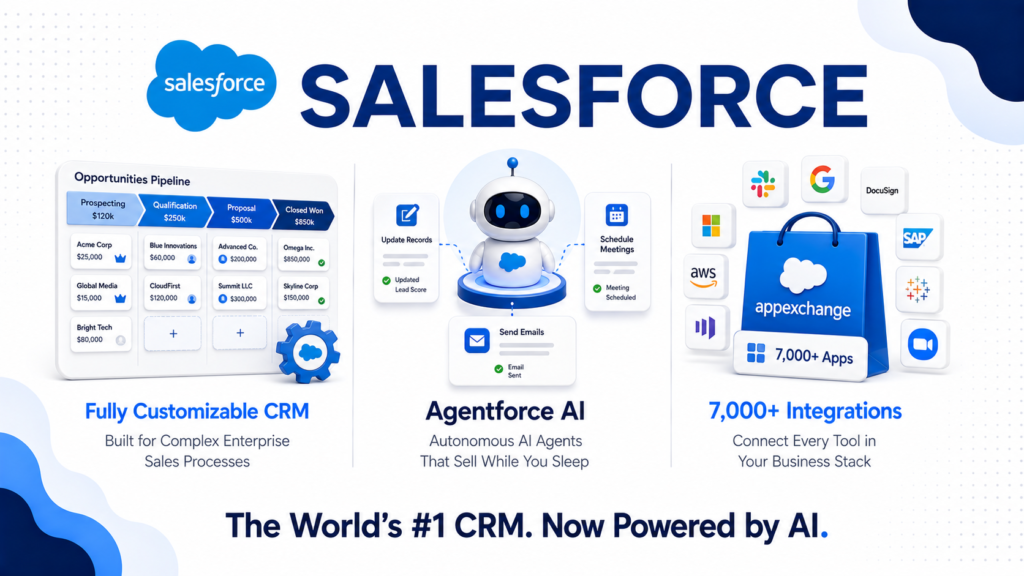
Agentforce is Salesforce’s most significant product investment of 2025 and 2026. It consists of AI agents that can autonomously perform tasks across the Salesforce platform, including researching prospects, drafting personalized outreach, qualifying inbound leads, scheduling meetings, updating records, and handling customer service inquiries without human intervention.
The Agentforce 1 Sales tier at $550 per user per month bundles these capabilities directly into the CRM subscription. For organizations running high-volume sales operations where the cost of manual administrative tasks is significant, autonomous AI agents that handle routine work represent a compelling ROI case.
However, Agentforce does not require the $550 tier to access. Organizations on Enterprise and Unlimited can access Agentforce capabilities through additional licensing, though the pricing for these add-ons varies based on usage and negotiation.
AppExchange Ecosystem
Salesforce’s AppExchange is the world’s largest enterprise application marketplace, with over 7,000 apps and components available for installation. It extends Salesforce’s functionality in every direction, from specialized industry solutions to integrations with virtually every business software platform.
This ecosystem depth is a meaningful competitive advantage. When a specific business requirement emerges that is not natively supported by Salesforce, the probability that an AppExchange solution already exists is high. Furthermore, most major SaaS platforms build and maintain native Salesforce integrations, making data synchronization straightforward.
Service Cloud
Service Cloud transforms Salesforce into a complete customer service platform with case management, a knowledge base, omnichannel routing (handling email, chat, phone, and social media in one queue), and AI-powered case resolution suggestions. Furthermore, integration with Sales Cloud means service agents have complete customer history including purchase records and previous sales interactions available in a single view.
For organizations that want to eliminate the gap between their sales and support teams’ understanding of each customer, the combination of Sales Cloud and Service Cloud in a single platform is genuinely valuable. However, Service Cloud is priced separately, which adds meaningful cost for organizations that need both.
Marketing Cloud and Data Cloud
Salesforce’s marketing capabilities span from basic email marketing in the Starter Suite to full Marketing Cloud Engagement for enterprise email and journey automation, Marketing Cloud Account Engagement (formerly Pardot) for B2B marketing automation, and Data Cloud for real-time customer data unification.
However, Marketing Cloud is a separate product with its own pricing structure that starts significantly above the Sales Cloud entry points. Furthermore, Data Cloud, which powers the most sophisticated personalization and AI use cases, is priced based on data record volume and can add substantial cost for organizations with large customer databases.
What Salesforce Does Well
Customization depth is unmatched. No CRM platform offers more flexibility in configuring the system to match your exact sales process, data model, and workflow requirements. Consequently, Salesforce can adapt to virtually any business model, industry, or sales methodology without requiring significant workarounds.
The ecosystem and integration depth are extraordinary. With 7,000 plus AppExchange apps and native integrations with virtually every major business platform, Salesforce connects to more tools than any competing CRM. Furthermore, its API is mature, well-documented, and extensively used by third-party developers.
Reporting and analytics are genuinely powerful at Enterprise tier. Custom report builders, real-time dashboards, and Einstein Analytics provide visibility that most competing platforms cannot match. For data-driven sales organizations that make decisions based on pipeline analysis and performance metrics, Salesforce’s reporting capabilities are a meaningful differentiator.
Agentforce represents a genuine AI competitive advantage. The autonomous AI agent platform is more advanced than what competing CRMs have deployed in 2026. For organizations ready to invest in AI-powered sales automation, Salesforce’s Agentforce is the most mature enterprise-grade implementation available.
Enterprise trust and compliance certifications are comprehensive. SOC 2, ISO 27001, GDPR, HIPAA, and dozens of other compliance certifications make Salesforce suitable for regulated industries and enterprise organizations with strict data governance requirements.
Where Salesforce Falls Short
The total cost of ownership is consistently underestimated. The $25 Starter Suite price creates a misleading first impression. Most organizations that implement Salesforce seriously end up on Enterprise at $175 per user per month minimum, plus implementation costs, plus add-ons, plus support plans. The median customer paying $74,700 per year reflects a reality that the pricing page does not communicate clearly.
Implementation complexity is a significant barrier. Salesforce is not self-service at enterprise scale. A meaningful Salesforce deployment requires either a dedicated internal Salesforce administrator or an external implementation partner. Consequently, the true cost of getting Salesforce working properly includes significant professional services spend beyond the license fees.
The Starter to Pro gap creates a pricing cliff. Going from $25 to $100 per user per month is a 4x increase for features that many teams consider standard requirements. Growing teams often find themselves forced to $100 per user per month very quickly after discovering what the Starter Suite actually does and does not include.
Aggressive renewal tactics are well documented. Multiple sources including Vendr’s procurement data consistently document Salesforce’s negotiating posture at renewal as aggressive. Auto-renewal clauses, price escalation provisions, and long minimum commitment terms are standard contract features. Therefore, organizations that do not actively manage their Salesforce contracts typically face higher costs at renewal than necessary.
User interface complexity frustrates non-technical users. Despite years of Lightning UI improvements, Salesforce remains more complex to navigate than modern CRMs built on simpler paradigms. Consequently, user adoption challenges are common, particularly among sales teams that resist data entry and administrative tasks.
Salesforce vs Competitors
Salesforce vs HubSpot: HubSpot offers a genuinely free CRM tier and a more accessible interface that drives higher user adoption. Furthermore, HubSpot’s Marketing Hub integration is tighter and its entry point is lower for small to mid-sized organizations. However, Salesforce’s customization depth, AppExchange ecosystem, and enterprise reporting capabilities significantly exceed HubSpot’s at the higher tiers. Therefore, HubSpot wins for accessibility and SMB use cases while Salesforce wins for enterprise complexity and customization. Read our full HubSpot review for a detailed comparison.
Salesforce vs Microsoft Dynamics 365: Microsoft Dynamics 365 is Salesforce’s closest enterprise competitor, with deep integration into the Microsoft 365 ecosystem including Teams, Outlook, and Azure. For organizations already standardized on Microsoft, Dynamics 365 often provides comparable CRM functionality at lower total cost. However, Salesforce’s AppExchange ecosystem and Agentforce AI platform are currently more developed. Therefore, Microsoft shops lean toward Dynamics while non-Microsoft organizations typically prefer Salesforce.
Salesforce vs Apollo.io: Apollo.io specializes in B2B prospecting with a 230 million plus contact database that Salesforce does not provide natively. Many organizations use Apollo.io for outbound prospecting and sync qualified leads into Salesforce for pipeline management. These tools are complementary rather than competitive for most B2B sales teams. Read our full Apollo.io review for details on how the two tools work together.
Salesforce vs Pipedrive: Pipedrive starts at $14 per user per month and offers a clean, intuitive pipeline interface that drives strong user adoption among smaller sales teams. However, it lacks Salesforce’s customization depth, reporting capabilities, and enterprise compliance certifications. Therefore, Pipedrive wins for simplicity and small team affordability while Salesforce wins for enterprise complexity and scale.
Salesforce vs Zoho CRM: Zoho CRM offers comparable feature depth at $14 to $52 per user per month, representing significant cost savings versus Salesforce Enterprise at $175 per user per month. Furthermore, Zoho’s broader product ecosystem parallels Salesforce’s multi-cloud approach. However, Salesforce’s AppExchange ecosystem, enterprise support options, and compliance certifications exceed what Zoho provides. Therefore, Zoho wins for cost-conscious mid-market teams while Salesforce wins for enterprises with complex integration requirements.
Who Should Use Salesforce?
Salesforce is the right choice if you are:
- A mid-market or enterprise B2B organization with a complex sales process that requires deep customization and workflow automation
- A business that needs to connect your CRM with dozens of other enterprise systems through robust API integrations
- An organization in a regulated industry where comprehensive compliance certifications are a procurement requirement
- A sales team that has outgrown simpler CRMs and needs the reporting depth and pipeline analytics that Salesforce provides at Enterprise tier
- An enterprise organization ready to invest in Agentforce AI automation to handle routine sales tasks autonomously
However, Salesforce may not be the right fit if you are:
- A small business or startup where the total cost of ownership including implementation, licenses, and support exceeds what simpler alternatives cost
- A team that needs quick time-to-value without significant implementation investment
- An organization where user adoption is a concern and interface simplicity matters more than feature depth
- A business with straightforward sales processes where a $14 to $25 per user per month alternative delivers adequate functionality
Salesforce Review: Final Verdict
Salesforce earns its market leadership position in 2026. The customization depth, AppExchange ecosystem, enterprise reporting, and Agentforce AI platform are genuinely unmatched by competing CRMs at the enterprise tier. For complex organizations with serious CRM requirements, Salesforce remains the most capable platform available.
However, the total cost of ownership is substantially higher than the pricing page suggests, the implementation complexity is real, and the renewal negotiation dynamics require active management to avoid overpaying. The median customer paying $74,700 per year is not buying a $25 per user per month product.
The honest recommendation is this: if your organization has a sales team of 10 or more people, a complex sales process, serious integration requirements, and a budget that can absorb Enterprise tier licensing plus implementation costs, Salesforce is the right platform. If you are smaller, simpler, or more budget-conscious, start with HubSpot’s free CRM, Pipedrive, or Zoho CRM and upgrade when the limitations become real constraints rather than theoretical ones.
Overall rating: 4.2 out of 5
Salesforce is the best enterprise CRM available. The challenge is ensuring your organization genuinely needs what only Salesforce provides before committing to the cost and complexity it requires.