Content teams don’t struggle with ideas, they struggle with execution.
Writing at scale while maintaining consistency, tone, and SEO quality is where things break down. Traditional AI tools often promise speed but deliver generic, repetitive output that still needs heavy editing.
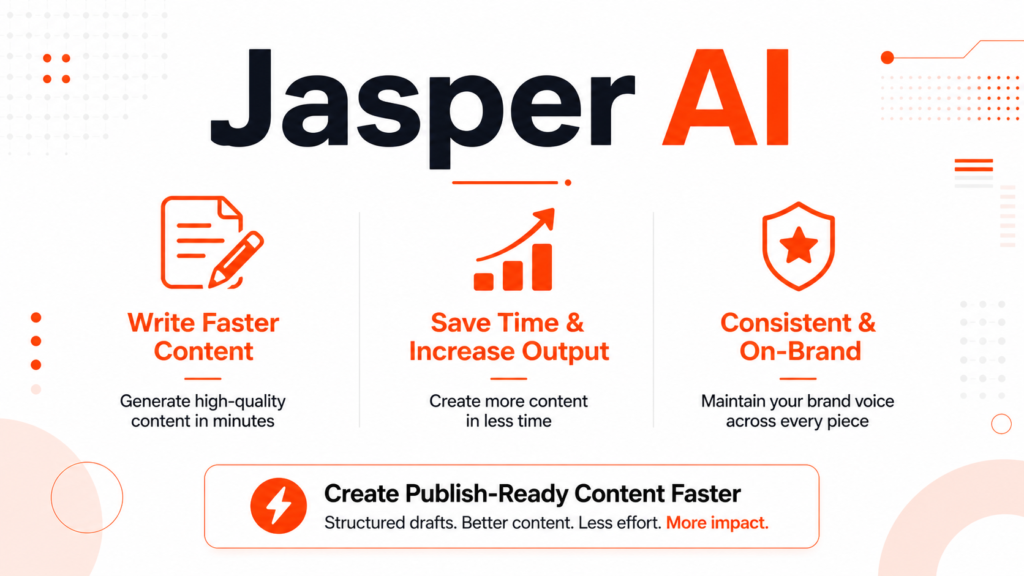
This is where Jasper AI becomes relevant. If you try Jasper AI, the immediate difference isn’t just speed, it’s structure and controllability. The tool is designed to produce usable drafts, not just raw text, which changes how content workflows operate.
The real gain is not “writing faster”, but reducing the gap between first draft and publishable content.
What the Tool Actually Does
Jasper AI is not just a text generator, it’s a guided content system. It combines prompt engineering, templates, and brand voice controls to produce structured outputs tailored for marketing and SEO workflows.
It performs best when:
- You have a clear objective (blog post, ad copy, landing page)
- You provide context (audience, tone, constraints)
- You iterate rather than expect perfect output in one pass
It struggles when:
- Inputs are vague or overly broad
- You expect deep subject matter expertise without guidance
- You rely entirely on automation without editing
One important observation: Jasper doesn’t “think” better than other AI models, it just constrains the output more effectively, which reduces randomness.
Key Features
Jasper’s templates look simple, but they significantly influence output quality. For example, using a blog post workflow template forces structure, introduction, argument flow, and conclusion, reducing the common issue of AI rambling.
However, this can also limit flexibility. If your use case doesn’t fit the template, you may need to switch to free-form mode.
The brand voice feature is where Jasper stands out in practice. Instead of rewriting tone manually each time, you can define style rules once. This works well for teams, but only if the input examples are strong. Weak examples lead to inconsistent tone replication.
Another notable capability is SEO integration (often via external tools). It helps guide keyword usage, but it does not guarantee ranking performance. The tool optimizes structure, not strategy.
How to Use It
Most users underestimate the importance of setup. Skipping tone definition, audience clarity, or content intent leads to average results.
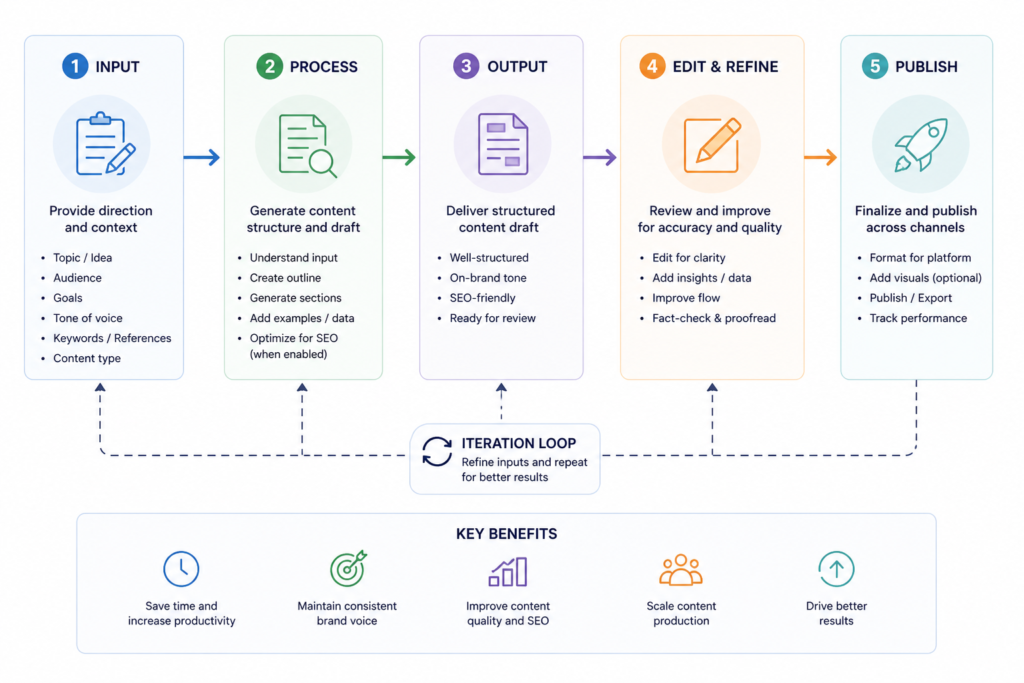
A typical workflow:
- Define the goal (e.g., SEO blog targeting a specific keyword)
- Input context (audience, tone, constraints)
- Generate outline first, not full content
- Expand section by section
- Edit and refine manually
During usage, Jasper tends to produce strong initial drafts but weaker conclusions. This is where manual intervention matters.
After generation, the real work begins: editing for clarity, adding data, and removing generic phrasing.
A better prompt example:
“Write a 1200 word blog post for SaaS marketers about reducing CAC using content marketing. Use a confident but analytical tone. Include practical examples and highlight trade offs.”
Common beginner mistake:
Users input “Write a blog about marketing” and expect quality output.
Fix:
Always define audience, goal, and constraints.
Real Life Use Cases
Content Marketing Teams
Used to scale blog production. Output becomes a structured draft that reduces writing time by 40-60%, but still requires editing for originality.
Freelance Writers
Helps generate first drafts quickly. The advantage is speed; the risk is over-reliance, which can lead to generic writing if not refined.
E-commerce Copywriting
Product descriptions can be generated in bulk. Works well for consistency, but struggles with differentiation across similar products.
SEO Agencies
Used for outlines and keyword-aligned drafts. Effective for structure, but strategy still depends on human input.
Example Outputs (Realistic Table)
| Task | Without AI | With Jasper AI |
|---|---|---|
| Blog intro | Takes 20-30 min, often rewritten | Generated in seconds, needs light editing |
| Product description | Repetitive, manual writing | Faster but may sound similar across items |
| Ad copy | Multiple iterations needed | Quick variations, but not always high-converting |
| SEO article | Structurally inconsistent | Strong structure, moderate depth |
Pricing
Jasper AI uses a subscription based model, typically tied to usage and features.
It becomes worth paying for when:
- You produce content regularly
- You work in a team environment
- You value consistency over raw creativity
A common mistake is assuming the subscription cost is the main expense.
The real cost is often how the tool is used, not the subscription itself. Poor inputs lead to wasted time editing low quality outputs.
Strengths and Limitations
Jasper performs well in structured writing tasks. It reduces cognitive load by handling formatting and flow, which is especially useful for repetitive content production.
However, it struggles with originality. Outputs can feel predictable if prompts are not specific. This matters in competitive niches where differentiation is critical.
Another trade off is control vs speed. While templates improve consistency, they can restrict creative flexibility.
Who Should Use It
Best suited for:
- Content marketers
- SEO teams
- Agencies managing high-volume output
Not ideal for:
- Deep technical writing without expert input
- Highly creative or narrative driven content
- Users expecting fully automated publishing
Advanced Tips
Use Jasper for structure, not final output. Generate outlines and expand selectively.
Feed it high quality examples. The output quality often mirrors the input quality.
Break tasks into smaller steps. Generating section by section improves coherence.
Combine with manual editing. The best results come from hybrid workflows.
Avoid overusing templates. Switch to free form when needed to maintain flexibility.
Final Verdict
Jasper AI is not a magic writing tool, it’s a structured content accelerator. It works best when you treat it as a drafting assistant rather than a replacement for thinking.
It is worth using if you produce content at scale and need consistency. It is less effective if you rely on it for originality or deep expertise.
The key limitation is predictability, but with the right inputs, this can be managed.
FAQ
Is Jasper AI better than other AI writing tools?
Not necessarily better, but more structured. It reduces randomness rather than improving intelligence.
Can it replace human writers?
No. It speeds up drafting but still requires human editing and judgment.
Does it help with SEO rankings?
It helps with structure and keyword alignment, but rankings depend on broader strategy.
How long does it take to learn?
Basic usage is quick, but mastering prompts and workflows takes time.
Call to Action
If you want to reduce content production time without losing control over structure and tone, test it in a real workflow and evaluate the results yourself. Start using Jasper AI.