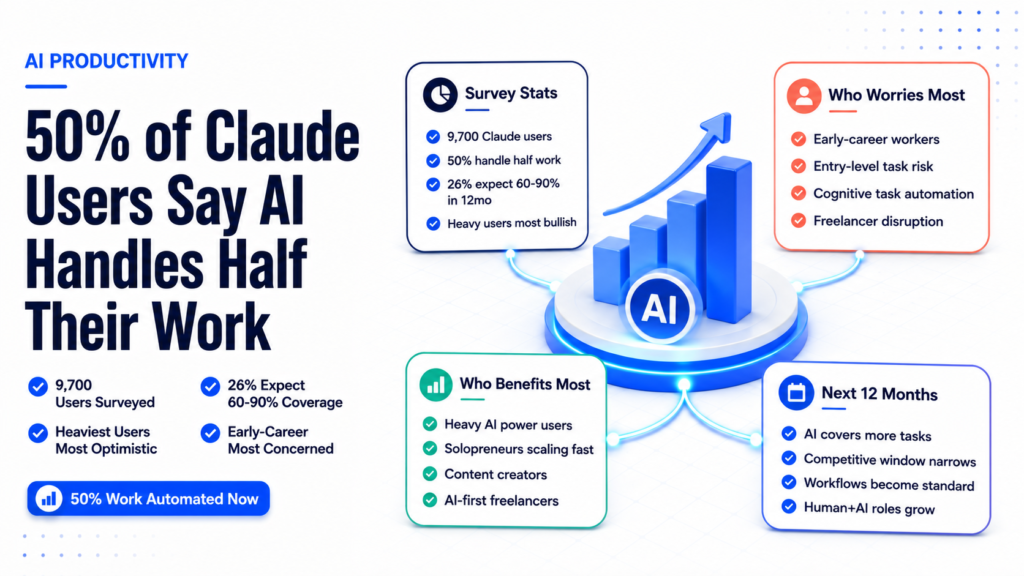
A new survey from Anthropic has just handed us one of the clearest data points yet about where AI is headed — and how fast. According to the research, which surveyed roughly 9,700 Claude users, about half of respondents said AI can already handle 50 percent or more of their work tasks. And in 12 months, 26 percent expect AI to cover between 60 and 90 percent of their workload.
If you use AI tools to earn money — whether as a freelancer, content creator, solopreneur, or small business owner — this data is not just interesting. It is a strategic signal you cannot afford to ignore.
What Anthropic’s Survey Actually Found
Anthropic’s survey covered nearly 10,000 Claude users across different industries and experience levels. The headline stat is striking enough: half of users already feel AI handles at least half their work. But the deeper findings tell an even more important story.
Early-career workers expressed the highest levels of concern, likely because AI is encroaching on the entry-level tasks that typically serve as stepping stones in a career. Meanwhile, the heaviest Claude users — the people who have integrated AI most deeply into their workflows — tend to be the most optimistic about the future. They are not worried. They are winning.
This mirrors a broader trend emerging across the AI landscape. According to Anthropic’s own research blog, Claude is increasingly being used not just for simple Q&A, but for extended autonomous tasks like coding, analysis, writing, and research — exactly the kinds of tasks that used to require hiring specialists.
For those already using tools like Claude professionally, you can explore the full comparison of leading AI assistants in our ChatGPT vs Claude vs Gemini honest comparison to make sure you are using the right tool for the right job.
The Opportunity Hidden Inside the Data
More AI Coverage Means More Room to Scale
If AI can already handle half your work, that is not a threat — it is leverage. The savviest online earners are not asking “will AI take my job?” They are asking “how do I use AI to do three times the work in half the time?”
Think about what this looks like in practice. A freelance writer who uses Claude for research, drafts, and editing can now take on twice as many clients. A digital product creator can launch more offers in less time. A small agency owner can deliver faster without hiring more staff.
If you are looking to put this into action, our guide on how to create and sell digital products with AI in 2026 walks through exactly how to build scalable income streams with tools like Claude at the center of your workflow.
The Heavy Users Are the Big Earners — Here’s Why
The survey finding that the heaviest Claude users are also the most optimistic is not a coincidence. People who have moved past casual experimentation and built real AI-powered workflows are experiencing genuine productivity gains. They are not worried about displacement because they have already displaced their old, slower ways of working.
This is the difference between using AI as a novelty and using it as infrastructure. The professionals making real money with AI in 2026 have typically done a few things right:
- They have identified which parts of their workflow AI handles best
- They have built repeatable systems around those tasks
- They use AI to handle volume while they focus on strategy and client relationships
- They stay updated as models improve — and they upgrade their workflows accordingly
For a practical look at how Claude specifically fits into a money-making stack, check out our breakdown on how to make money with Claude and Perplexity AI as a research and writing powerhouse duo.
What This Means for Early-Career Workers and New Freelancers
The survey data shows early-career workers are the most anxious — and that concern deserves a serious, honest response rather than empty reassurance.
Entry-level tasks in writing, coding, data entry, customer support, and research are genuinely being automated at scale. According to a McKinsey report on the state of AI, repetitive cognitive tasks are among the first to be impacted by generative AI adoption across industries.
But here is the reframe: the people who learn to operate AI at a high level are not being replaced — they are becoming the new entry-level. The bar has shifted. Knowing how to prompt, deploy, and manage AI outputs is now a foundational skill, not an advanced one.
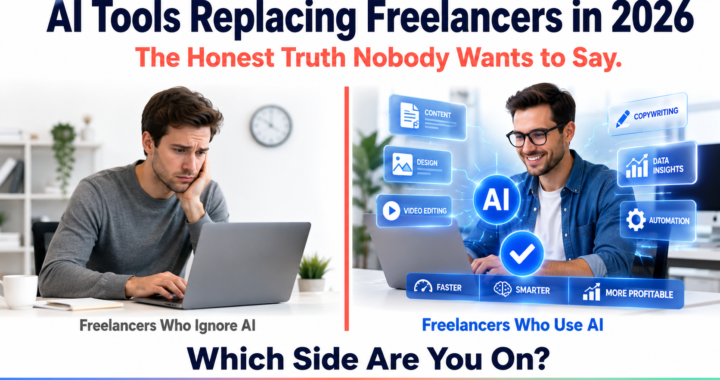
If you are just starting out, the smartest move is to learn AI tools deeply and fast. Our article on AI tools that are replacing freelancers right now — and what to do about it gives an honest look at which roles are most at risk and how to pivot before the disruption hits you directly.
What the Next 12 Months Look Like for AI-Powered Earners
The 26 percent of Claude users who expect AI to cover 60 to 90 percent of their work within a year are not outliers. They are likely the early adopters whose predictions tend to come true because they are the ones actively making it happen.
For anyone building income online with AI tools, the next 12 months present a narrowing window of competitive advantage. Right now, being an expert AI user still sets you apart. In two years, it will simply be expected.
The opportunity is clearest for:
- Freelancers who can use AI to increase output and undercut agencies on price while maintaining quality
- Content creators who can produce more content, across more formats, faster than ever before
- Solopreneurs who can run operations that previously required a small team
- Consultants and coaches who can use AI to scale deliverables and serve more clients simultaneously
According to the World Economic Forum’s Future of Jobs Report, the fastest-growing roles globally are those that combine human judgment with AI augmentation — exactly the skill set that heavy AI tool users are developing right now.
The Bottom Line
Anthropic’s survey is more than an interesting data point. It is a real-time snapshot of how quickly AI is moving from productivity experiment to core work infrastructure. Half of Claude users already see AI handling half their work. Within 12 months, a significant portion expect that number to climb much higher.
For people using AI tools to build income, this is a confirmation of the strategy — not a warning to retreat. The goal is not to avoid AI disruption. It is to be so far ahead of it that disruption becomes your competitive advantage.
Use more AI. Build better systems. Stay ahead of the curve. The data says the heavy users are winning — and there is no reason you cannot be one of them.