Let us not pretend this is not happening.
A study published in February 2026 by Ramp, using actual company spending data from thousands of firms, found that more than half of businesses that were spending on freelance platforms like Upwork and Fiverr in 2022 had completely stopped by 2025. Freelance marketplace spending as a share of total company spend dropped from 0.66% to 0.14%, a nearly 5x decline. At the same time, AI model provider spending went from 0% to 2.85% of total spend in the same period.
The numbers are not ambiguous. Businesses are replacing freelance work with AI tools at a scale and speed that was hard to predict even two years ago.
But here is what those numbers do not tell you: which freelancers are being replaced, which ones are thriving, and what the difference is between the two groups.
This article gives you the honest picture.
The Freelance Categories Under the Most Pressure
Not all freelance work is equally at risk. The categories facing the most disruption are the ones built around tasks that are repetitive, templated, and do not require deep human judgment.
Basic Content Writing
Generic blog posts, simple product descriptions, and templated social media captions were among the first freelance services to feel serious pressure. Tools like ChatGPT, Claude, and Jasper can produce this type of content in seconds at a cost of fractions of a cent per word.
Clients who used to pay $30 to $80 for a simple 500-word blog post increasingly handle this work themselves using AI tools. The market for generic, undifferentiated writing work has shrunk significantly and will continue to shrink.
What is still safe: Deeply researched, opinion-driven, and strategically crafted content that requires industry expertise, a distinctive voice, and genuine insight. AI can write words. It cannot replace a writer who understands an industry deeply and knows what an audience actually needs to hear.
Basic Graphic Design
Simple logo creation, social media post templates, and generic marketing graphics have been heavily commoditized by tools like Canva, Midjourney, and Adobe Firefly. Clients who used to pay $50 to $200 for basic design work can now produce it themselves in minutes.
The middle tier of design work, competent but not exceptional, has been squeezed hardest. Basic design is getting commoditized rapidly.
What is still safe: Brand strategy, complex visual identity systems, UX and product design, and creative direction that requires understanding business objectives and human behavior. You do not get paid for making things look good. You get paid for making things perform.
Data Entry and Basic Research
Repetitive data collection, transcription, simple research tasks, and copy-paste data work have been heavily automated. Tools like Perplexity AI, Bardeen, and various RPA tools handle these tasks faster and cheaper than any human freelancer.
What is still safe: Research that requires synthesis, judgment, and interpretation rather than just collection. Knowing which sources to trust, which patterns matter, and what the data actually means for a specific business context remains a human skill.
Basic Translation
Simple, straightforward translation between major language pairs has been largely automated. Tools like DeepL, Google Translate, and GPT-based translation systems handle routine translation at near-professional quality for common language pairs and standard content types.
What is still safe: Literary translation, legal and medical translation requiring precision and liability, localization work requiring cultural nuance, and translation in less common language pairs where AI quality drops significantly.
Basic Customer Support Writing
Writing FAQ responses, standard support email templates, and scripted chat responses has been taken over by AI tools like Tidio and various other AI customer service platforms. Companies are deploying AI that handles the majority of routine customer inquiries without human involvement.
What is still safe: Complex customer escalations, relationship management, and support work that requires genuine empathy, creative problem solving, and understanding of context that AI still handles poorly.
The Data That Puts This in Context
Before drawing the wrong conclusions, here is the broader picture.
77% of freelancers now report using AI tools in their work, and those who do report productivity gains of 20% to 40%. The gap between AI-fluent freelancers and those who resist adoption is widening quickly.
Freelancers who adopted AI workflows report that deliverables that once took six hours now take two and a half hours, with rates staying the same. That is a near-tripling of profit per hour.
The overall labor market is shifting rather than disappearing. AI replacing jobs is occurring alongside the rise of companies built entirely around artificial intelligence, creating entirely new roles around AI development, integration, and workflow design.
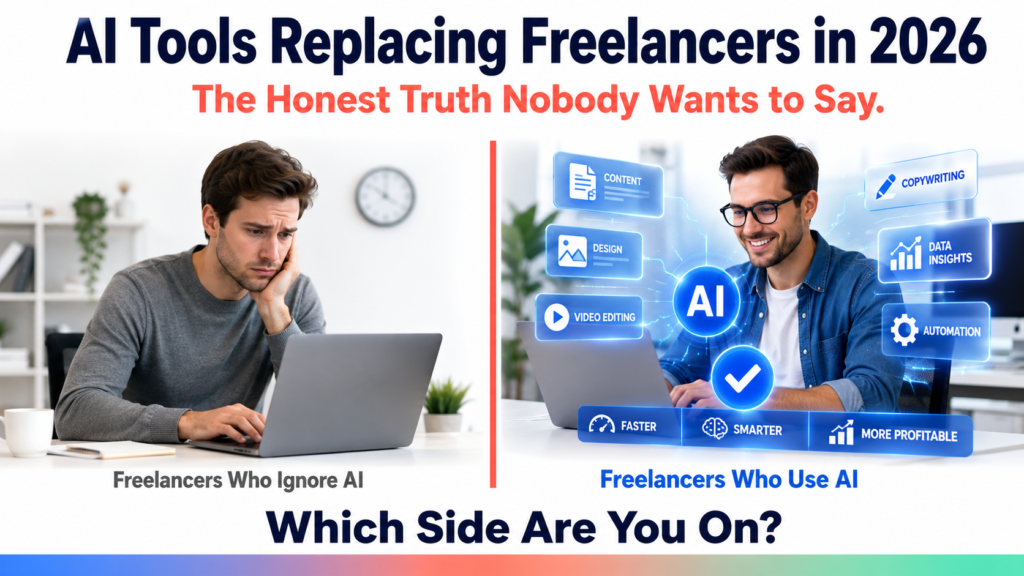
The freelancers being replaced are not the ones being replaced by AI. They are being replaced by other freelancers who use AI and can therefore deliver more, faster, at competitive prices.
The Freelancers Who Are Thriving
While some categories contract, others are growing. The freelancers doing best in 2026 share a common pattern: they use AI as a force multiplier for skills and judgment that AI cannot replicate.
AI Implementation Consultants
Small businesses know they need to adopt AI but have no idea how to do it practically. Freelancers who can audit a business’s workflows, identify the right tools, and set up working AI systems are in enormous demand. This is a service that did not meaningfully exist two years ago and is now one of the fastest-growing categories on Upwork.
Prompt Engineers and AI Workflow Designers
Companies using AI tools internally need people who can design effective prompts, build repeatable workflows, and train teams to use AI tools correctly. This is a highly specialized skill that most business owners do not have time to develop themselves.
AI-Augmented Video Producers
Freelancers who combine tools like HeyGen, Synthesia, Descript, and Kling AI can deliver video production at a scale and speed that traditional video freelancers simply cannot match. The demand for video content has never been higher and AI-fluent video producers are capturing a growing share of it.
Strategic Content Writers
Writers who combine AI tools for research and drafting with genuine industry expertise and strategic thinking are earning more than ever. Clients are not paying for words in 2026. They are paying for ideas, strategy, and the expertise to know what an audience needs to hear. AI can write the words. It cannot replace the thinking behind them.
Multilingual Content Specialists
Creators who combine AI translation tools with genuine cultural fluency are helping brands reach international audiences at a speed and cost that traditional translation agencies cannot match. This is a growing niche as global businesses expand into new markets.
The Shopify Signal That Every Freelancer Should Read
In early 2026, Shopify CEO Tobi Lütke sent an internal memo stating that reflexive AI usage is now a baseline expectation at the company, and that AI questions would be added to performance reviews and hiring decisions. He gave every employee access to tools including GitHub Copilot, Claude, and Cursor.
Shopify is not an outlier. It is an early signal of where the entire professional world is heading. Companies are going to expect everyone, employees and freelancers alike, to use AI tools as a baseline. The freelancers who have already built those skills are ahead of the curve. The ones who have not are falling behind it.
What to Do If You Are a Freelancer Right Now
The honest advice is simple but requires real action.
Stop competing on price for commoditized work. If your service can be replicated by a $20/month AI tool, competing by lowering your rates is a race you will not win. Move up the value chain toward work that requires judgment, strategy, and expertise.
Add AI tools to your workflow immediately. The productivity gains are real. Freelancers who adopted AI workflows report completing the same work in less than half the time. That translates directly to higher effective hourly rates and the ability to take on more clients.
Reposition what you sell. You are not selling writing, design, or research. You are selling outcomes. A client does not want a blog post. They want more organic traffic. A client does not want a logo. They want a brand that attracts customers. Position yourself around the outcome and use AI to deliver it better and faster than anyone else.
Build direct client relationships. Platform dependency is a vulnerability. When algorithms change or new competitors enter the marketplace, freelancers without direct relationships are the most exposed. Build your own client pipeline through referrals, content marketing, and professional networking so you are not entirely dependent on Fiverr or Upwork.
Specialize deeply in a niche. Generic freelancers are the most exposed to AI replacement. Specialists with deep expertise in a specific industry are the hardest to replace because their value comes from knowledge and judgment that took years to develop, not from the execution of tasks that AI can now handle.
The Bottom Line
AI is not replacing freelancers. It is replacing freelancers who do not adapt.
The data is clear: the market for routine, templated, commoditized freelance work is contracting. The market for strategic, expert, AI-augmented freelance work is growing. The freelancers who understand this distinction and act on it are not just surviving. They are earning more, working fewer hours, and building more resilient careers than they had before AI arrived.
The window to adapt is open right now. In 12 to 18 months, AI literacy will likely be a baseline expectation rather than a differentiator. The freelancers who build these skills today will be the ones setting the rates and choosing the clients tomorrow.
The question is not whether AI will change your freelance career. It already has. The question is whether you are going to be the one using it or the one being replaced by someone who does.