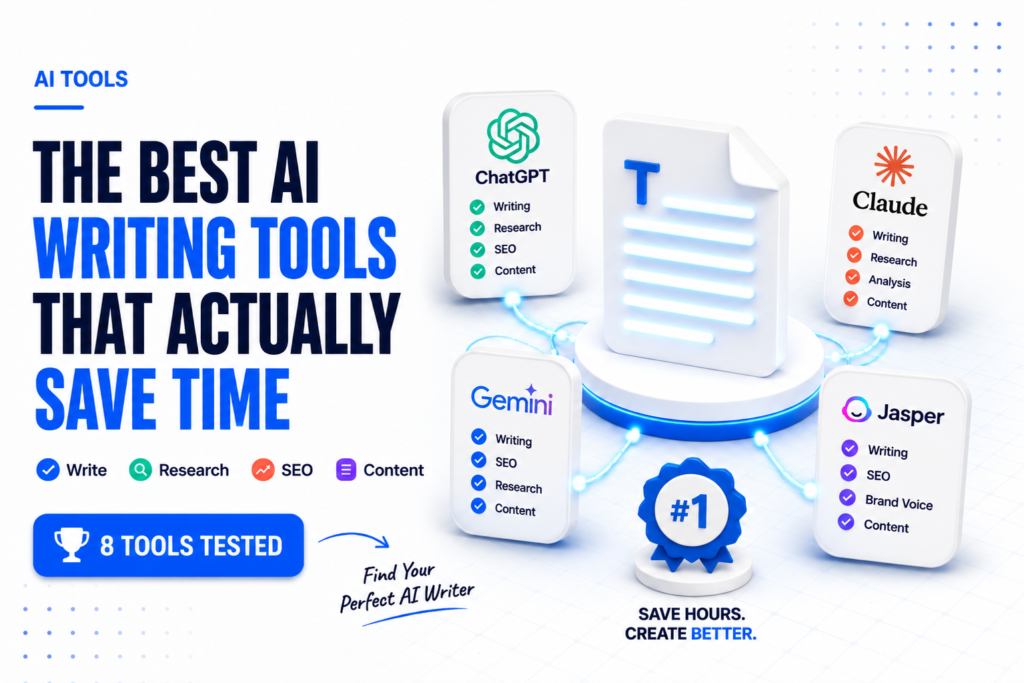
The best AI writing tools in 2026 have moved far beyond basic grammar checks and simple sentence rewrites. Today, they generate full articles, marketing copy, email sequences, and social media content at a professional level. However, not every tool delivers the same quality. This guide covers the strongest options available and helps you choose the right one for your workflow.
Why AI Writing Tools Matter in 2026
Content demand has exploded across every channel. Businesses, freelancers, and creators are expected to produce more written content than ever before. However, time and resources rarely scale alongside that demand. As a result, AI writing tools have become essential rather than optional for anyone producing content at volume.
Furthermore, the gap between AI-generated and human-written content has narrowed significantly. The best tools now produce output that requires only light editing before publication. Consequently, a single writer using AI can produce the output of an entire small team.
1. ChatGPT — Best Overall AI Writing Assistant
ChatGPT remains the most versatile AI writing tool available in 2026. It handles everything from long-form blog posts to short ad copy, email drafts, and creative writing. Moreover, its conversational interface makes it easy to iterate and refine output in real time.
The free tier covers most everyday writing tasks. The Plus plan at $20 per month unlocks faster performance and access to more advanced models. As a result, ChatGPT is the logical starting point for anyone new to AI writing tools.
Best for: Blog posts, emails, brainstorming, general writing tasks
Pricing: Free / $20 per month
2. Jasper AI — Best for Marketing Copy
Jasper AI is built specifically for marketing teams and content professionals. It includes over 50 templates covering ad copy, product descriptions, landing pages, social media posts, and long-form articles. Furthermore, Jasper’s Brand Voice feature lets you train the tool to write in your specific tone and style.
Jasper integrates with Surfer SEO, which makes it a strong choice for teams producing SEO-optimized content at scale. Consequently, it is the preferred tool for agencies and in-house marketing teams with high content volume requirements.
Best for: Marketing copy, brand content, SEO articles at scale
Pricing: From $39 per month
3. Copy.ai — Best for Short-Form and Sales Copy
Copy.ai excels at generating short-form content quickly. It covers product descriptions, email subject lines, social media captions, cold outreach messages, and ad headlines. Moreover, its workflow automation features allow teams to build repeatable content pipelines without manual effort.
The free plan includes a generous number of monthly credits, making it accessible for solopreneurs and small teams. In addition, Copy.ai’s chat interface allows users to refine output through natural back-and-forth conversation, similar to ChatGPT but with more marketing-specific templates.
Best for: Sales copy, email marketing, social media content
Pricing: Free / from $36 per month
4. Writesonic — Best for SEO Content
Writesonic is one of the strongest AI writing tools for SEO-focused content production. It includes built-in web search, real-time data access, and a Surfer SEO integration for optimizing content during the writing process. As a result, it is particularly well suited for bloggers and content marketers who prioritize search visibility.
Its Chatsonic feature functions as a web-connected AI assistant, which makes it more accurate than tools relying solely on training data for factual content. Furthermore, Writesonic supports long-form article generation with structured outlines, headings, and meta descriptions built in.
Best for: SEO blog content, factual articles, content marketing
Pricing: Free trial / from $16 per month
5. Grammarly — Best for Editing and Refinement
Grammarly is not a content generation tool in the traditional sense. However, it is one of the most important AI writing tools for anyone who produces written content professionally. It catches grammar errors, improves clarity, adjusts tone, and now includes a generative AI assistant for rewrites and suggestions.
Moreover, Grammarly works across nearly every platform including Google Docs, WordPress, Gmail, and most browsers. Consequently, it functions as a constant quality layer over everything you write rather than a standalone writing environment.
Best for: Editing, proofreading, tone refinement, writing quality
Pricing: Free / Premium from $12 per month
6. Notion AI — Best for Writers Who Work in Notion
Notion AI integrates directly into the Notion workspace, making it the obvious choice for writers and teams already using Notion for project management and note-taking. It generates content, summarizes documents, drafts meeting notes, and rewrites existing text without leaving the workspace.
Furthermore, the collaborative nature of Notion means AI-generated content can be reviewed and edited by team members in the same document. As a result, it removes the friction of copying content between tools. The AI features are included in the Notion Plus plan at $10 per month.
Best for: Teams using Notion, note-to-content workflows, collaborative writing
Pricing: Included in Notion Plus at $10 per month
7. Surfer SEO — Best for Optimizing AI Content for Search
Surfer SEO is not a writing tool on its own. However, it is essential for anyone using AI writing tools to produce search-optimized content. It analyzes top-ranking pages for any keyword and provides a real-time content score based on word count, keyword density, headings, and structure.
Moreover, Surfer integrates directly with Jasper and Writesonic, allowing writers to optimize content while drafting rather than after the fact. Consequently, combining an AI writing tool with Surfer SEO produces content that competes in search from day one.
Best for: SEO content optimization, keyword targeting, competitive analysis
Pricing: From $89 per month
8. Perplexity AI — Best for Research-Backed Writing
Perplexity AI functions as a research assistant that cites its sources in real time. For writers who need accurate, current information, it removes one of the biggest weaknesses of traditional AI writing tools: outdated or hallucinated facts.
Use Perplexity to research a topic first, then bring the verified information into ChatGPT, Jasper, or Writesonic for full article production. Furthermore, Perplexity’s Pro plan includes access to more powerful models and higher usage limits. As a result, this two-tool workflow produces content that is both well-written and factually grounded.
Best for: Research, fact-checking, current events content
Pricing: Free / Pro at $20 per month
How to Choose the Right AI Writing Tool
The right tool depends entirely on your primary use case. Therefore, start by identifying the single type of content you produce most.
- High-volume blog content for SEO → Writesonic or Jasper with Surfer SEO
- Marketing copy and sales content → Copy.ai or Jasper
- General writing and brainstorming → ChatGPT
- Editing and quality control → Grammarly
- Team collaboration → Notion AI
- Research accuracy → Perplexity AI
Furthermore, most tools offer free tiers or trials. Consequently, there is no reason to commit to a paid plan before testing the tool against your actual workflow.
Can AI Writing Tools Replace Human Writers?
This is the most common question in the content industry right now. The honest answer is: for some tasks, yes. However, for strategic, deeply researched, or highly creative content, human oversight remains essential.
AI tools are strongest at producing structured, informational content quickly. They are weaker at original analysis, nuanced opinion, and content that requires genuine subject matter expertise. Therefore, the most effective approach in 2026 is using AI to handle the first draft and speed up production, while a human writer refines the output and adds depth.
As a result, writers who learn to work with AI tools rather than against them will significantly outperform those who ignore them.
Final Thoughts
The best AI writing tools in 2026 cover every stage of the content production process, from research and drafting to editing and SEO optimization. However, no single tool does everything perfectly. The strongest workflows combine two or three tools that complement each other.
Start with ChatGPT or Writesonic for drafting, add Grammarly for editing, and layer in Surfer SEO if search visibility is a priority. Consequently, you will have a production pipeline that scales without sacrificing quality.