ChatGPT still serves over 900 million weekly active users in 2026. However, more people than ever are exploring alternatives, and for good reason.
OpenAI tightened free-tier usage limits in late 2025. Furthermore, ChatGPT Plus remains priced at $20 per month while specialized alternatives often deliver better results for specific tasks at lower cost. Therefore, the question is no longer whether ChatGPT is good. It is whether it is still the best tool for what you specifically need.
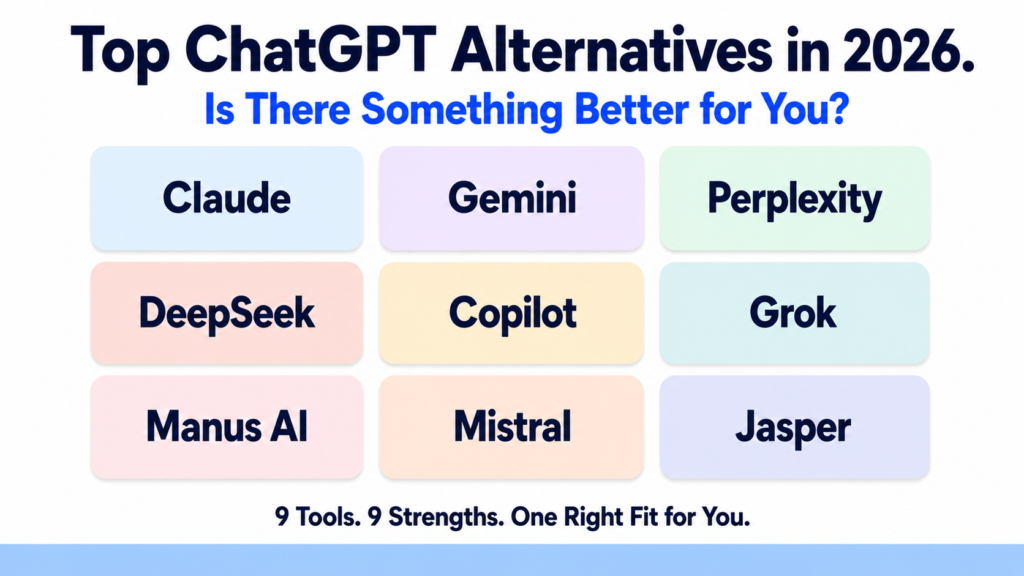
This guide covers the top ChatGPT alternatives in 2026, what each one does better, and exactly who should switch.
Why People Are Switching from ChatGPT
Before looking at alternatives, it helps to understand the common reasons people switch.
Cost pressure. ChatGPT Plus costs $20 per month, and the free tier comes with meaningful usage limits. Consequently, many users explore free or cheaper alternatives that deliver comparable quality for their specific needs.
Specialized tasks. ChatGPT is a generalist. However, for specific tasks like research with citations, long document analysis, or coding, specialized tools often outperform it significantly.
Ecosystem integration. Users already inside Google Workspace or Microsoft 365 often find native AI integration more convenient than switching to a separate ChatGPT tab.
With that context, here are the tools worth considering.
1. Claude, Best for Writing and Long Documents
Claude is widely considered the strongest overall ChatGPT alternative for long-form writing and nuanced reasoning. Furthermore, its 1 million token context window on Opus 4.7 is the largest available, meaning it can work through entire books, contracts, or codebases in a single conversation.
For writers, researchers, and developers who need an AI that handles long documents and produces high-quality, natural text, Claude consistently outperforms ChatGPT. Additionally, Claude tends to be more honest about uncertainty, which makes it particularly valuable for research and professional work.
Best for: Long-form writing, document analysis, complex reasoning, and professional content where consistency and nuance matter.
Pricing: Free plan available. Pro at $20/month for full access and Projects.
2. Google Gemini, Best Free Alternative for Google Users
Google Gemini is the best free ChatGPT alternative for users already inside the Google ecosystem. It integrates natively across Gmail, Google Docs, Google Drive, and Sheets. Moreover, its free tier includes multimodal capabilities, meaning it handles image, video, and audio input at a level that rivals paid tools.
In fact, Gemini’s free tier has been called the most logical replacement for ChatGPT Plus for most users, thanks to its strong multimodal performance at zero cost.
Best for: Google Workspace users, multimodal tasks, and anyone who wants a powerful free alternative.
Pricing: Free with full features. Google AI Pro at $19.99/month for higher limits.
3. Perplexity AI, Best for Research with Citations
Perplexity AI remains the top choice for research because every answer comes with cited, clickable sources. While ChatGPT can produce confident-sounding but unverified information, Perplexity shows you exactly where its information comes from.
Therefore, for students, journalists, marketers, and anyone who needs to verify information before using it, Perplexity is significantly more reliable than general chatbots.
Best for: Research, fact-checking, current events, and any task where source verification matters.
Pricing: Free plan with daily limits. Pro at $20/month for unlimited searches and Deep Research.
4. DeepSeek, Best Free Option for Coding
DeepSeek offers the most capable free coding experience available in 2026, with a generous free tier and API access that costs a fraction of competing providers. For developers and technical users who need strong coding assistance without subscription costs, DeepSeek is genuinely competitive with paid tools.
Furthermore, DeepSeek’s open-weight approach means developers have more flexibility in how they integrate it into their own applications and workflows.
Best for: Developers, coding assistance, and cost-conscious technical users.
Pricing: Free tier available. API access at significantly lower cost than competitors.
5. Microsoft Copilot, Best for Microsoft 365 Users
Microsoft Copilot is embedded directly into Word, Excel, PowerPoint, Outlook, and Teams. For users whose work happens inside Microsoft 365, Copilot eliminates the need to switch between a chat tab and your work documents.
Consequently, if your organization runs on Microsoft tools, Copilot often provides more practical day-to-day value than a standalone chatbot, even one as capable as ChatGPT.
Best for: Microsoft 365 users, enterprise environments, and anyone who wants AI directly inside their existing work documents.
Pricing: Included with certain Microsoft 365 plans. Standalone Copilot Pro available separately.
6. Grok, Best for Real-Time Information and Direct Answers
Grok, developed by xAI, focuses on real-time factual accuracy and a more direct, less filtered conversational style. For users who want quick answers without extensive caveats and disclaimers, Grok’s approach feels notably different from ChatGPT’s more cautious tone.
Additionally, Grok’s integration with X (formerly Twitter) gives it access to real-time social media data, making it useful for tracking current events and trends as they happen.
Best for: Real-time information, current events, and users who prefer a more direct conversational style.
Pricing: Included with X Premium subscriptions. Standalone access varies.
7. Manus AI, Best for Autonomous Task Execution
Manus AI represents a different category of tool entirely. Rather than just answering questions, it autonomously executes multi-step tasks. You give it a goal, and it plans, researches, and completes the work independently, checking in only when necessary.
For users who need an AI to actually complete tasks rather than just provide information, Manus AI’s autonomous execution capabilities go beyond what ChatGPT offers in standard conversation mode.
Best for: Complex multi-step tasks, research projects, and users who want an AI that works independently toward a goal.
Pricing: Check current pricing on their website, as plans have evolved rapidly through 2026.
8. Mistral, Best Open-Source Option for Privacy and Control
For users and organizations who prioritize data privacy and want full control over where their AI runs, Mistral offers powerful open-source models that can be self-hosted. This means your data never leaves your own infrastructure.
Although self-hosting requires more technical setup than using a cloud-based chatbot, Mistral’s models are competitive with proprietary alternatives. Therefore, organizations with strict data requirements increasingly choose this path.
Best for: Privacy-focused organizations, self-hosting, and developers who want full control over their AI infrastructure.
Pricing: Open-source models are free to self-host. API access available for those who prefer not to self-host.
9. Jasper, Best for Marketing-Focused Writing
While ChatGPT is a generalist writing tool, Jasper is built specifically around marketing frameworks. Its templates for ad copy, email sequences, and landing pages are designed using proven conversion principles, not generic writing patterns.
For marketers and business owners who write content specifically to drive sales, Jasper’s specialized templates often produce more directly usable output than ChatGPT’s general-purpose responses.
Best for: Marketing copy, ad campaigns, email sequences, and content built around conversion goals.
Pricing: Creator plan at $39/month, with templates and brand voice features.
Quick Comparison Table
| Tool | Best For | Free Plan | Standout Feature |
|---|---|---|---|
| Claude | Writing and documents | Yes | 1M token context window |
| Google Gemini | Free alternative | Yes (full) | Google Workspace integration |
| Perplexity AI | Research | Yes | Cited sources on every answer |
| DeepSeek | Coding | Yes | Free, capable coding model |
| Microsoft Copilot | Microsoft 365 | Included in some plans | Embedded in Office apps |
| Grok | Real-time info | Included with X Premium | Live social media data access |
| Manus AI | Autonomous tasks | Varies | Independent multi-step execution |
| Mistral | Privacy and control | Yes (self-hosted) | Full data control |
| Jasper | Marketing copy | Trial available | Conversion-focused templates |
How to Choose the Right Alternative
The truth is simple. There is no single “best” ChatGPT alternative. The right choice depends entirely on what you are trying to accomplish.
If you write long-form content professionally, Claude is the strongest choice. If you want a powerful free option and already use Google products, Gemini fits naturally. If your work depends on verified, current information, Perplexity is essential.
Furthermore, many professionals in 2026 do not pick just one. They use Claude for writing, Perplexity for research, and ChatGPT for quick brainstorming, switching between tools based on the task at hand. Therefore, instead of asking “what should replace ChatGPT,” consider asking “what should I add alongside it.”
The Bottom Line
ChatGPT remains a strong, versatile tool in 2026. However, it is no longer the only strong option, and for many specific tasks, it is not even the best option.
The smartest approach is not to abandon ChatGPT entirely. Instead, build a small toolkit where each tool handles what it does best. Most of the tools on this list offer free plans, so testing them costs nothing but time.
Start with the alternative that addresses your biggest current frustration with ChatGPT. Use it for a week. You will quickly know whether it earns a permanent place in your workflow.