HubSpot is the most recognizable name in CRM and inbound marketing. Over 238,000 companies across 135 countries use it. Furthermore, it has built one of the most complete customer platform ecosystems available, combining marketing automation, sales CRM, customer service, content management, and operations tools under one roof.
However, HubSpot is also famous for its pricing complexity. A free plan that feels genuinely useful quietly transforms into a $800 to $3,600 per month commitment once you need the features that actually matter. Furthermore, mandatory onboarding fees, marketing contact charges, and the new HubSpot Credits system add layers of cost that most buyers do not anticipate.
This honest review covers the real pricing, the genuine strengths, the hidden costs, and who HubSpot actually works best for in 2026.
What Is HubSpot?
HubSpot is a customer platform that organizes its products into six Hubs, each covering a specific business function. Marketing Hub handles email marketing, landing pages, and campaign automation. Sales Hub manages pipelines, sequences, and deal tracking. Service Hub covers customer support tickets and knowledge bases. Content Hub manages website and blog content. Operations Hub (renamed Data Hub in March 2026) handles data synchronization and workflow automation. Commerce Hub manages payments and subscriptions.
You can purchase individual Hubs or bundle them together in the CRM Suite, which includes all Hubs at a given tier. Furthermore, HubSpot moved to a seat-based pricing model in 2024, with ongoing updates through 2026, which significantly changed how costs scale for growing teams.
The core idea is compelling. Instead of managing separate tools for marketing, sales, and customer success, HubSpot connects all customer-facing operations in one platform with shared contact records, unified reporting, and seamless handoffs between teams. Consequently, it eliminates the data silos that typically form between marketing and sales departments.
HubSpot Pricing in 2026
HubSpot’s pricing structure is genuinely complex. Understanding it requires knowing the difference between Hubs, tiers, seat types, marketing contacts, and HubSpot Credits. Here is the verified breakdown as of August 2026:
Free Plan
HubSpot’s free plan is one of the best free CRMs available in 2026. It includes unlimited users, contact management, deal pipelines, basic email marketing limited to 2,000 emails per month, live chat, meeting scheduling, and basic reporting. However, every email, form, chat widget, and landing page on the free plan displays “Powered by HubSpot” branding. Removing that branding requires upgrading to Starter.
Starter Plans
Marketing Hub Starter starts at $9/seat/month (annual billing), designed for small marketing teams needing professional branding and basic automation beyond the free tier. Sales Hub Starter starts at $20/seat/month. Service Hub Starter starts at $20/seat/month. The Starter Customer Platform bundle starts at $20/month and includes Starter access across all Hubs for one seat.
Professional Plans
This is where HubSpot becomes powerful and expensive simultaneously. Marketing Hub Professional starts at $800/month (annual billing) and includes 3 core seats with a required one-time onboarding fee of $3,000. Sales Hub Professional starts at $100/seat/month with additional core seats at $50/month. Service Hub Professional starts at $100/seat/month. The Professional CRM Suite bundles all Professional Hubs starting at approximately $1,500/month.
Enterprise Plans
Marketing Hub Enterprise starts at $3,600/month (annual billing) with 5 core seats and a required onboarding fee of $7,000. Sales Hub Enterprise starts at $150/seat/month. Service Hub Enterprise starts at $150/seat/month.
HubSpot Credits (The Hidden Complexity)
The newest pricing layer most guides still miss is HubSpot Credits, introduced to power AI features including Breeze agents and data enrichment. Each plan includes a monthly credit allotment. Starter plans include 500 credits per month. Professional plans include 3,000 to 5,000 credits depending on the Hub. Enterprise plans include up to 10,000 credits. Additional credits cost $9 per 1,000.
The critical risk here is well-documented in user reviews. One highly upvoted warning from a real user: accidentally enriching a list of 10,000 contacts consumed over 100,000 credits in minutes, generating thousands of dollars in unexpected charges with no way to stop the process mid-run. Consequently, any team using AI enrichment or Breeze agents at scale needs to monitor credit consumption carefully.
Marketing Contacts (The Growth Tax)
Marketing Hub pricing scales with the number of marketing contacts, meaning contacts you actively send emails and ads to. The first 1,000 are included on Starter. On Professional, contacts beyond 2,000 are billed in blocks of 1,000 at $50/month per block. Consequently, a growing email list directly increases your HubSpot bill without any plan upgrade required. This is what users frequently describe as a “tax on success.”
The Real Cost Warning
The price on HubSpot’s pricing page is only the base. The real monthly cost stacks multiple layers. A 10-person sales team on Sales Hub Professional pays $100 per seat for 3 included seats, then $100 for each of the 7 additional seats, totaling $1,000/month. Add the required $1,500 onboarding fee amortized over 12 months, and the first-year cost exceeds $13,500 for sales alone. Always calculate your full cost including seats, marketing contacts, credits, and onboarding before committing.
Key Features
CRM and Contact Management
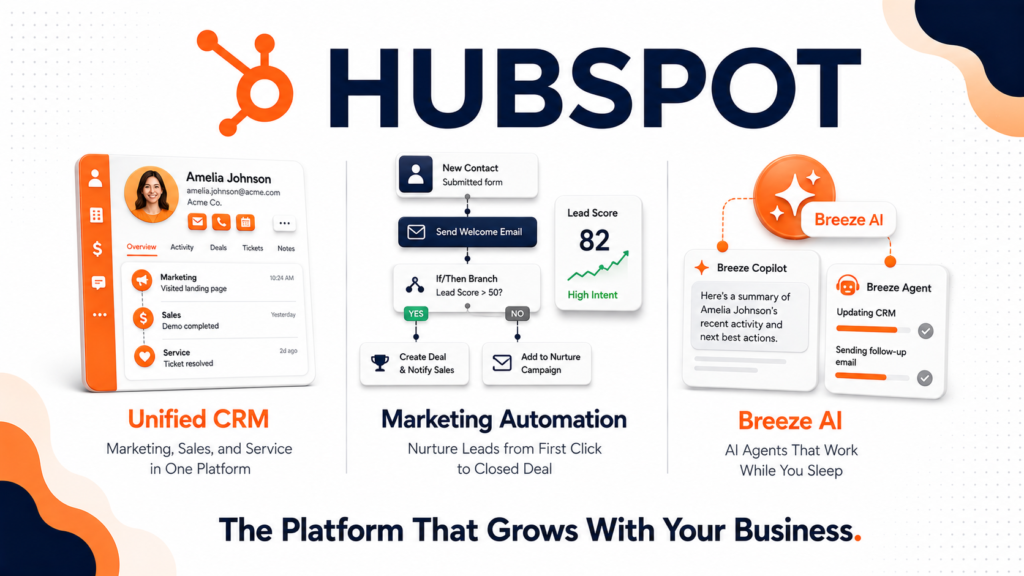
HubSpot’s CRM is its strongest and most consistently praised feature. Every contact, company, deal, and conversation is stored in a unified record that all teams share. Marketing knows which contacts sales has spoken to. Sales knows which emails marketing has sent. Service knows which deals a customer has purchased. Furthermore, the contact timeline shows every interaction across all channels in chronological order.
This unified data model is genuinely difficult to replicate with separate tools. Consequently, organizations that have experienced the pain of disconnected marketing and sales data consistently cite the unified CRM as HubSpot’s most valuable feature.
Marketing Automation
HubSpot’s marketing automation on Professional plans is comprehensive. Visual workflow builders support complex lead nurturing sequences, behavioral triggers, lead scoring, and A/B testing. Furthermore, the integration between marketing automation and the CRM means leads are automatically routed to sales when they meet qualification criteria.
However, meaningful marketing automation requires the Professional plan at $800/month minimum. The Starter plan offers only basic email sequences, which limits automation to simple follow-up messages rather than sophisticated multi-stage nurture campaigns. This gap between Starter and Professional is the most common source of buyer frustration.
Sales Hub and Pipeline Management
Sales Hub provides visual deal pipelines, email sequence automation, meeting scheduling, call logging with AI transcription, quote generation, and predictive lead scoring on Professional plans. Furthermore, the AI-powered Breeze Sales Agent can research prospects, draft personalized outreach, and update deal records automatically.
For sales teams that previously managed pipelines in spreadsheets or basic CRMs, the structured visibility HubSpot provides is genuinely transformative. However, for smaller teams with simpler sales processes, the Professional tier’s cost is difficult to justify relative to what tools like Apollo.io or ActiveCampaign provide at lower price points.
Breeze AI (HubSpot’s AI Layer)
In 2026, HubSpot consolidated its AI features under the Breeze brand. Breeze Copilot provides AI assistance across the platform for drafting content, summarizing records, and suggesting next actions. Breeze Agents are specialized AI workers that handle specific tasks including customer service responses, social media content, and prospecting research autonomously.
The Breeze Customer Agent for service automation is outcome-based pricing, meaning you only pay when a conversation is actually resolved by AI. However, the credit system governing most other Breeze features introduces the consumption risk described in the pricing section above.
Content Hub
Content Hub manages your company website, blog, landing pages, and multimedia content. In 2026, it added AI content generation, brand voice training, and content remix features that repurpose existing content across multiple formats automatically. Furthermore, the smart content feature personalizes website content for different visitor segments without requiring separate page versions.
Reporting and Analytics
HubSpot’s reporting capabilities are strong across all paid tiers. Custom report builders, attribution modeling, and revenue analytics on Professional and Enterprise plans provide genuine visibility into which marketing activities generate revenue rather than just traffic or leads. Furthermore, the unified data model means marketing and sales reports draw from the same contact records, eliminating the discrepancies that typically occur when teams use separate tools.
What HubSpot Does Well
The free CRM is genuinely one of the best available. Unlimited users, real contact management, deal pipelines, email marketing, and meeting scheduling at zero cost is extraordinary. Consequently, small teams can run meaningful sales and marketing operations without spending anything until they outgrow the limitations.
The unified data model eliminates the marketing-sales divide. When marketing and sales share the same contact records, the handoff between lead generation and sales follow-up becomes seamless. Furthermore, attribution reporting becomes accurate rather than disputed between teams using separate systems.
The ecosystem depth is unmatched. With six Hubs covering every customer-facing function, HubSpot is the only platform that can genuinely replace your entire marketing and sales software stack with one vendor. Consequently, for organizations that prioritize simplicity and integration depth over best-of-breed specialization, HubSpot offers a compelling consolidation argument.
Breeze AI features are meaningfully useful. Unlike AI features that feel bolted on to existing tools, HubSpot’s Breeze AI integrates naturally into workflows. The Breeze Customer Agent’s outcome-based pricing for service automation is particularly innovative and reflects genuine product thinking about how AI should be priced.
The partner and integration ecosystem is enormous. HubSpot connects with over 1,500 integrations and has one of the largest certified partner networks in SaaS. Consequently, finding implementation support, custom integrations, and ongoing optimization help is straightforward regardless of your industry or region.
Where HubSpot Falls Short
The jump from Starter to Professional is enormous. Marketing Hub goes from $9/month to $800/month. This is not a gradual progression but a massive leap that leaves many growing businesses in an uncomfortable middle ground. They have outgrown Starter’s basic automation but cannot justify the $800/month minimum for Professional.
Required onboarding fees are frustrating. A mandatory $3,000 onboarding fee for Marketing Hub Professional and $7,000 for Enterprise creates a significant upfront cost on top of the first year’s subscription. Furthermore, many users report that the onboarding support they receive does not match the premium paid. Consequently, experienced teams that do not need hand-holding still pay the same onboarding fee as complete beginners.
The HubSpot Credits system introduces unpredictable risk. The documented case of a user accidentally generating $11,000 in unexpected credit charges through an unintended enrichment operation is not an edge case. It reflects a systemic risk in credit-based pricing where usage can spike dramatically without intuitive warnings or hard limits. Therefore, any team using Breeze agents or data enrichment features needs robust monitoring in place.
Marketing contact pricing penalizes growth. Paying extra as your email list grows means your HubSpot bill increases even without changing your plan or adding users. For email-heavy marketing operations, this contact-based pricing model can make HubSpot significantly more expensive than alternatives like Brevo, which prices by email volume rather than contact count.
Customer support quality depends on your plan. Free and Starter plan users primarily access community forums and knowledge base articles. Live chat and phone support are available on Professional and Enterprise. Consequently, smaller teams without in-house HubSpot expertise face a meaningful support gap during onboarding and troubleshooting.
HubSpot vs Competitors
HubSpot vs Salesforce: Salesforce offers deeper customization, more advanced reporting, and stronger enterprise configurability. However, it requires significantly more technical expertise to implement and maintain. Furthermore, Salesforce does not include marketing automation natively, requiring separate Marketing Cloud licensing. Therefore, HubSpot wins for SMBs and mid-market companies that want an integrated platform without a dedicated Salesforce administrator, while Salesforce wins for large enterprises with complex custom requirements.
HubSpot vs ActiveCampaign: ActiveCampaign offers more sophisticated email automation at significantly lower price points, starting at $49/month for Plus versus HubSpot’s $800/month for Professional marketing automation. However, ActiveCampaign lacks HubSpot’s content management, service hub, and operations capabilities. Therefore, pure marketing automation buyers often choose ActiveCampaign while organizations wanting a complete customer platform choose HubSpot. Read our full ActiveCampaign review for a detailed comparison.
HubSpot vs Apollo.io: Apollo.io specializes in B2B prospecting and outbound sales with a 230 million plus contact database that HubSpot cannot match. However, HubSpot’s CRM, marketing automation, and customer service capabilities far exceed Apollo’s scope. Therefore, outbound-heavy sales teams often use Apollo.io for prospecting while relying on HubSpot for broader CRM and marketing operations. Read our full Apollo.io review for details.
HubSpot vs Brevo: Brevo offers email marketing, SMS, WhatsApp, and basic CRM at a fraction of HubSpot’s cost, with volume-based pricing that suits businesses with large contact lists. However, Brevo lacks the sales pipeline depth, content management, and reporting sophistication that HubSpot provides. Therefore, early-stage businesses or those with simple marketing needs choose Brevo for cost efficiency while growth-stage companies invest in HubSpot’s full platform. Read our Brevo review for a full breakdown.
Who Should Use HubSpot?
HubSpot is the right choice if you are:
- A B2B company with a defined sales process that wants marketing and sales teams working from shared contact data
- A mid-market organization that wants to consolidate multiple customer-facing tools into one platform with unified reporting
- A business that generates inbound leads through content and needs to nurture them through automated workflows into qualified opportunities
- A company willing to invest in the Professional tier and onboarding to access the automation depth that makes HubSpot genuinely powerful
- An organization that values ecosystem depth and wants access to HubSpot’s partner network for implementation and optimization support
However, HubSpot may not be the right fit if you are:
- A small team or startup where the Starter to Professional price jump is prohibitive and the free plan’s limitations are already frustrating you
- A business with a large email list where HubSpot’s marketing contact pricing makes it more expensive than volume-based alternatives
- A company that primarily needs sophisticated email automation rather than a full CRM platform, where ActiveCampaign provides more value at lower cost
- An outbound-focused sales team where Apollo.io’s prospecting database and sequencing tools are more relevant than HubSpot’s inbound-oriented CRM
HubSpot Review: Final Verdict
HubSpot is the most complete customer platform available for small to mid-market businesses in 2026. The unified CRM, Breeze AI integration, and ecosystem depth are genuine competitive advantages that no single-point solution can match.
However, the complexity and cost of the Professional and Enterprise tiers require serious evaluation before committing. The jump from Starter to Professional is not gradual. The mandatory onboarding fees are unavoidable. The HubSpot Credits system introduces unpredictable financial risk for teams using AI features at scale. And the marketing contact pricing model penalizes success rather than rewarding it.
The honest recommendation is straightforward. If you are a growing B2B company with a marketing and sales team that needs to share data and work from a unified platform, HubSpot is worth the investment at the Professional tier. If you are a small team or cost-sensitive business, start with the free CRM and evaluate whether your actual usage justifies the Professional upgrade before committing.
Overall rating: 4.2 out of 5
HubSpot is excellent for the right organization at the right stage. The key is going in with clear eyes about the real total cost before signing an annual contract.
Are you using HubSpot for your marketing and sales? Share your experience in the comments below.
Internal Links to Add:
- In the Sales Hub section, link to: Apollo.io Review on the anchor text “B2B prospecting”
- In the Marketing Automation section, link to: ActiveCampaign Review on the anchor text “marketing automation”
- In the HubSpot vs Brevo section, link to: Brevo Review on the anchor text “email marketing”
- In the conclusion, link to: Kit Review on the anchor text “email marketing for creators”