Anthropic just made a serious move in the scientific community. In 2026, the company behind Claude — one of the most capable large language models on the market — has launched Claude Science, a dedicated AI workbench built specifically for researchers. With over 60 preconfigured skills spanning genomics, computational chemistry, and beyond, plus a built-in verification agent that automatically checks citations and calculations, this isn’t just another chatbot with a science theme. This is a purpose-built research operating system — and it has significant implications for anyone who makes a living in science, consulting, or AI-powered research services.
Whether you’re an independent researcher, a scientific consultant, or an entrepreneur offering data analysis services, Claude Science represents a genuine productivity shift worth understanding. Let’s break down what it does, who it’s for, and how you can potentially monetize it.
What Is Claude Science and What Makes It Different?
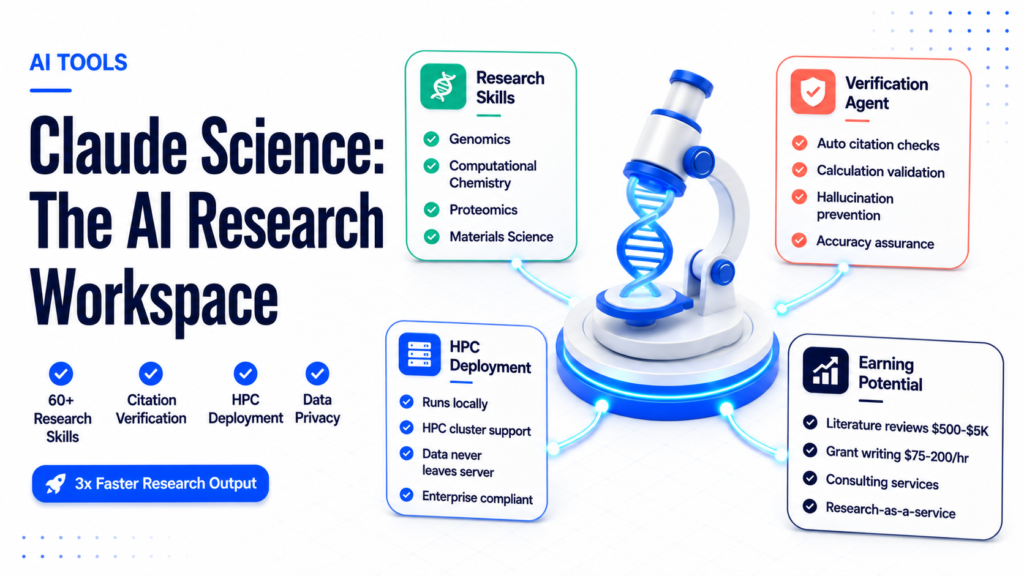
Claude Science is Anthropic’s specialized AI workspace designed to serve the needs of professional researchers. Unlike general-purpose AI assistants, Claude Science arrives pre-loaded with more than 60 domain-specific skill configurations covering fields such as genomics, proteomics, computational chemistry, materials science, and clinical research. Think of it as Claude with a PhD — and a very organized lab notebook.
Key Features That Set It Apart
- 60+ Preconfigured Research Skills: Each skill is tuned for a specific scientific domain, meaning researchers don’t have to spend hours crafting prompts. The tool already understands the language, methodology, and output expectations of your field.
- Verification Agent: This is arguably the most important feature. Claude Science includes an AI agent that automatically cross-checks citations and validates calculations — a huge deal in a world where AI hallucinations have long been the Achilles’ heel of using LLMs in serious scientific work.
- Local and HPC Deployment: Claude Science runs locally on your machine or integrates with high-performance computing (HPC) clusters. This means sensitive research data — clinical trials, proprietary compounds, unpublished findings — never has to leave your secure environment. For enterprise and institutional clients, this is a non-negotiable feature.
According to The Decoder, Anthropic’s launch signals a broader push by AI companies to move beyond general productivity and into specialized professional verticals — a trend that’s accelerating rapidly in 2026.
Who Should Care About Claude Science in 2026?
If you work in research — or sell services to people who do — Claude Science should be on your radar immediately. Here’s a breakdown of the people who stand to benefit most:
Academic and Independent Researchers
Researchers at universities and independent institutions spend enormous amounts of time on literature reviews, data analysis, and writing — all tasks where AI can dramatically compress timelines. With Claude Science’s verification agent checking sources automatically, researchers can move faster without sacrificing accuracy. That translates directly to more publications, more grant applications, and stronger career outcomes.
Biotech and Pharma Consultants
Scientific consultants charging $150–$500 per hour for domain expertise can now use Claude Science to handle much of the computational and literature-review legwork behind their recommendations. This means more clients, faster turnaround, and higher margins. The local deployment option is critical here — clients in pharma will not accept their proprietary compound data touching a cloud server they don’t control.
AI-Powered Research Service Entrepreneurs
Perhaps the most exciting opportunity is for entrepreneurs building research-as-a-service businesses. With a tool like Claude Science, a small team — or even a solo operator — can offer literature synthesis, competitive landscape analysis, or scientific due diligence services to biotech startups, VC firms, and corporate R&D departments. This is a market with serious budget, and the barrier to entry just dropped significantly.
It’s worth noting that Claude has already been proving its value at scale. As we’ve covered previously on Actualiti, half of Claude users say the AI can already handle half their work — and that was before a dedicated scientific workspace existed.
Real Earning Opportunities with Claude Science
Let’s get specific about the money. Here are three concrete ways professionals and entrepreneurs can monetize Claude Science in 2026:
1. Scientific Literature Review Services
Biotech companies, law firms handling IP cases, and investment funds doing due diligence all need rapid, accurate literature reviews. A thorough scientific literature review can command anywhere from $500 to $5,000 depending on the depth and domain. With Claude Science’s preconfigured skills and citation verification, you could deliver in hours what used to take days — and price competitively while maintaining strong margins.
2. Computational Chemistry and Genomics Consulting
With 60+ preconfigured skills that include computational chemistry and genomics, even professionals without deep domain expertise in every subfield can offer informed analysis. Pair Claude Science with your core expertise and expand your service offerings laterally. A molecular biologist can now credibly offer computational chemistry screening reports. A data scientist can add genomics pipeline consulting to their portfolio.
3. Grant Writing and Scientific Proposal Services
Grant writing is one of the most time-consuming parts of academic and independent research. Claude Science can accelerate the background research, literature positioning, and technical justification sections of grant applications enormously. Freelance grant writers currently charge $75–$200 per hour, and the ability to move 3x faster while maintaining accuracy is a direct income multiplier. For more on how AI is reshaping freelance income, see our guide on AI tools that are replacing freelancers — and what to do about it.
Data Privacy and Enterprise Adoption: Why the HPC Option Matters
One of the most significant differentiators for Claude Science in the enterprise market is its ability to run entirely on-premise or on private HPC infrastructure. In regulated industries — pharmaceuticals, clinical research, government-funded science — data sovereignty isn’t optional. It’s a compliance requirement.
By offering local deployment, Anthropic has essentially unlocked the institutional and enterprise research market that has been largely closed to cloud-based AI tools. A hospital system running clinical trials, a defense contractor doing materials research, or a Fortune 500 company with a proprietary drug pipeline can now use Claude Science without routing sensitive data through external servers.
This is a major competitive moat. According to Nature’s coverage of AI in scientific research, data security remains one of the top concerns preventing widespread AI adoption in professional science. Claude Science directly addresses this barrier.
For entrepreneurs, this also opens a consultancy opportunity: helping research institutions deploy and configure Claude Science in compliant, on-premise environments is a specialized service that could command significant fees in 2026 and beyond. If you’re already working in the AI tools and automation space — for instance, building workflows with tools like those covered in our guide to creating and selling digital products with AI — pivoting some of your expertise toward scientific clients is a logical and lucrative expansion.
Conclusion: Claude Science Is a Signal, Not Just a Product
Anthropic’s launch of Claude Science tells us something important about where the AI industry is heading in 2026: the era of one-size-fits-all AI assistants is giving way to deeply specialized, domain-aware AI workspaces. Science is just the first frontier. Expect similar purpose-built workbenches for legal, financial, and engineering workflows to follow.
For professionals and entrepreneurs in the research space, the opportunity right now is significant. The tools are here. The market need is proven. The data privacy concerns — historically the biggest blocker — have been addressed with local deployment. What remains is execution.
Whether you’re a researcher looking to dramatically accelerate your output, a consultant ready to expand your service offerings, or an entrepreneur eyeing the research-as-a-service market, Claude Science deserves serious attention. The researchers who adopt these tools first won’t just work faster — they’ll redefine what a competitive research practice looks like in 2026.