Anthropic just made Claude Code significantly more powerful — and if you use AI tools to build products, automate workflows, or run an online business, this update is worth your full attention. Claude Code now comes with a built-in browser that allows the AI to open web pages, read content, click elements, and type directly into external sites — all from within your development environment. No plugins. No third-party integrations. Just Claude, your code, and the live web.
This isn’t a minor quality-of-life update. It’s a fundamental shift in what an AI coding assistant can do — and for entrepreneurs and developers looking to squeeze more revenue out of AI tools, the implications are substantial.
What Is the Claude Code Built-In Browser?
Until now, AI coding tools like Claude Code operated largely in a closed loop. They could read your files, write code, run terminal commands, and reason about your project — but they couldn’t actually go out and interact with the web in real time. That limitation is now gone.
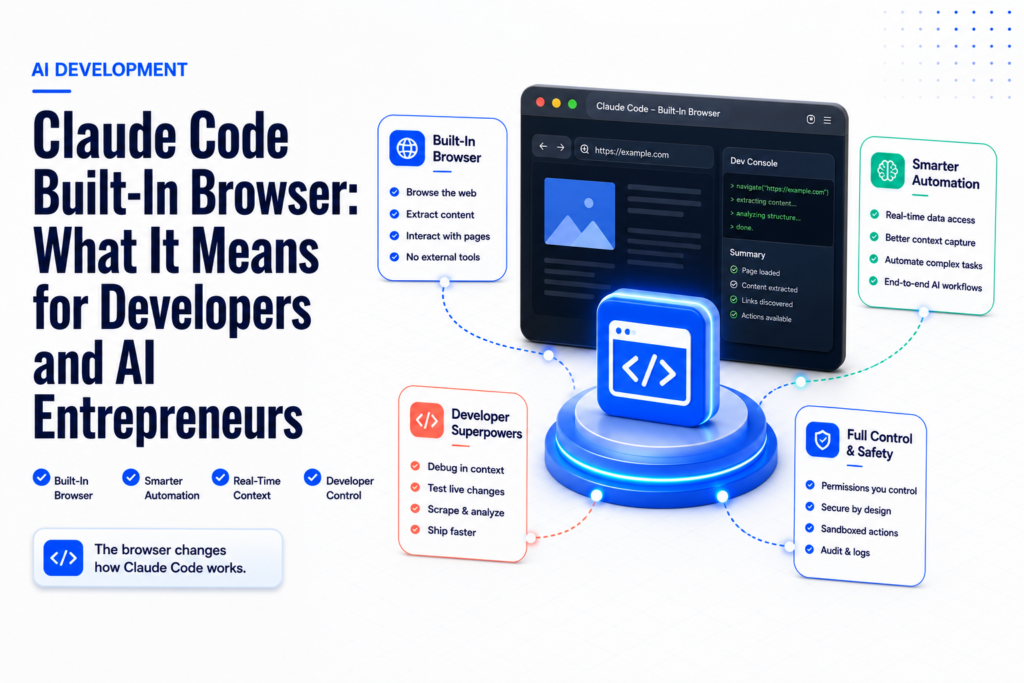
Claude Code’s built-in browser gives the AI the ability to:
- Open and navigate external websites without leaving the development environment
- Read and extract content from live pages, including dynamic or JavaScript-rendered content
- Click buttons, fill forms, and type into web elements directly
- Perform research, testing, and data gathering as part of a coding task
This brings Claude Code closer to the concept of a true autonomous AI agent — one that doesn’t just help you write code but actively participates in the broader digital environment your code is meant to operate in.
How Does Anthropic Handle Safety?
Giving an AI the ability to interact with external websites raises obvious safety concerns. Anthropic has addressed this thoughtfully. Write actions — meaning any interaction that changes something on an external site, like submitting a form or clicking a purchase button — are screened by classifiers before execution. High-stakes actions like making purchases or creating accounts require explicit user approval before Claude proceeds.
This layered permission model means you stay in control of what Claude actually does in the world, even as it gains the ability to act more independently. It’s a sensible balance between autonomy and accountability — something the AI industry has been grappling with as agents become more capable.
Real Use Cases for Developers and Online Entrepreneurs
So what does this actually look like in practice? Here are some of the most compelling ways this feature can directly improve your productivity and earning potential in 2026.
1. Automated Competitive Research and Market Monitoring
If you’re building SaaS products, e-commerce tools, or content businesses, competitive intelligence is everything. With the built-in browser, you can instruct Claude Code to visit competitor pricing pages, read their feature lists, pull changelog updates, or monitor specific product pages — and then incorporate that data directly into your codebase, a dashboard, or a report. What previously required a scraping script, a proxy service, and hours of setup can now be delegated to Claude in natural language.
2. End-to-End Testing Against Live Environments
Developers who build web apps know the pain of testing against live third-party services. Claude Code can now navigate to external APIs, documentation pages, sandbox environments, or even live staging URLs and verify behavior in real time. This dramatically reduces the back-and-forth between writing code and manually confirming it works against external dependencies.
3. Workflow Automation Without Complex Toolchains
For entrepreneurs who rely on tools like Zapier or Make.com to automate their business operations, Claude Code’s browser capability opens up an alternative path — one where the AI handles web interactions directly as part of a custom script. If you’re interested in how automation tools can drive revenue, check out our guide on how to make money with Zapier and Make.com in 2026 — and consider how Claude Code could extend or replace parts of those workflows entirely.
4. Content and Data Aggregation at Scale
Bloggers, researchers, and digital product creators can use Claude Code to visit multiple sources, read and synthesize information, and feed it back into a writing or product pipeline. Combined with Claude’s strong reasoning capabilities, this makes it a genuinely useful research assistant — not just a code generator. If you’re already using Claude in your content workflow, our article on Claude prompting tips for 2026 can help you get even more out of these expanded capabilities.
What This Means for Your Income and Productivity
Let’s be direct: the most valuable thing Claude Code’s built-in browser does is collapse the gap between thinking and doing. Previously, an AI could help you plan a web scraper, write the code, and debug it — but you still had to manually run it, check the output, and troubleshoot any site-specific quirks. Now, Claude can do all of that in a single session, in real time, with live feedback from the actual web.
For freelance developers, this is a significant leverage multiplier. Tasks that billable clients expect to take days can now be scoped and prototyped in hours. For solo entrepreneurs building digital tools or SaaS micro-products, it lowers the barrier to building data-driven features without needing a dedicated QA or research team.
It’s also worth noting that Claude Code isn’t free — it runs on Anthropic’s API and token-based pricing, which means costs can scale with usage. If you’re looking to keep those costs manageable while using Claude Code more intensively, it’s worth reading about pxpipe, the open-source tool cutting Claude Code token costs by up to 70% in 2026. Smart cost management will determine who can scale profitably with these new capabilities and who burns through their budget too fast.
According to industry analysts tracking AI agent adoption, tools that combine coding assistance with real-world web interaction are expected to see the fastest productivity gains among technical users through 2026 and beyond. Claude Code’s browser puts Anthropic squarely in that lane.
Conclusion: A New Bar for AI Coding Assistants
The Claude Code built-in browser isn’t just a feature — it’s a signal about where AI development tools are heading. The next generation of coding assistants won’t just write code for you. They’ll interact with the real world on your behalf, gather information, test assumptions, and take actions — all while keeping you in the loop on anything consequential.
For developers, freelancers, and entrepreneurs who are serious about using AI to build and monetize digital products, this update makes Claude Code one of the most capable tools in the category. The key is knowing how to direct it effectively, manage costs intelligently, and stay ahead of how these capabilities evolve.
The web is now part of Claude’s workspace. Make sure it’s working for yours.